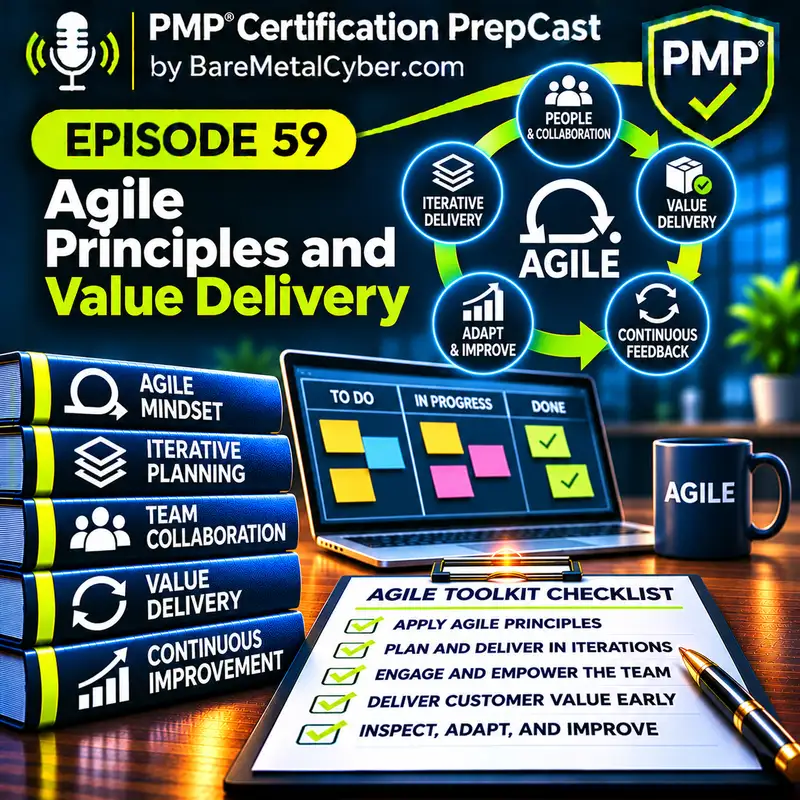
PMP 2026 | 59 | Agile Principles and Value Delivery
Why study agile as a P M P candidate? Because many situational questions blend predictive and agile choices, and recognizing the underlying principles, not the labels, is what examiners test. Agile is fundamentally about shortening feedback loops, delivering small increments, and learning quickly, not about being chaotic. If you grasp why teams choose short cycles, you’ll answer scenario questions that ask when to pivot, when to protect scope, and how to involve stakeholders in real time.
Welcome to Certified, the P M P prepcast. This is episode fifty nine of season one. Today we are exploring agile principles, short feedback loops, and the delivery of value.
Short feedback loops can reveal mistaken assumptions before the team commits to a larger investment. A usable increment may enable an early benefit, but delivery alone does not prove adoption or improvement. Examine what people actually do with the result and which risks remain. The advantage of adaptive work is the opportunity to learn and respond sooner, not a guarantee of lower risk or happier stakeholders in every setting.
Situational items on the exam often probe where scope discovery, rapid pivots, and stakeholder collaboration matter most, know the signs: unclear requirements, fast-changing markets, or opportunities that reward early feedback. Pause and think: if the environment demands discovery and adaptation, agile is the posture that surfaces learning quickly. Regulation requires suitable evidence and control in any approach; it does not by itself dictate predictive delivery. Stable requirements and tightly linked physical work may support more predictive planning. The skilled candidate chooses the principle that fits context, not a framework by rote.
Start with the core values in plain language: people and their interactions matter because small, trusted teams talking often are faster and more resilient than large, document-heavy bureaucracies. Working increments matter because showing a slice of real functionality reduces the chance of surprise at the end. Customer collaboration means deciding with stakeholders rather than delivering to them. Responding to change means planning continuously and welcoming new information that improves decision quality.
Translate principles into simple behaviors: prioritize frequent, short conversations; produce usable slices frequently so reviewers can react; involve stakeholders in shaping priorities; and treat change as new information, not failure. Avoid framework dogma, don’t insist a single ceremony or artifact is mandatory in every context. Focus on the intent behind practices: continuous feedback, visible progress, and shared problem solving. These intents guide pragmatic choices across teams and organizations.
Value delivery is a mindset that privileges outcomes over sheer output: say it plainly, value over volume. Slice work by customer value, not by internal components, so each increment delivers something usable. That means breaking features into vertical slices that can be validated with real users, not just completed internally. Value-first slicing reduces big-bang integration risk and makes the delivery pipeline a continuous experiment whose results inform subsequent priorities.
Treat uncertainty as a normal condition and validate assumptions quickly. Design small experiments or spikes to learn cheaply: prototype a workflow, test a risky integration, or run a quick user test. Each experiment should have an owner, a short timebox, and clear acceptance criteria for learning. When a hypothesis fails, record what you learned and adjust the backlog. This habit converts guessing into evidence and turns risk into manageable knowledge rather than buried anxiety.
Protect quality with clear, usable completion criteria and the checks the work requires. In Scrum, the Definition of Done is a required commitment associated with the Increment. A Definition of Ready is an optional working practice, not a required Scrum artifact or a guarantee that all uncertainty has disappeared. Avoid treating partially complete work as a usable Increment, and include necessary testing, review, and documentation in the plan. Appropriate preparation supports learning without turning readiness into a barrier to useful discovery.
Separate product outcomes from delivery-process measures. Adoption or successful service use may help assess whether the result creates value, while cycle time describes how work moves through a defined workflow. Both can be useful, but faster completion does not by itself prove a better customer outcome. Choose measures that test the particular claim being made, and look for groups or consequences hidden by an aggregate result.
Stable cross-functional teams and clear priority authority can support adaptive delivery. In Scrum that priority accountability belongs to the Product Owner, while other approaches may distribute responsibilities differently. Understand the model actually in use rather than requiring every agile setting to use the same titles. Minimize disruptive reassignment where possible and ensure the team can obtain the capabilities needed for usable outcomes.
Make work visible with backlogs and boards plus explicit workflow policies so everyone understands how things move from idea to done. A board is not theater, it’s a coordination tool showing W I P, blockers, and flow policies like pull limits. Cadence matters: a regular rhythm of planning, demonstration, and retrospective creates predictable moments for inspection and adaptation. These lightweight rituals make trade-offs explicit and keep the team aligned without heavy overhead.
Inspect-and-adapt is the heartbeat: frequent reviews demonstrate increments, collect feedback, and adjust the backlog; retrospectives surface process improvements and help the team remove impediments. Keep review formats short, focused on user value, and evidence-based, show working increments, not slides. Retrospectives should produce concrete experiments the team can try next iteration; treat them as short learning contracts rather than gripe sessions.
Governance should be lightweight but real: embed controls into cadence and artifacts rather than imposing disconnected reports. Use the applicable quality criteria and pipeline checks to produce relevant evidence, and verify that all actual compliance obligations are met, automate evidence where possible, and keep formal reviews for major handoffs. The P M role is to enable decision flow and remove impediments while keeping benefits, compliance, and risk visible without throttling speed.
In hybrid contexts, translate backlog items into organizational baselines: communicate how sprint outcomes map to release goals, regulatory gates, and budget milestones. The P M must speak both languages, sprint-level commitment and program-level expectations, and present options as trade-offs rather than edicts. Communicate choices with short, decision-ready scenarios: what happens to schedule, cost, and quality if we prioritize X now versus Y later?
The P M enables decision flow by clarifying options and removing blockers so teams can focus on delivering value rather than chasing approvals. Keep stakeholders aligned by showing demos, providing concise impact summaries, and surfacing risks as backlog items with owners. Communicate trade-offs as options with consequences, not mandates, and protect team cadence while ensuring necessary governance is respected. This balance is the craft of modern project leadership in mixed-mode environments.
To see the principles in practice, consider a fictional service that helps households arrange bulky-item collection. The initial idea is a sophisticated scheduling application with photographs, route optimization, notifications, and payment features. The desired outcome is simpler: more eligible collections completed correctly without repeated calls. Those are not the same statement. A team could build every proposed feature while residents still struggle to identify what can be collected. Start by making the outcome and the uncertain assumptions explicit before deciding how much software to build.
One assumption is that residents abandon requests because the existing form is slow. Another is that they cannot tell whether their item is eligible. A third is that they do not trust the collection confirmation. Each suggests different work. Improving form speed will not resolve an eligibility misunderstanding, and a better confirmation will not fix an unavailable collection route. Write the questions separately and gather evidence from actual service interactions rather than turning the first explanation into a complete product specification.
The team designs a small permitted pilot for one neighborhood and one eligible item category. Residents can check eligibility, request an available date, receive confirmation, and see how to correct a mistake. That is a vertical slice because it crosses the necessary parts of the service to produce a usable outcome. Building only the database, only the visual screen, or only the dispatch engine would be component progress. Such components may be necessary, but none alone proves that a resident can obtain a completed collection.
Small does not mean exempt from quality. The pilot still needs accurate scheduling, appropriate handling of personal information, and an operational response when a collection cannot be completed. A narrow scope reduces the number of situations supported; it does not justify unreliable behavior in the situations promised. Confirm the conditions for using the service with the operating owner and the relevant specialists. Keep any experimental limitations clear to participants instead of advertising the pilot as a fully mature service.
A paper prototype can answer some questions even earlier. It may show whether residents understand the eligibility wording or can locate the cancellation option. It cannot demonstrate that the live dispatch integration works or that confirmation arrives reliably under production conditions. A technical spike can examine that integration without producing a customer-ready service. Name the kind of evidence each experiment can generate. Confusing a learning artifact with a releasable increment causes stakeholders to believe more has been proven than the team has actually tested.
Suppose the pilot receives one hundred eligible attempts. Seventy reach a confirmed booking, and sixty of those bookings result in a correct completed collection during the observation period. The booking completion rate is seventy percent of attempts. The completed-collection rate is sixty percent of attempts, or about eighty-five point seven percent of confirmed bookings. Each measure answers a different question. Reporting seventy successful collections would confuse an intermediate service output with the final outcome the project is trying to improve.
The team examines the ten confirmed bookings that did not lead to correct collections. Some residents selected an item category incorrectly, while others placed the item outside the permitted location. The booking screen may work technically while the service fails operationally. Involve dispatch and residents in the review rather than asking developers to guess at the cause. A clearer eligibility example or a location instruction could create more value than adding the elaborate payment option originally planned for the next release.
This is the point at which responding to change becomes a disciplined decision rather than an excuse for interruption. The evidence changes the order of future work, within the product owner's delegated boundary where that accountability is used. It does not automatically authorize a new service region, a changed data use, or an increased budget. Identify whether the proposed adjustment changes a controlled commitment. Many backlog decisions can be made locally, while others require a different owner. Adaptability depends on clear authority, not its absence.
Economic thinking helps explain why sequence matters. Suppose the fictional service estimates that resolving the eligibility problem could avoid two hundred repeat calls per month, while a decorative map would mainly improve presentation. Validate those estimates and consider the effort, risk, and dependencies of each option. The more attractive opportunity may be the smaller change that reduces recurring confusion. Do not treat the number of requested features as a measure of value or assume that a senior stakeholder's preferred feature has no need for evidence.
The existing process and tools still have value. A shared booking record prevents conflicting collections, documentation preserves the eligibility rules, and the contract defines the supplier's responsibilities. Agile values do not instruct the team to discard these controls. They challenge the team to avoid letting process, paperwork, or a fixed plan become more important than understanding and solving the actual customer problem. A short useful record can support collaboration; an impressive report can also conceal the absence of a usable service.
A related danger is confusing customer collaboration with unquestioning agreement. Residents may request collections the service is not authorized or equipped to perform. The team should listen, clarify the need, and explain the boundary. It may discover a valid service expansion opportunity, but that belongs in an explicit decision rather than an informal promise. Collaboration includes communicating why a request cannot be met now and what alternatives exist. Saying yes to incompatible requests is not a reliable way to build trust.
Technical choices influence the cost of later adaptation. If every eligibility rule is duplicated in several systems, a small policy change can become a large coordination effort. The team may invest in a shared rule source and suitable tests to reduce that coupling. This enabling work is valuable because it supports a specific future capability or reduces a demonstrated risk, not merely because engineers prefer a new architecture. Explain the connection so stakeholders can compare necessary foundation work with visible features without pretending that only screen changes matter.
Sustainable pace protects the learning loop. A team that repeatedly uses overtime to finish a release may postpone tests, documentation, and improvement work, producing more hidden problems in the next cycle. Examine work in progress, interrupt demand, and dependencies before asking for another burst of effort. A manageable workload gives people time to understand feedback and make sound changes. The aim is not low effort; it is a way of working that can continue producing reliable increments without consuming the team's future capability.
Reflection should change something observable when evidence supports a change. In the pilot, the team notices that dispatch learns about booking-rule revisions only after residents complain. It tries a short joint review of rule changes before they become live. Define what improvement would look like, such as fewer contradictory instructions at handover, and inspect the result. A retrospective action is more useful when it has an owner and a testable purpose than when it is a broad promise to communicate better.
Now change the context to test your judgment. Suppose the same project also replaces a physical collection depot that cannot operate until access, power, equipment, and safety conditions are all ready. Frequent design feedback may still help, but releasing an incomplete depot is not necessarily useful or permissible. Some work may require detailed sequencing and a coordinated handover. An adaptive digital service and a more predictively planned physical facility can coexist. Select practices for the characteristics of each part rather than forcing every deliverable into the same release pattern.
There are also times when stopping is the valuable result of learning. Suppose representative testing shows that the proposed application excludes the very residents the service is intended to reach, and an improved telephone process offers a better route. The money already spent does not prove the original solution should continue. Present the evidence, remaining costs, alternatives, and transition implications to the appropriate decision owner. A pivot or closure can protect value when the original assumptions no longer support further investment.
In an exam-style situation, look for the specific uncertainty and the permitted scope of action. An untested usability assumption may justify a limited prototype. A demonstrated safety issue may require immediate protection. A request beyond funding authority needs the appropriate decision even when it arrives during an iteration. The word agile does not make one response correct in all three cases. The reasoning comes from feedback, usable outcomes, sustainable work, and responsible adaptation under the facts given.
Adaptive planning connects an intended outcome with near-term work and a revisable forecast. A vision, roadmap, release plan, or iteration plan may help, but not every approach requires the same planning hierarchy. Use relevant delivery evidence and make assumptions about remaining scope, capacity, and dependencies explicit. Distinguish a forecast from an authorized external commitment, and revise the forecast when the evidence changes.
There is also a useful distinction between improving a capability and adding another capability. In our collection service, revising the eligibility explanation after observing failed bookings is iterative learning. Adding a second collection area with its own routing constraints is an increment of service coverage. The team may do both, but the questions differ. One asks whether the existing approach now works better; the other asks what additional usable scope has been created. Counting new areas alone would miss whether the original booking problem was actually resolved.
Neither kind of progress automatically requires a public release after every small edit. The team still considers operational readiness, quality, and the consequences of exposing users to a change. A reversible wording experiment can have a different decision path from changing the rules that determine which vehicle carries a hazardous item. This is why responding to change requires judgment rather than permanent urgency. Make the next learning step small where possible, but preserve the safeguards appropriate to what could happen if the assumption is wrong.
Forecast from relevant observed performance and an explicit model of the remaining work. A range communicates uncertainty, but labels such as high or medium confidence do not establish a statistical probability. Explain what the range assumes and whether any probability was actually estimated. Update the forecast when work mix, dependencies, or capacity change, while keeping it separate from the date that has been formally approved.
Release planning balances ambition with realistic capacity: protect slack for unknowns, reserve time for integration, and use lightweight buffers rather than brittle hard dates. Translate backlog priority into a release slice that maximizes early customer value, and commit to the minimal scope that validates benefit. When trade-offs arise, present options as clear consequences on date, scope, and risk so leaders choose with eyes open. Keep demo artifacts current so forecasts are supported by working evidence rather than promises.
Build applicable controls and evidence collection into the work where practical, while retaining any required independent review or authorization. In Scrum, the Definition of Done supports the required quality of an Increment; it is not a substitute for every organizational approval. Automation can produce evidence about the checks performed without proving every obligation has been met. Keep risk responses visible and resourced in the appropriate planning system.
Translate applicable safety or regulatory obligations into verifiable requirements and the relevant release conditions. Plan the necessary reviews and evidence, including independent approval where required. An emergency process can authorize particular temporary controls only when the obligation permits them. It cannot waive a non-waivable condition merely to keep delivery moving. Confirm the authority, duration, and verification for any permitted exception.
Tailor risk governance to the uncertainty and consequence involved. A short experiment may answer a discovery question, while a high-impact commitment may need a formal decision supported by evidence. These are possible combinations, not a mandatory two-track model for every agile project. Choose enough structure to protect the obligation and make authority clear without inventing unnecessary approval steps.
Choose indicators relative to the outcome you want to understand: monitor cycle time to see how long items take from start to done, watch W I P to detect overload, track throughput for trending capacity, and watch escaped defects as a signal of quality erosion. An aging item or growing queue can warn of trouble before completion. A completed item’s cycle time or an escaped defect records an outcome already observed, although its trend can inform future decisions. Share them in short, actionable visuals and use them to inform planning rather than to punish teams; they are tools for learning and timely adjustment.
Outcome signals provide evidence about whether the intended benefit is emerging. Interpret adoption, customer experience, and operating results alongside context and unintended effects. Faster delivery without useful adoption may mean the team is building the wrong capability, but it may also reveal a separate readiness problem. Investigate before declaring success or failure from a single measure.
Avoid vanity metrics that confuse activity for impact: story point totals, raw commit counts, or long lists of completed tasks do not prove value. Replace volume-focused numbers with measures tied to user behavior and decision-making. Share compact dashboards that answer a clear question, such as whether the release conditions have been met. Accompany each visual with a concise interpretation and recommendation so the intended decision maker can understand what the evidence supports.
Consider an uncertain requirement near a delivery date. In this teaching situation, the team has permission to test a small, compliant, usable slice without changing an external commitment. It could build the whole proposed feature before receiving feedback, or test the narrow slice first and use the result to guide further work. What information would each choice provide, and how much investment would be committed before the assumption is tested?
Under those stated conditions, testing a minimal usable slice with stakeholders is a reasonable next action before expanding the investment. That choice preserves feedback, reduces the risk of building the wrong solution, and gives stakeholders a concrete artifact to judge priority. It also enables early mitigation of integration or performance issues and keeps momentum by shipping something usable. The strongest distractor is building the full feature without validation: it consumes time and exposes you to expensive rework if assumptions prove wrong.
If the minimal slice demonstrates value, use that evidence to negotiate scope and schedule for subsequent increments; if it fails, record the learning and pivot quickly rather than doubling down. Communicate trade-offs and the governance path: what happens if stakeholders demand the full feature now, and what compensating actions are acceptable? This evidence-based route aligns delivery with real outcomes instead of blind commitment.
Exam pitfalls often arise when candidates mistake agile for lack of plan or accountability: don’t answer as if agile means no scope, no timeline, or no quality. Beware treating velocity as a hard commitment rather than a trend and never skip quality checks to chase short-term throughput. Cultural misunderstandings, calling every meeting a “ceremony” to justify absence of decision, also show weak comprehension. Ground answers in principles: short feedback loops, measurable definitions of done, and outcome focus.
A concise playbook for exam and practice: slice work by value, plan releases with ranges and confidence, pull high-risk items early as backlog citizens, embed controls into the pipeline, measure leading and outcome signals, demo early and often, and adapt on cadence. When presenting options, show trade-offs in date, scope, and risk, and recommend the path that preserves learning while protecting quality. That pattern demonstrates true agile judgment, value over volume, without framework dogma.
For more certification study resources, books, and podcasts, visit Bare Metal Cyber dot com. Thank you for listening to Certified, the P M P prepcast.