PMP 2026 | 23 | Building a Common Vision and Shared Understanding
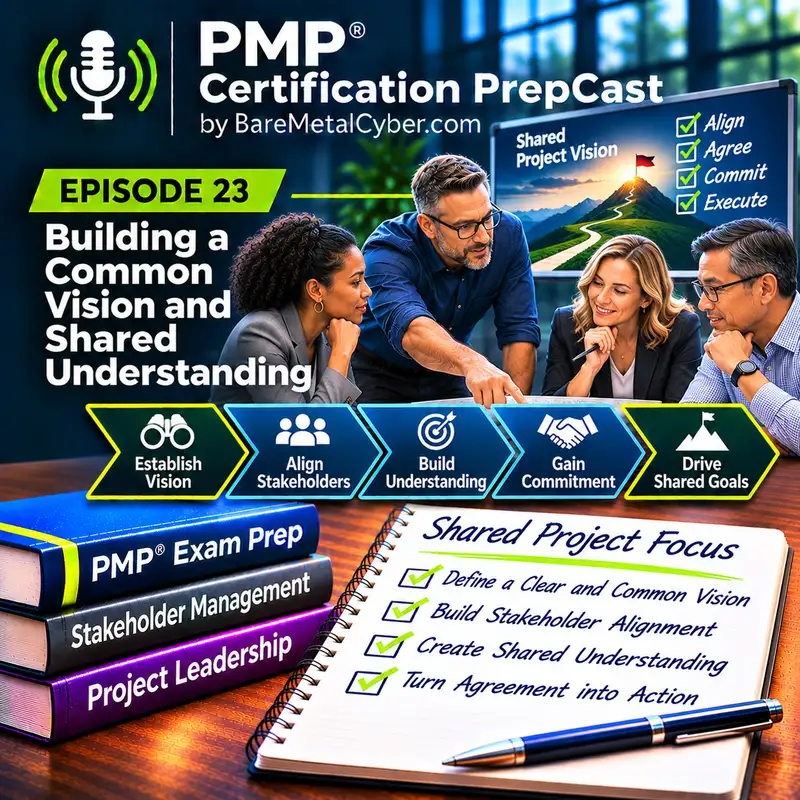
A sponsor, user, and delivery lead can agree that a project matters while meaning different things by success. Shared understanding makes the intended outcome, acceptance conditions, constraints, and decision rights explicit. It supports developing a common vision and aligning stakeholder expectations in the current People domain. The participants do not have to hold identical preferences, but they need a usable account of what has been agreed and what remains undecided. The project manager helps expose those differences and connect them with evidence and authority before an unsupported assumption becomes a commitment.
Welcome to Certified, the P M P prepcast. This is episode twenty three of season one. Today we are exploring how to build a common vision and a shared understanding of project success.
When shared understanding is missing, teams find themselves caught in cycles of “I thought you meant…” conversations. A sponsor may approve requirements thinking one outcome will result, while the technical team builds something entirely different. The gap is not usually a lack of effort but a lack of common reference. By focusing on explicit alignment, the project manager ensures everyone is working from the same foundation. The exam tests this subtly, when misaligned expectations appear, the correct response often involves clarifying and documenting agreements, rather than rushing into delivery or escalation.
Shared understanding is not just about documents, though artifacts play a role. It is about the process of aligning people. The project manager facilitates conversations that surface assumptions, tests interpretations, and forces precision where ambiguity exists. Shared understanding is always a living construct, not a one-time achievement. As conditions change, the team revisits and refreshes its agreements. On the P M P exam, correct answers highlight this iterative nature, avoiding the trap of assuming a one-and-done agreement will survive shifting realities. Sustainable clarity requires continual engagement and visible reinforcement.
Inputs to building shared understanding begin with the business case, which defines why the project exists. Scope statements, product backlog items, constraints, and known risks all feed into these conversations. Misalignment signals often appear as contradictory emails, conflicting interpretations of requirements, or surprise expectations voiced late. Phrases like “I assumed” or “I thought that meant” are red flags that clarity has slipped. Missing or conflicting definitions and vague acceptance criteria also point to danger. The project manager must recognize these signals early. On the exam, scenarios often disguise them, and the best answer involves pausing to confirm understanding rather than pressing ahead.
Different audiences can use different representations of the same project. A process diagram, backlog, and executive summary may each show a useful part of the work. Check whether their facts and commitments are consistent rather than requiring them to look identical. If a diagram shows a handoff the backlog omits or a report promises an unapproved feature, establish the current authorized position and correct the inconsistency. Assign ownership for maintaining the relevant record so that the same conflict does not simply reappear in the next update.
Capturing expectations and concerns explicitly also prevents drift. For example, a stakeholder who cares about customer satisfaction may frame requirements differently than one focused on regulatory compliance. Unless both are surfaced and reconciled, the team may inadvertently prioritize one over the other. Shared understanding requires making these priorities visible and subject to conscious agreement. P M I emphasizes that surprises late in a project usually trace back to missed signals early. On the exam, the right answer typically involves surfacing and documenting expectations now, not deferring alignment for later.
Shared language becomes useful when people can apply it to an example. A glossary can clarify a term, acceptance criteria can describe required behavior, and a prototype can test an interpretation. In Scrum, the Definition of Done provides the Increment's quality commitment; a Definition of Ready is an optional practice for preparing work, not a required Scrum artifact. Choose the aid that resolves the actual ambiguity. Examples of what meets a condition and what does not help people test whether they truly mean the same thing.
Ask people to check your interpretation when it affects a decision. You might say, I understand that the opening means an accepted facility and a staffed service; is anything missing from that definition? The response can reveal a dependency that a simple status statement hides. When the needed conditions are already clear and the action is authorized, another round of confirmation may add no value. Use clarification to resolve a relevant uncertainty rather than turning it into a delay before every action.
The process of building shared understanding follows a structured sequence. First, elicit viewpoints from all relevant stakeholders, ensuring no voice is skipped. Next, synthesize these viewpoints into a draft articulation of goals, scope, and constraints. Then, validate this draft using examples and acceptance tests, asking stakeholders to confirm explicitly. Once confirmed, capture agreements in visible artifacts and assign owners for ongoing stewardship. Finally, set a cadence for review and refinement as facts and constraints evolve. On the exam, correct answers often reflect this structure, elicit, synthesize, validate, capture, and refine, rather than improvisation.
Elicitation is more than asking for requirements. It means actively listening, probing for assumptions, and encouraging diverse perspectives. A sponsor may articulate a goal differently than an end user, and reconciling those differences is critical. Synthesis then transforms scattered inputs into a coherent whole, avoiding the trap of treating stakeholder statements as separate requirements without alignment. Validation is where understanding is tested, examples, prototypes, or walk-throughs make abstract commitments tangible. On the exam, correct answers usually emphasize facilitation of this process, not unilateral interpretation by the project manager.
Capture the current agreement in the appropriate controlled record. That may be acceptance criteria, a requirement, a backlog item, a decision record, or an approved baseline when the relevant authorization applies. Clarifying an interpretation does not necessarily change a commitment, and editing a record does not authorize a new one. Make clear which conditions are agreed, who decided, and what remains open. This lets the record support shared understanding without treating paperwork as a substitute for the decision.
Revisit assumptions and expectations when new evidence, stakeholders, or constraints affect them. A review can clarify meaning, reveal a missing dependency, or support a proposed change. Learning something new does not itself require approval, but changing an approved commitment or mandatory completion condition may. Keep that distinction visible, especially when a test failure tempts people to redefine success afterward. Record the authorized outcome and update the relevant information so the team can act from a consistent position.
Establish which record is authoritative for each important commitment and who maintains it. Several linked records may be necessary, including a scope reference, operating plan, and acceptance evidence. They should agree on the conditions that connect them. A meeting nod, a shared file location, or a polished diagram is not proof that the required owner has approved the result. Confirm the decision and make its meaning usable to the people who must deliver or accept the work.
The techniques so far establish a practical foundation: identify the ambiguity, test it with an example, and preserve the authorized meaning in a usable record. The next part applies those techniques to delivery approaches and to a clinic-expansion case. Keep the distinction between clarifying a condition and changing it in mind as the facts become more detailed.
Every approach needs enough shared understanding for the decision being made, and every approach can learn as work develops. A predictive project may establish important design and handover commitments early while refining permitted implementation detail later. An adaptive team can clarify future work frequently while keeping mandatory quality and external obligations intact. Hybrid work needs clear interfaces between those conditions. Decide whether new information changes an interpretation, a forecast, or an authorized commitment, then use the corresponding response.
Regardless of mode, the principle remains: confirm before commit, document after agreement. Agile teams confirm shared understanding through examples in backlog items or stories. Predictive projects confirm via requirements reviews and sign-offs. In hybrid contexts, the project manager ensures backlog clarity is reconciled with governance documents so all parties are aligned. The P M P exam often embeds subtle cues, phrases like “sprint demo” or “stage gate” point to the delivery mode. The correct answer is the one that ensures understanding is validated and documented in the right artifacts for that context.
Techniques that support shared understanding often rely on simple, repeatable practices. One is the “read back” method, where the project manager restates what they heard: “I’m hearing that success means reducing errors by twenty percent, did I miss anything?” This invites correction and ensures alignment. Another technique is example-first acceptance criteria, often written in a “Given-When-Then” format. For example: “Given a logged-in user, when they submit a form, then they receive confirmation.” This concreteness prevents ambiguity. On the exam, correct answers usually emphasize confirmation and examples rather than assumption or abstraction.
Contrast pairs, examples and non-examples, are another powerful tool. Showing both what meets acceptance and what does not clarifies boundaries. For instance, “Valid orders include those with approved payment; invalid orders include those with expired cards.” This dual framing ensures stakeholders see the scope from both sides. Another technique is the “three-question close”: What does success look like? What constraints matter most? How will acceptance be proven? These questions ensure shared understanding is testable, not vague. On the exam, scenarios often reward explicit validation through examples or contrast pairs rather than trusting verbal agreements alone.
These techniques also lend themselves to audio-friendly practices, which matter in distributed teams. Reading back, asking clarifying questions, and summarizing aloud ensure alignment even when stakeholders cannot see visual artifacts. This adaptability reinforces P M I’s philosophy that shared understanding is about inclusive communication. The exam frequently tests whether candidates adapt collaboration methods to context, audio calls, distributed teams, or face-to-face workshops. The best answers show flexibility while keeping clarity and validation intact.
Consider the fictional public-clinic expansion in chapter nine of P M P for Busy People. It uses a predictive construction plan because design, procurement sequence, and the building handover date create important dependencies. The project is in week eighteen of a twenty-four-week plan and remains within its approved two-point-four-million-dollar budget. Four additional consultation rooms are being fitted. All figures, thresholds, and roles in this case are invented teaching data. The decisions concern project alignment and governance; they do not establish clinical practice or a general building-law requirement.
The sponsor describes success as four new rooms open on time. The clinic service owner explains why that statement needs more detail. The intended benefit is capacity for one hundred sixty additional appointment slots each week, above the current four hundred eighty. The service owner will measure the staffed schedule for twelve weeks after opening. That is a capacity measure, not evidence that every slot will be booked or that a completed building automatically produces appointments. Staffing and reception arrangements must be confirmed by week twenty-two, and the service owner owns the roster and operating plan.
The approved delivery commitment is four fitted rooms handed over by the end of week twenty-four within the two-point-four-million-dollar budget. The facilities lead supplies the required completion and test evidence. Acceptance also includes the agreed room checks, a visitor-route review, reception preparation, and the operating handover. The designated acceptance owners confirm their respective conditions. These facts separate construction completion from operating readiness without suggesting that either can be ignored. Keep the week-twenty-two staffing dependency visible even when the construction report remains on schedule.
Two entrance layouts are still being compared. Both fit the approved construction scope and date, but their effect on the route through reception needs review before the layout is finalized on Thursday. A community representative has received the general progress email but has not seen the marked route plans. The representative raises concerns from visitors who use mobility aids. The case has not established that either option is suitable or unsuitable. That uncertainty calls for relevant input and qualified review, not a claim that a particular design has already failed.
The project manager can arrange an accessible review with the community representative, reception staff, and qualified design lead before Thursday without delaying unrelated construction. That is the useful engagement step: put the actual options in front of the people whose evidence is missing. The design and facilities leads can explain the constraints, reception staff can describe the workflow, and the representative can provide and check visitor input. The representative has no overall project approval authority. Listening to that person improves the decision without transferring the formal acceptance responsibility.
A clinic manager also requests a mobile check-in system and asks the team to begin immediately. That system is excluded from the approved scope. A preliminary assessment estimates an additional forty-two thousand dollars and one extra week, with support and training needs still to be confirmed. The project manager has not promised the feature. The sponsor asks for a recommendation that explains the effect on the approved opening and expected service benefit. The request may be attractive, but enthusiasm does not resolve its scope, timing, operating, or funding consequences.
Read the delegation carefully. The project manager may approve implementation spending up to fifteen thousand dollars from available project funds only while remaining within the approved scope and finish date. The proposed mobile system exceeds that spending amount, lies outside the scope, and carries a preliminary additional week. The sponsor owns changes to scope, budget, and the committed finish date. The clinic service owner owns operating arrangements and benefit evidence, but cannot independently change the project scope or finish date. Several conditions therefore require the sponsor's decision; reducing the price alone would not remove the other limits.
Prepare the recommendation with the evidence already available and identify what remains uncertain. Explain the excluded scope, the preliminary cost and time effect, and the support and training assessment still needed. The sponsor may need to compare retaining the current commitment, considering a separately authorized later initiative, or approving a supported change through the proper route. Those are options to evaluate, not decisions the case says have already been made. Keep the team working to the current authorized position while the appropriate owner considers the request.
The next meeting should leave a usable record of the success conditions, the people supplying missing evidence, the accepted tradeoffs, and decisions still awaiting their owner. The sponsor needs a clear request; the service owner needs to close the staffing and reception dependency; acceptance owners need their respective evidence. The community representative needs an accessible opportunity to review the actual route options. This is shared vision, stakeholder engagement, expectation alignment, and governance working together. The lesson is to connect each expectation with its evidence and owner instead of using one broad phrase, such as open on time, to stand in for every decision.
Use three variations to test whether the clinic's shared understanding is genuinely precise. In the first, the project is still in week eighteen and the operating roster is due in week twenty-two. A draft roster is incomplete. That is a dependency to monitor and manage, but the case has not yet established a missed week-twenty-two commitment. The project manager should clarify progress and any uncertainty rather than report a failure that has not occurred. Now move the status date to week twenty-three and say that the required staffing confirmation is still absent. The same dependency has become a present readiness issue with a different urgency.
In the second variation, the mobile check-in proposal is revised to cost twelve thousand dollars instead of forty-two thousand. It now falls below the manager's stated fifteen-thousand-dollar implementation limit. Does that make it authorized? No. The delegation also requires the work to remain within approved scope and the finish date. The mobile system is still excluded, and the revised proposal must establish its timing and operating effects. A single favorable condition cannot erase the other conditions attached to authority. This is why a shared understanding of the complete delegation matters more than remembering its largest number.
In the third variation, the clinic reports that available appointment capacity has risen from four hundred eighty slots to six hundred forty slots per week. The difference is the intended one hundred sixty additional slots. Relative to the original capacity, that is an increase of one third, or about thirty-three percent. It does not show that six hundred forty appointments occurred, that every slot was used, or that a separate service outcome improved. The evidence supports a capacity claim. A different claim needs a different measure.
These variations also change how progress should be communicated. The sponsor needs to know whether a delivery commitment or decision boundary is affected. The service owner needs to know whether staffing supports the planned capacity. The community representative needs to know how visitor input affected the route decision. One broad statement that the project is green cannot carry all of that meaning. A concise report can still preserve the distinctions by stating the condition, the evidence, and the owner of any remaining action.
To practice, explain the clinic's success in three separate sentences: what the project must deliver, what must be ready to operate, and what benefit will be measured afterward. Then name which sentence a proposed mobile check-in system would change. You may discover that the feature is a possible means of improving the service, not a required part of the current authorized delivery. That does not make it a bad idea. It identifies the decision that must be made before enthusiasm becomes a commitment.
Consider a separate example in which quality assurance says a feature fails its acceptance condition, while the sponsor calls it good enough. Establish the agreed condition, the test evidence, and the designated acceptance authority. If the condition has been misunderstood, clarify it with the appropriate participants. If the feature genuinely fails, arrange the authorized correction or decision rather than silently lowering the criterion to produce a pass. Some requirements cannot be waived locally. A discussion can improve the evidence, but it does not erase the failure or create authority that the participants lack.
A predictive version of that disagreement may use the approved requirement, traceability record, and test result to show what was promised and observed. Determine whether the work needs correction, a permitted change needs approval, or a qualified acceptance owner needs more evidence. Use the applicable governance route and keep the result visible. The important distinction is between proving the agreed condition and changing it through a legitimate decision, not merely finding a document that can be edited to end the argument.
Exam pitfalls around shared understanding often involve acting without clarifying acceptance criteria or scope intent. Another pitfall is assuming a prototype alone equals agreement. While prototypes are useful, they must be paired with explicit acceptance criteria and documented agreements. Updating artifacts after the fact is another common error, leaving audit trail gaps. Finally, skipping dissenting stakeholders to “save time” often backfires, creating resistance later. On the exam, these pitfalls appear as tempting distractors. The correct answer usually emphasizes inclusive validation, artifact updates, and transparency.
A common trap is treating prototypes as substitutes for agreement. While stakeholders may nod during a demo, unless expectations are documented and artifacts updated, alignment remains fragile. P M I emphasizes that prototypes support understanding but do not replace formal agreement. On the exam, correct answers require combining prototypes with updated acceptance criteria, decision logs, or baselines. This reinforces the principle: shared understanding must be traceable and testable, not just informal.
Provide relevant affected people a practical opportunity to contribute, including those who disagree or are less visible. Ask what evidence or constraint their perspective adds and address it through the appropriate role. Shared understanding does not require unanimous preference or unlimited delay while every possible participant is contacted. Keep the consultation proportionate to the decision, the effect on people, and the applicable requirements. Explain the authorized outcome and any remaining disagreement rather than treating silence as consent or dissent as a veto.
Define the important terms and test them with concrete examples. Invite the relevant people to confirm or correct the interpretation, then identify the decision owner and the record that preserves the outcome. Review the understanding when material facts change. Learning and clarification can happen continuously; a change to a controlled commitment follows the applicable authorization. Keep an owner and next action for anything still unresolved. This turns a conversation into usable alignment without pretending that every participant must approve every detail.
Invest in clarification where the missing understanding can change the decision or create avoidable harm. In the clinic case, the route review can occur before Thursday without delaying unrelated construction, so meaningful engagement is compatible with continued progress. Another situation may include an immediate obligation or a deadline that requires a bounded decision from the authorized owner. Use the available evidence and make remaining uncertainty explicit. Good alignment supports timely action instead of becoming a reason to postpone it indefinitely.
Shared understanding connects the common vision with specific expectations, evidence, and authority. The clinic example shows why an on-time building, a usable operating plan, and permission to add a feature are separate questions. Read-backs, examples, and appropriate records can make those distinctions clear. Keep open decisions visible and revisit assumptions when the facts require it. The next episode considers the same need for clarity across virtual teams, where distance and handoffs can make an unnoticed difference in meaning more expensive.
For more certification study resources, books, and podcasts, visit Bare Metal Cyber dot com. Thank you for listening to Certified, the P M P prepcast.