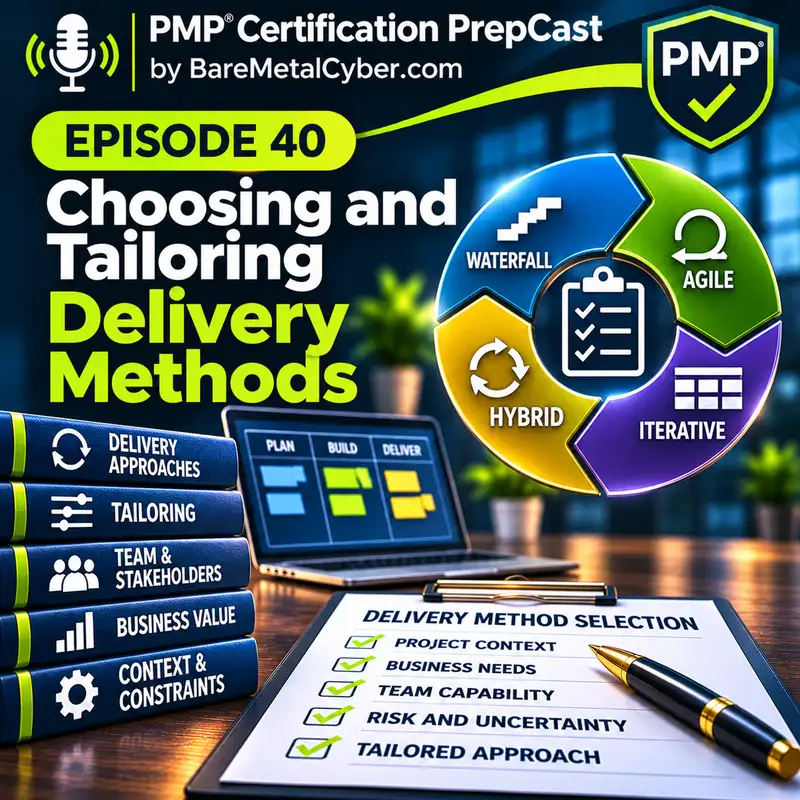
PMP 2026 | 40 | Choosing and Tailoring Delivery Methods
Determining the right project methodology is one of the most critical responsibilities of a project manager. Methodology provides the overarching framework for how work will be planned and delivered. Methods are structured ways of applying that framework, while practices are the concrete techniques used day to day. Together, these choices shape how the team collaborates, how decisions are made, and how stakeholders see progress. Selecting the wrong approach can create friction and rework, while thoughtful selection builds alignment and confidence. This is not about dogma or loyalty to one system. It is about aligning approach with the nature of the work, the environment, and the value the project is meant to deliver.
Welcome to Certified, the P M P prepcast. This is episode forty of season one. Today we are exploring how to select and tailor delivery methods and practices.
The key to good methodology selection is context. Every project exists within an environment that carries a level of uncertainty and a degree of complexity. Uncertainty refers to how well scope and requirements are understood. Complexity refers to interdependencies, governance demands, or technical challenges. Projects with low uncertainty and moderate complexity often suit predictive approaches, where baselines provide stability. Projects with high uncertainty and a need for learning in short cycles often benefit from agile approaches. Many projects fall in between, where hybrid solutions are appropriate. The project manager begins by honestly diagnosing these dimensions before declaring any approach.
Uncertainty can be thought of as clarity about the problem. A bridge built to an approved, well-understood design may have relatively stable requirements while still facing uncertainty in ground conditions, permits, resources, or weather. Designing a new mobile service in an emerging market has high uncertainty: customer needs will shift, and technology may evolve. Complexity, on the other hand, is about scale and interconnections. A small app may be uncertain but simple. A global E R P rollout may be certain in scope but complex in scale. Both dimensions together inform the decision. Project managers who skip this assessment risk forcing the wrong methodology onto the work.
Organizational context matters as much as technical context. Some projects require particular compliance evidence and approval points. Adaptive work can satisfy those requirements; documentation alone does not make an approach predictive. Some organizations have cultures built on stage-gates and formal sign-offs, while others thrive on rapid iteration and collaboration. A methodology that ignores culture and governance is likely to be resisted, no matter how well it fits technically. Sponsors also influence choice. Some want fixed forecasts and visibility into earned value, while others want incremental delivery and fast reprioritization. The project manager’s role is to balance these influences into a coherent, defensible approach.
Once the environment is understood, the project manager selects an overarching approach. Predictive methods are grounded in detailed up-front planning, fixed baselines, and variance analysis. Agile methods emphasize adaptive planning, collaborative decision-making, and delivery in increments. Hybrid approaches intentionally blend the two, for example using a planned procurement sequence alongside iterative product development. Governance and compliance apply across the resulting approach. The choice should never feel arbitrary. It must be tied directly to uncertainty, complexity, culture, and sponsor expectations. Explaining why the chosen methodology was selected builds confidence and strengthens alignment with governance bodies. Transparency around this decision is itself a best practice.
Methods come next. A methodology provides direction, but methods bring discipline to that direction. In predictive settings, methods such as critical path analysis, earned value management, and requirements traceability provide the structure for planning and monitoring. In agile environments, methods such as backlog refinement, velocity tracking, and iterative reviews ensure adaptation and transparency. Each method brings a structured way of seeing work and making choices. A project manager who simply declares “we are agile” or “we are predictive” without naming and using methods risks running an approach that is vague and ineffective.
Practices operationalize the chosen methods. A method like earned value requires practices such as collecting actual costs, calculating variances, and updating performance indexes. Backlog refinement can use conversations, decomposition, and acceptance examples. User stories and story points are possible techniques, not requirements for every adaptive team. Practices are the visible daily or weekly routines that teams follow. They should be chosen deliberately to fit the team’s maturity and the project’s needs. Too many practices create bureaucracy. Too few practices create drift. Balance is the goal. The project manager’s role is to set these practices thoughtfully and coach the team in applying them consistently.
Team readiness influences which practices can succeed. A team familiar with a particular adaptive approach may already know its events and measures, but experience does not mean every practice, such as velocity tracking, is suitable. A team unfamiliar with iterative delivery may resist or misunderstand these rituals until trained. Similarly, a finance-heavy team may find earned value natural, while a small creative team may find it overwhelming. Practices must be introduced at the pace the team can absorb. Readiness assessments and training are part of methodology selection. Forcing practices too soon leads to frustration and resistance. Supporting adoption with coaching, mentoring, and feedback transforms practices into habits that improve performance rather than hinder it.
Tailoring continues as evidence about the work and team changes. P M I stresses that tailoring is expected, not optional. Tailoring means adapting methods and practices to suit the size, risk, and constraints of the project. For example, a ten-million-dollar defense contract may require extensive procurement and risk planning. A two-week internal pilot may need only a lightweight backlog and checklists. Tailoring is about sufficiency: enough discipline to provide visibility and governance, without overloading the team with unnecessary bureaucracy. Documenting tailoring decisions demonstrates professionalism and provides rationale for auditors or governance boards later.
Tailoring also requires setting guardrails. Guardrails are the boundaries that protect governance while still allowing flexibility. These might include mandatory compliance checkpoints, required quality standards, or budget approval thresholds. For example, an agile team may use lightweight documentation, but guardrails require retaining test evidence and sign-offs. A predictive team may streamline reporting frequency, but guardrails still require variance analysis above a certain threshold. Guardrails reassure sponsors that flexibility will not devolve into chaos. They create the balance between empowerment and accountability that mature organizations demand. Without guardrails, tailoring can feel like cutting corners rather than thoughtful adjustment.
The steps to making methodology choices are sequential. First, assess context, uncertainty, complexity, culture, governance, and sponsor expectations. Second, select the overarching methodology, predictive, agile, or hybrid, based on that context. Third, identify supporting methods that bring structure to the chosen framework. Fourth, choose concrete practices that will operationalize those methods day to day. Fifth, tailor the combination to fit the project’s size, risk, and maturity, while setting guardrails to maintain governance. Following these steps in order ensures that methodology is not a matter of habit or preference, but a deliberate and defensible decision.
Discipline in methodology selection pays off in credibility. A project manager who can explain, “We will learn through short delivery cycles while producing the evidence and decisions required at each regulatory checkpoint” demonstrates maturity. Stakeholders gain confidence when choices are transparent and tied to project needs. Teams gain clarity about why they are working in a particular way. Governance bodies gain reassurance that oversight is respected. This reduces conflict and accelerates delivery. Methodology, methods, and practices are not theoretical, they are levers for trust and value.
An exam scenario may combine changing requirements with strict oversight. Identify what can be learned incrementally, what must be decided in advance, and what the organization actually requires. A hybrid may fit, but the words regulatory or government do not automatically select it. An adaptive approach can retain rigorous controls, and a predictive approach can respond to approved change. Test each proposed approach against the case facts instead of using a keyword rule.
A fictional company is developing a portable demonstration stand and the booking process used to send it to events. The stand must fit specified transport dimensions and meet agreed physical performance requirements. The booking workflow is much less understood: users disagree about approvals, shared equipment, and last-minute changes. Treating the whole project as either completely certain or completely uncertain would hide this variation. Method selection should examine the work, the decisions, and the cost of learning in each part before choosing the overall delivery arrangement.
The physical stand offers some opportunities for early design confirmation. The supplier needs stable dimensions before cutting expensive components, and transport arrangements depend on the final package. Those commitments favor deliberate design and procurement planning. However, uncertainty may remain about ease of assembly or how well visitors can see a demonstration. A low-cost mock-up can test those questions before final manufacture. Predictive planning does not forbid experiments. The useful distinction is whether the experiment reduces uncertainty before an expensive commitment and whether its results can still influence the design.
The booking workflow offers a different learning opportunity. Staff can try a simple prototype with fictional reservations, observe where instructions fail, and adjust the workflow before broad deployment. Short feedback cycles are useful because users can discover needs through interaction rather than specifying every detail from memory. That does not mean the team should release an incomplete operational system without required controls. A prototype used to learn, an increment ready for use, and a formally accepted service are different states. The delivery approach should describe what evidence moves work from one state to another.
An intentional combined approach could use a planned manufacturing sequence for the stand and iterative development for the booking service. The important work is defining their interface. The booking system needs equipment identifiers, availability rules, and realistic transport lead times. The stand's delivery schedule needs to know when those rules and staff procedures will be ready. A shared milestone may depend on both. Calling the project hybrid does not resolve these dependencies. Owners, data definitions, readiness conditions, and change rights still have to be agreed and reflected in the integrated plan.
Consider reversibility as well as uncertainty. Changing a prototype button may be inexpensive, while changing the stand's dimensions after manufacture may require costly rework. That difference can justify learning sooner and committing later on the physical design. It does not imply that all software changes are harmless or reversible. A booking change that sends incorrect commitments to customers can have consequences beyond the application. Evaluate the whole operating effect and recovery options. The appropriate feedback cycle depends on what can be safely learned and changed, not merely whether the work uses computers or physical materials.
Customer participation also changes feasibility. An adaptive workflow requires timely access to people who can clarify needs and evaluate outcomes. If staff can review only once every two months, claiming to learn from them every week would be an unsupported planning assumption. The manager can negotiate representative participation, use agreed decision delegates, or adapt the feedback arrangement. The answer is not automatically to abandon adaptive work, but to make its required participation real. A chosen method should describe how decisions will actually occur with the people and calendars available.
Team capability matters in a similarly concrete way. A team new to visual work management may need help making work small enough to observe, defining completion, and distinguishing started work from finished value. Simply installing a board will not create reliable flow. Conversely, a capable team should not be required to produce extensive new reports solely because a template exists. Identify which information the sponsor, customer, and team need for decisions, and select practices that produce it with proportionate effort. Capability development and necessary oversight can proceed together.
For a flow-based approach, imagine that booking requests arrive continuously and vary in urgency. Visualizing the work, making policies explicit, and controlling work in progress may be useful. For a product team pursuing a coherent learning goal, a timeboxed approach may fit better. Neither choice means every task must be estimated with story points or every discussion called a ceremony. Techniques are selected for their purpose. When a named framework is used, represent it accurately; optional additions can be tailored without pretending that removing its essential elements leaves the framework unchanged.
The contract and funding model must also fit the intended learning. A supplier asked to deliver a tightly specified stand for a defined price receives a different commitment from a supplier engaged to explore uncertain workflow options within a capped investment. Both require clear acceptance and change arrangements appropriate to their terms. The team cannot promise unrestricted feature growth, a fixed date, and a fixed budget merely by using an adaptive label. Make the negotiable dimension explicit and identify who can approve trade-offs. Methodology organizes uncertainty; it does not repeal constraints.
Establish signals that will prompt a review of the approach. If prototype reviews consistently reveal major misunderstood needs, the team may need more discovery before committing expensive work. If operational requests repeatedly interrupt planned development, clarify priorities, support responsibilities, and work policies. If mandatory evidence is missing at each milestone, integrate its production into the work rather than adding a last-minute paperwork sprint. A single poor iteration does not prove the method is wrong. Diagnose whether the cause is a practice, capability, dependency, or the overall approach before changing everything.
The decision can finally be explained in ordinary language: certain physical commitments need early verification, uncertain user workflows need frequent feedback, and both need one coherent release and support arrangement. That explanation is stronger than saying the company always uses one method. On a different project with stable repeatable work and little useful intermediate feedback, a more predictive approach may be entirely appropriate. On another with independently valuable increments and rapid user access, a predominantly adaptive approach may fit. The reasoning comes from the facts, while the label summarizes the resulting design.
Hybrid approaches deserve special attention because so many real-world projects fall between pure predictive and pure agile. A common hybrid pattern is to use predictive planning for long-range governance while executing work in short agile iterations. For example, a product development program might establish milestones, budgets, and regulatory checkpoints in a predictive structure, but teams deliver features through sprints. Another hybrid form is phased delivery, where early stages are agile to explore uncertainty and later stages shift to predictive once scope stabilizes. P M I emphasizes that hybrids are not compromises but intentional blends, chosen to respect both uncertainty and control. Compliance and changing requirements are factors to assess, not a formula that automatically selects hybrid.
A useful way to think of hybrid is through layers. The outer layer provides structure for governance, stage gates, baselines, and executive reporting. The inner layer enables adaptability, backlogs, demos, and retrospectives. This layered model reassures stakeholders who need forecasts while empowering teams to adapt as they learn. Without this balance, projects swing between rigidity and chaos. The project manager must explain how the layers work together, so stakeholders know when to expect predictability and when to expect flexibility. On the exam, distractors often push candidates toward one extreme. The correct answer usually blends oversight with adaptability.
Some hybrid patterns emerge naturally in specific industries. Construction projects, for instance, rely heavily on predictive methods for engineering and compliance, but design teams may use agile techniques to iterate drawings or prefabricated elements. In I T infrastructure projects, predictive procurement plans coexist with agile delivery of configuration or coding. The exam often tests whether you can recognize these practical realities. Strict contractual obligations and evolving technical requirements require a clear explanation of decision rights, learning cycles, and commitments; compare the available approaches on that basis. P M I’s philosophy is simple: use predictive for what must be fixed, use agile for what benefits from adaptation, and tie the two together with integration practices.
Methodology choices must also align with governance expectations. Organizations operate within portfolios and programs that impose standards, reporting requirements, and decision checkpoints. A project manager who chooses agile must still honor those governance needs, perhaps by translating backlog burn-downs into milestone forecasts. A predictive project must still engage stakeholders continuously, not only at sign-offs. The art is to map chosen practices onto governance frameworks, ensuring nothing is lost in translation. On the exam, scenarios about “ignoring governance” test whether you understand this alignment. The correct answer emphasizes adaptation without bypassing oversight.
Change management is tightly connected to methodology. Predictive projects control changes to approved commitments using the defined authority, which may be a board or a delegated decision maker. In agile projects, change is built into backlog reprioritization. In hybrid projects, both paths must coexist: backlog items shift by policy, while baseline shifts require governance approval. The project manager must ensure stakeholders understand these dual tracks. Without clarity, sponsors may expect immediate changes when the baseline actually requires impact analysis. On the exam, stems about “urgent sponsor requests” often probe this distinction. The correct answer stresses using the right change path for the chosen methodology, not improvising.
The sponsor’s role must also be honored. Predictive projects expect sponsors to approve major changes, provide resources, and monitor benefits realization at milestones. Adaptive projects need timely sponsor involvement and customer feedback. In Scrum, the Product Owner is accountable for Product Backlog ordering; sponsor funding or escalation authority is a different responsibility. Hybrid projects require both: periodic governance involvement and ongoing collaboration. P M I emphasizes that methodology must align sponsor engagement with organizational norms. On the exam, clues about absent sponsors or unaligned expectations often signal methodology mismatch. Correct answers involve clarifying roles and ensuring the chosen approach integrates sponsor responsibilities appropriately.
Consider a healthcare project with changing product requirements and mandatory evidence at defined regulatory checkpoints. Iterative development can help the team learn, while its delivery plan specifies when the required tests, records, and qualified approvals must exist. A deliberately combined approach may fit that situation. The rationale is the relationship between the work, learning, and commitments, not an assumption that all documentation is predictive. Confirm that the planned approach actually produces the required evidence in time, rather than assuming a label resolves the tension.
Now consider a sponsor seeking fixed cost and a fixed date while stakeholders expect the scope to keep expanding. No methodology can guarantee all three without regard to capacity and uncertainty. Clarify the minimum required outcome, negotiable features, constraints, and risk tolerance. Options may include a fixed investment with variable feature scope, staged decisions, additional funding, or a changed date, each subject to the relevant authority. A hybrid can organize those choices, but it cannot remove the underlying tradeoff.
Common exam pitfalls revolve around methodology dogma. One is assuming agile is always better for speed. Agile without governance leads to missed compliance and uncontrolled costs. Another is assuming predictive is always better for control. Predictive without adaptability leads to rework and stakeholder frustration when needs change. A third is ignoring hybrid, even though many real-world projects require it. The exam often tempts you with “all or nothing” language. The best approach is usually pragmatic: analyze uncertainty, complexity, and governance, then select accordingly. Use the stated uncertainty, constraints, team capability, and decision rights to support the choice; a method label alone does not identify the best response.
Another pitfall is skipping tailoring. P M I emphasizes that every methodology must be tailored to context. Simply declaring “we are agile” or “we are predictive” is insufficient. Without tailoring, teams either drown in unnecessary processes or miss critical governance. Tailoring requires documented rationale, so stakeholders know why practices are included or excluded. The exam often tests this by asking what to do when a team is burdened with excessive documentation. The correct answer is usually to tailor appropriately, not to abandon methodology altogether. Tailoring is about right-sizing, not rejecting structure.
Team maturity is another exam theme. Forcing advanced practices on an inexperienced team creates failure. P M I expects project managers to adjust practices to maturity, coaching and training as needed. The exam may present a scenario where a team resists daily standups or earned value reporting. Understand the cause, support learning, and tailor optional practices where appropriate. A binding reporting or safety obligation still applies while the team develops its capability. Methodology is a tool for enabling performance, not a stick for enforcing conformity. Teams grow into practices, and the project manager guides that growth.
Cultural mismatch is a further trap. Some organizations are deeply hierarchical, expecting formal approvals for even small changes. Others thrive on empowerment and delegation. A methodology that ignores this culture will fail. The exam may describe an agile rollout in a conservative organization and ask how to proceed. The wrong answer is to impose agile unaltered. Clarify which organizational controls must be honored and which practices can change. If essential Scrum elements are omitted, describe the resulting approach accurately rather than claiming it is unchanged Scrum. Culture cannot be wished away; it must be integrated into the methodology decision. P M I stresses respecting culture while nudging maturity forward.
A practical quick playbook helps anchor this domain. First, assess uncertainty, complexity, governance, and culture. Second, select predictive, agile, or hybrid as the overarching approach. Third, identify methods within that approach, such as earned value or backlog refinement. Fourth, choose practices that fit team maturity and stakeholder needs. Fifth, tailor by documenting rationale and setting guardrails. Sixth, align methodology with governance and change policies, ensuring sponsors and stakeholders remain engaged appropriately. Following this playbook ensures deliberate, defensible choices. On the exam, answers echoing this structured reasoning usually align with P M I’s philosophy.
The value of deliberate methodology selection is that it transforms how projects deliver. A well-chosen methodology increases alignment, reduces rework, and enhances trust with stakeholders. It also positions the project manager as a thoughtful leader who balances adaptability with accountability. The exam tests not only whether you can define predictive, agile, and hybrid, but whether you can reason through scenarios to choose wisely. The message is consistent: avoid dogma, analyze context, tailor deliberately, and respect governance. Doing so makes methodology a strength, not a stumbling block, in delivering business value.
For more certification study resources, books, and podcasts, visit Bare Metal Cyber dot com. Thank you for listening to Certified, the P M P prepcast.