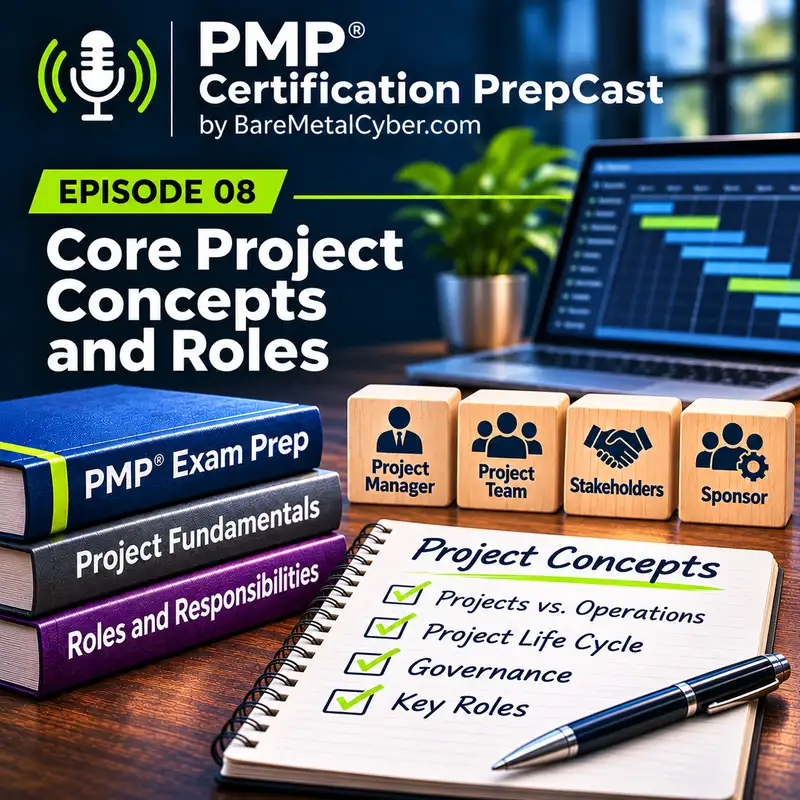
PMP 2026 | 08 | Core Project Concepts and Roles
In this glossary session, we will review key terms and concepts that are essential to understanding modern project management. Each definition is explained in clear language, with enough detail to make the idea practical and memorable. Listen carefully, and pause whenever you need extra time to repeat the term aloud in your own words.
Welcome to Certified, the P M P prepcast. This is episode eight of season one. Today we are exploring core project concepts and the responsibilities of key roles.
Governance and governance framework. Governance is the system of oversight that ensures projects are managed responsibly and in line with organizational priorities. It includes policies, procedures, and accountability structures that define who makes decisions and how progress is monitored. A governance framework provides the detailed structure, such as escalation paths, approval boards, and review cycles, that make governance actionable. Together, governance and its framework keep projects aligned with strategy, ensure transparency for stakeholders, and prevent misuse of resources.
To make these terms work together, we will follow a fictional community clinic that wants to replace its paper appointment process. Patients sometimes receive conflicting appointment times, staff reenter information, and managers cannot reliably distinguish a cancellation from a missed visit. Those are the problems to investigate. Buying software is a possible response, not the problem itself. The clinic authorizes a project to introduce a new scheduling capability, while normal appointment booking continues as an operational activity. The temporary effort and the ongoing service are connected, but they have different responsibilities and different measures of success.
The clinic's governance arrangement names a sponsor who can approve funding within a stated limit, a clinical lead who must approve changes affecting patient workflow, and an information-security specialist who reviews access arrangements. A project manager coordinates the delivery effort. None of those roles can be reduced to the word boss. The sponsor may authorize an investment without knowing whether a receptionist can use a particular screen. The clinical lead can judge a workflow without having authority to increase the budget. The project manager integrates their contributions without pretending to possess every professional qualification or approval right.
Suppose the team finds that a requirement cannot be satisfied within the approved funding. Governance tells the project manager where the decision belongs and what evidence that decision needs. The manager can develop alternatives, explain consequences, and recommend a path. That is different from silently increasing the budget because the manager believes the project is important. It is also different from sending every minor question to the sponsor. Delegated authority should allow decisions at the appropriate level, while defined thresholds identify when a different decision-maker must become involved.
A baseline is an approved reference used to compare performance with an agreed position. The scope baseline defines the authorized work and its boundaries. The schedule baseline is the approved time reference, while a current schedule model can show updated forecasts. The cost baseline is the approved, time-phased cost reference, including contingency reserves where provided; management reserve is outside that baseline. Report variances honestly rather than rewriting history. A change to an approved baseline follows the applicable authorization route, while forecasts and current records are updated to show what the evidence says now.
The distinction between a baseline and a forecast becomes clearer when the clinic reviews its dates. Its approved plan places staff training on the first Monday in June. A supplier now forecasts that the training environment will be available a week later. The approved reference has not magically moved because the forecast changed. The project manager must show the original commitment, the new forecast, the reason for the difference, and the options for response. Concealing the new forecast to protect the appearance of being on plan is misleading. Erasing the original commitment without authorization is misleading in a different way.
A current working schedule can therefore contain information that differs from the baseline. That difference is useful: it tells decision-makers something has changed. A recovery option might involve preparing training material while the environment is completed. Another might involve a limited simulation that does not expose real patient information. A third might be an approved date change. The team needs to analyze which option is feasible before presenting it as a commitment. Updating a forecast, recommending a recovery action, and approving a new baseline are three distinct acts.
The same distinction applies to cost. Imagine that the fictional clinic approved a cost baseline of one hundred thousand dollars, including a clearly identified contingency allowance. A forecast of one hundred and twelve thousand dollars does not by itself authorize another twelve thousand dollars of spending. It signals the need to explain the estimate, investigate the causes, and follow the relevant financial decision route. Nor does a contingency allowance mean anyone can use it for any purpose. The agreed reserve rules and ownership still matter. The term baseline is valuable because it preserves the difference between what was authorized and what is now expected.
Phase gate or stage gate. A phase gate is a formal checkpoint between stages of a project where progress, alignment, and readiness are evaluated. At each gate, leaders review deliverables, confirm that objectives are being met, and decide whether to continue, adjust, or stop the project. Stage gates ensure discipline by preventing projects from moving forward without the right approvals. They also provide an opportunity to revalidate benefits and confirm that resources are still justified for the next phase of work.
At the clinic's pilot-readiness gate, the review group receives three kinds of evidence. The team demonstrates the booking workflow, the security specialist reports the access-test results, and the operations manager confirms whether staff and support arrangements are ready. Those reports answer different questions. A successful demonstration does not prove access controls are acceptable. A completed security test does not prove reception staff can handle a cancellation. A signed training attendance sheet does not prove support coverage exists for the first morning of use.
In this fictional project, the agreed gate permits continuation only when all three readiness conditions are satisfied. If one condition is missing, the group should not quietly reinterpret the gate after seeing the result. It can request additional evidence, require corrective work, or consider a formally authorized change to the proposed pilot. A conditional approval needs specific conditions, accountable owners, and a clear limit on what may proceed. Otherwise, the phrase approved with conditions can conceal an unresolved decision rather than establish a controlled next step.
A gate can also test whether continuing still makes sense. Suppose a regional service has become available that could meet the clinic's need with less local maintenance. The team should not ignore that option simply because design work has already been completed. The decision concerns the remaining costs, risks, benefits, and obligations of the available paths. Work already performed is part of the history, but it cannot by itself justify further investment. A governance checkpoint should support that comparison, not merely celebrate completed tasks.
A minimum viable product is a deliberately limited way to test important assumptions about a product and learn from the people it is intended to serve. The form depends on what must be learned, and a usable early release is one possible form. Minimum does not mean that safety, required controls, or the acceptance conditions for actual use can be ignored. Decide which uncertainty the experiment addresses and what observation would count as useful evidence. A small feature set creates an opportunity to learn; it does not guarantee that the desired benefit will occur.
The clinic decides that its first learning question is narrow: can reception staff use a simpler booking flow without creating duplicate appointments? It does not need every reporting feature to investigate that question. A limited pilot might include one appointment type, a small group of trained users, and a controlled way to return to the previous process. The team defines what will be observed, such as duplicate bookings, correction time, and requests for help. Those observations can inform the next decision without pretending that one successful pilot proves the whole service is ready for every patient and every clinic.
A minimum viable product and a prototype are related ideas but are not interchangeable labels in every situation. A prototype may help people explore a layout or explain a workflow without being suitable for live service. An early usable release may support a real but limited activity. The team must say which it is offering. Calling a screen demonstration a production pilot can encourage stakeholders to rely on capabilities that have not been established. Conversely, demanding a complete product before testing a basic usability assumption can delay inexpensive learning.
The learning design should include a decision rule. In our example, the clinic might agree that recurring duplicate bookings require investigation before broader use. It could also decide that a particular access failure stops the pilot immediately. These are conditions established for the fictional project, not universal numerical rules. Their purpose is to make learning actionable. An experiment without a question or a response to its results can become a small release that generates data without helping anyone decide what to do next.
An increment adds usable capability, while an iteration is a repeated period of work and feedback. The exact arrangements depend on the approach. In Scrum, a Sprint lasts one month or less, and each usable Increment meets the Definition of Done and adds to what was created before. More than one Increment can be created during a Sprint. Delivering in increments can make progress inspectable, but the team must still test whether that capability is useful and adopted. A calendar rhythm and a completed feature are evidence of activity and delivery, not automatic proof of realized value.
Now distinguish a work period from a usable result. During an iteration, the team may investigate appointment reminders, refine the screen design, and complete a tested cancellation function. The iteration is the period in which the work occurred. The cancellation capability is an addition to the product if it meets the agreed completion conditions and works with the existing capabilities. The unfinished reminder research is valuable information, but it is not the same kind of result. Calling everything completed work would conceal those differences.
Usable does not necessarily mean released to every user immediately. The clinic may decide when and how to introduce a capability based on operational readiness and other constraints. In Scrum, however, an Increment must meet the Definition of Done to count as part of the Increment. A partially tested function does not become Done because the calendar period ended or because a stakeholder is enthusiastic about it. A review can expose progress and guide adaptation without relaxing the quality agreement to make a report look better.
Listen for the distinction in this practice question. The team finishes its two-week work period but cannot demonstrate that new appointment records remain consistent with existing records. Has the passage of two weeks proved that usable capability was delivered? No. Time has passed and work has occurred, but the relevant completion evidence is missing. The next useful discussion concerns the unmet condition and the work needed to satisfy it. Relabeling the result would change the vocabulary without changing the product.
In Scrum, one Scrum Team consists of a Product Owner, a Scrum Master, and Developers. The Product Owner is accountable for maximizing product value and for effective Product Backlog management. The Scrum Master is accountable for establishing Scrum and helping improve the team's effectiveness. Developers plan the Sprint work, create usable Increments, and adapt their plan while protecting quality and the Sprint Goal. The team is cross-functional and self-managing. These are Scrum-specific accountabilities; another adaptive approach may organize responsibilities differently and should be read on its own terms.
Imagine that the clinic uses Scrum for its software work. The Product Owner hears competing requests from reception, billing, and clinicians and is accountable for effective ordering of the Product Backlog. The Developers determine how to turn selected work into usable results and adapt their plan during the Sprint. The Scrum Master helps establish Scrum and improve effectiveness. These accountabilities do not mean the Product Owner personally writes every item, the Scrum Master assigns every technical task, or the Developers ignore organizational constraints. Delegating a task is not the same as transferring the accountability attached to a role.
A senior clinician asks a developer to add an extra screen immediately. The request may be valuable, but the team must consider it in relation to the Sprint Goal, current work, and the relevant decision arrangements. The answer is not that agile requires accepting every request on the spot. It is also not that no discussion of scope can occur during a Sprint. Clarification and negotiation can occur as more is learned, provided the Sprint Goal is not endangered and quality is not reduced. The practical task is to make the trade-off visible rather than hide additional work in a private agreement.
The project manager's broader coordination work may still include facilities, contracts, organizational readiness, and dependencies that extend beyond the software team's work. That does not make project manager an additional Scrum accountability. It means the organization has responsibilities to coordinate and must explain how they interact. On a question, read the actual role and decision being described. A person coordinating a clinic rollout should not automatically take over product ordering or tell Developers how to organize their technical work.
Organizational structure affects how resources and decisions are coordinated. In a functional arrangement, people generally work within specialties and functional managers hold significant resource authority. In a project-oriented arrangement, project leadership may have more direct authority and dedicated teams. A matrix combines project and functional responsibilities, often requiring negotiation over capacity and priorities. These are common patterns, not a substitute for the actual charter, delegation, or working agreement. Check who can authorize a decision in this project rather than assuming that an organizational label gives you unlimited authority.
In the same clinic, a specialist is assigned to the project for two afternoons a week while continuing to report to a functional manager. The project manager needs the specialist for an additional afternoon to complete access testing. A matrix label alone does not answer who may approve that time. The manager should review the resource commitment and discuss the impact with the person who controls the specialist's availability. The conversation can compare the value of the additional testing, the work that would be delayed elsewhere, and alternative ways to obtain the needed capability.
This is influence without unlimited authority. The project manager can prepare a clear case and negotiate a decision instead of simply issuing instructions that conflict with the specialist's other obligations. The functional manager, in turn, needs the project context rather than a vague request to help more. If the conflict exceeds their delegated authority or cannot be resolved within the necessary time, it can follow the agreed escalation route. Escalation then carries evidence about a decision that needs resolution, not an accusation that another department is unhelpful.
Customers, users, sponsors, and stakeholders can overlap, but those words do not always identify the same person. The clinic organization may fund the system, patients may receive the service, reception staff may operate it, and a sponsor may champion the investment. A supplier is also a stakeholder because its work and obligations affect the outcome. Mapping these differences matters when deciding whose needs to elicit, who accepts a deliverable, and who owns a benefit. The most senior person in the room is not automatically the person qualified or authorized to answer every one of those questions.
A project charter formally authorizes the project and establishes the project manager's authority within the organization. It commonly states the purpose, high-level objectives, sponsor, major stakeholders, initial constraints, and connection to the business case. Read the authority it actually grants rather than assuming the project manager can approve any change. Some organizations use an equivalent authorization instrument with a different name. The essential point is a clear, approved basis for beginning the project and committing the resources specified in that authorization.
A charter should be read as an authorization and alignment instrument, not as a complete technical design. The clinic's charter can authorize the project, describe its intended outcome, name the sponsor and project manager, and establish high-level boundaries before every screen or training exercise has been specified. Detailed planning follows as the team learns more. That is not permission to start with no meaningful purpose or limits. It is recognition that high-level authorization and detailed planning answer different questions at different levels of resolution.
Suppose the sponsor asks the project manager to support a second clinic as well. The charter currently authorizes one location. The manager should not assume that the sponsor's enthusiasm automatically changes every resource commitment or contractual boundary. The proposal needs to be evaluated and handled through the applicable authority and change arrangements. Depending on the organization, the relevant authorization may need revision, or a separate initiative may be more appropriate. The important distinction is between discussing an attractive extension and authorizing the commitments needed to deliver it.
Business case. A business case is the justification for why a project should exist. It explains the problem or opportunity, outlines the proposed solution, and describes the expected benefits, costs, and risks. Decision makers use the business case to determine whether the investment is worthwhile and aligned with strategic priorities. A well-prepared business case provides a foundation for the project charter and ensures that the work undertaken has clear purpose and measurable outcomes.
The business case connects the investment to a problem worth solving and a benefit worth pursuing. In our fictional clinic, reducing duplicate entry may release staff time and improve the reliability of appointment information. The case should identify the assumptions behind that expectation. For example, it may assume that staff will actually use the new workflow, that information can be transferred accurately, and that the clinic can support the service after handover. Each assumption is a potential source of uncertainty, not an established fact merely because it appears in an approved document.
Compare two proposals. The first delivers the greatest number of features but requires specialist support the clinic does not have. The second delivers fewer features but meets the priority need and can be operated with the available staff. A feature count alone cannot identify the better investment. The decision needs costs, risks, intended outcomes, and realistic operating responsibilities. Approval of the business case does not remove the need to revisit those factors when evidence changes. It establishes a reasoned basis for the project that can be checked as the project proceeds.
Benefits realization. Benefits realization is the process of ensuring that the expected advantages of a project are achieved and sustained. It starts with identifying benefits in the business case and continues through monitoring after project completion. Benefits can include financial gains, efficiency improvements, regulatory compliance, or customer satisfaction. By tracking benefits beyond project close, organizations confirm that value was delivered and that resources were used effectively.
At handover, the clinic receives the scheduling capability, supporting information, and agreed operational preparation. Those are delivery results. The benefits owner must then assess whether duplicate entry falls and service reliability improves under actual use. If staff maintain a parallel paper process because they do not trust the system, the project may have delivered software without enabling the expected result. The response should investigate that gap rather than announce success solely because the installation is complete.
A useful benefits measure needs a starting point, a meaningful comparison, an owner, and a review time. If the clinic measures booking corrections before and after implementation, it must consider whether the number and type of appointments changed. A busier month could produce more corrections even while the correction rate improves. The measure should match the intended outcome and be interpreted in context. An operational owner needs to know both what will be measured and what action follows when the result is disappointing.
Bring the glossary together by telling the clinic's story in sequence. The business case explains why an investment may be worthwhile. The charter authorizes the project within defined boundaries. Governance establishes decision rights. Baselines preserve approved references, while forecasts show current expectations. Iterations organize repeated work, usable increments add capability, and a limited product experiment can test an assumption. Roles clarify who makes which decisions. Benefits realization asks whether the resulting capability produces the intended value. Understanding those relationships is more useful than memorizing eleven isolated definitions, because a realistic project question will usually require several of them at once.
One final distinction prevents a common role error: accountability does not imply that one person performs all the work. The clinic's benefits owner may rely on an analyst to collect usage data and an operations supervisor to investigate a poor result. The owner remains responsible for ensuring the benefit is pursued and reviewed under the agreed arrangement. Similarly, a project manager can coordinate acceptance without being the person authorized to accept every deliverable. Ask who prepares the evidence, who evaluates it, and who makes the decision. Those responsibilities may sit with different people, and making that separation explicit reduces both bottlenecks and unauthorized commitments.
To check your understanding, explain why the clinic could complete an iteration without achieving a benefit, update a forecast without changing a baseline, and delegate an analysis without transferring approval authority. Each explanation should name the boundary between the two concepts. When you can do that, the vocabulary is becoming a tool for reasoning rather than a collection of labels.
For more certification study resources, books, and podcasts, visit Bare Metal Cyber dot com. Thank you for listening to Certified, the P M P prepcast.