PMP 2026 | 27 | Emotional Intelligence and Team Performance
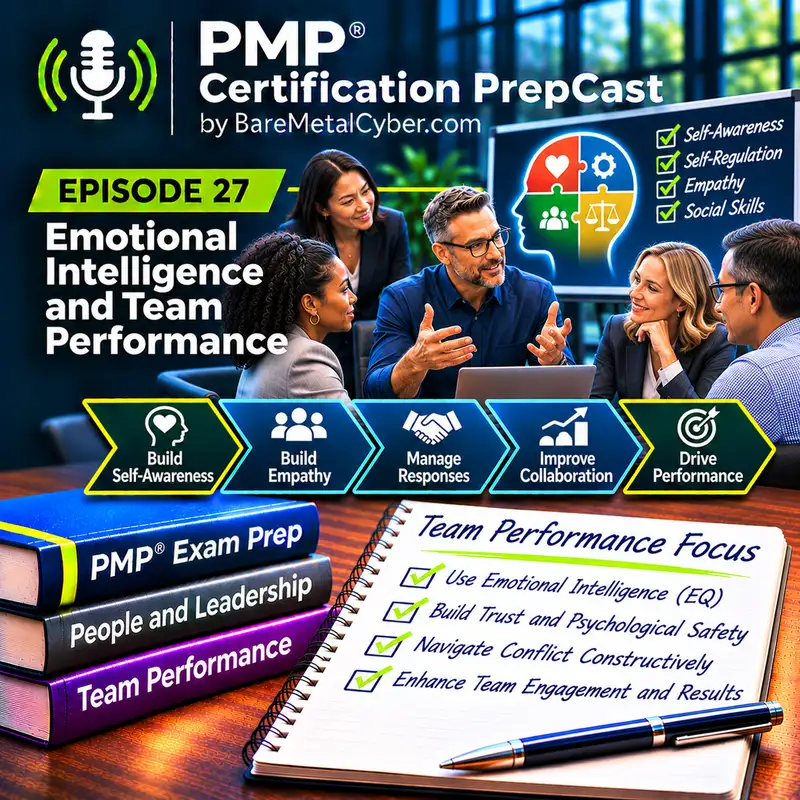
Emotional intelligence, often abbreviated as E I, is the ability to recognize, understand, and manage your own emotions while also recognizing, understanding, and influencing the emotions of others. One useful model organizes it into four areas: self-awareness, self-management, social awareness, and relationship management. In project management, E I is not an optional soft skill but a critical enabler of collaboration, decision quality, and delivery outcomes. Using E I, a project manager fosters trust, builds psychological safety, and helps teams recover quickly from conflict. The stance of the project manager is to model emotionally intelligent behavior, normalize reflection, and create a culture where feedback is welcomed. On the P M P exam, E I themes often appear in stems describing tense meetings, defensive emails, or disengaged participants.
Welcome to Certified, the P M P prepcast. This is episode twenty seven of season one. Today we are exploring how emotional intelligence can support leadership and team performance.
The outcomes of applying E I in projects are measurable. Trust grows when team members feel understood and respected. Psychological safety allows individuals to voice concerns without fear of ridicule or retaliation. Teams recover more quickly from conflict because members can separate issues from identities. A resilient pace emerges as stress is managed constructively rather than allowed to accumulate. These outcomes directly support project performance: fewer rework loops, clearer decisions, and higher stakeholder confidence. Evaluate whether empathy, facilitation, formal referral, or an immediate protective response fits the facts. Constructive dialogue helps ordinary disagreements, while threats, harassment, or a mandatory reporting duty may need prompt escalation. P M I emphasizes that emotions, when managed well, are data that improve delivery.
Project managers are expected to model E I behaviors. This means demonstrating calmness under stress, showing curiosity instead of judgment, and providing feedback respectfully. When leaders model reflection, admitting mistakes, labeling emotions, or pausing to think, teams learn that these are acceptable behaviors. This creates an environment where problems are surfaced earlier and resolved faster. The project manager does not need to be a therapist, but they do need to demonstrate practical skills that turn tension into alignment. On the exam, the correct response often involves modeling constructive behavior rather than demanding it from others without personal accountability.
Signals that emotional intelligence is needed often show up subtly before they escalate. Sarcasm in meetings, prolonged silence during discussions, or parallel “side channels” of communication may indicate disengagement. Repeated discussion may reflect unresolved concerns, unclear requirements, missing decisions, or other causes. Stress indicators also appear: missed cues, spikes of perfectionism, or blame-laden language. These are not merely interpersonal quirks but warning signs of delivery risk. The project manager should ask respectful questions and test possible explanations rather than diagnosing a person from these signals. On the exam, answers that highlight noticing and responding to these signals usually reflect P M I’s emphasis on awareness and prevention rather than reactive escalation.
Diagnostic tools for gauging team sentiment are simple but powerful. Pulse checks, brief surveys or quick “temperature checks” in retrospectives, reveal hidden concerns. Retrospective sentiment tracking allows patterns over time to surface, such as declining morale or rising frustration. One-on-one conversations provide deeper context, uncovering themes that may not appear in group settings. Use these signals responsibly to understand both working conditions and delivery effects. Respect, wellbeing, and appropriate conduct matter even before a measurable schedule impact appears. Emotional friction that seems “soft” often results in missed deadlines, reduced quality, or weakened stakeholder confidence. On the exam, correct answers usually involve linking emotional signals to delivery impact rather than treating them as irrelevant noise.
Understanding the connection between emotions and outcomes helps the project manager prioritize. For example, recurring sarcasm may be more than mood, it might signal a stakeholder feeling unheard, leading to disengagement from decisions. Blame language, if unchecked, can fracture collaboration and cause duplication of work. Recognizing these early allows interventions that restore flow and trust. The P M P exam often disguises such issues within technical scenarios. The correct answer typically emphasizes facilitation or clarification, addressing the emotional dimension before it degrades performance further.
The four core competencies of E I provide a framework for project leadership. Self-awareness is the foundation: noticing your triggers, biases, and emotional state under pressure. Self-management builds on this by pausing, labeling, and reframing, choosing your response instead of reacting impulsively. Social awareness extends the lens outward, emphasizing empathy, active listening, and cultural sensitivity. Relationship management integrates all three, enabling a project manager to coach, mediate, and influence without relying solely on authority. On the exam, questions often test whether you can apply these competencies in practical ways during conflict or tense negotiations.
Self-awareness is particularly critical for project managers, who operate under pressure from multiple stakeholders. Recognizing when frustration is building or when biases are shaping judgment prevents poor decisions. Self-management involves techniques like pausing before responding to a tense email or reframing criticism into constructive dialogue. Social awareness requires tuning into cues from others, silence can have many explanations, so invite input without presuming agreement or resistance. Relationship management enables constructive action: mediating conflicts, coaching team members, or persuading stakeholders through empathy. On the exam, the correct answer usually demonstrates awareness and management of emotions, not suppression or denial of them.
Micro-skills bring E I into daily practice. Reflective listening is one example, where the project manager summarizes what they heard: “What I’m hearing is that the testing timeline feels unrealistic, did I capture that correctly?” This validates the speaker and confirms understanding. Naming emotion and impact is another: “Tension seems high in this discussion; let’s slow down to ensure we make a sound decision.” Curiosity prompts invite openness: “Tell me more about the constraint you’re facing.” Reframing shifts the conversation from positions to interests: instead of arguing about dates, the group explores value, risk, and constraints. These micro-skills are exam-friendly because they are observable and specific.
Scripts provide practical guidance for emotionally intelligent conversations. Using reflective statements reduces defensiveness and invites correction. Naming emotion normalizes discussion of tone without blaming individuals. Curiosity prevents assumptions by inviting stakeholders to share their reasoning. Reframing allows negotiation to move from “I want this feature” to “What benefit are we protecting?” On the exam, options that involve curiosity, reframing, or reflective listening usually reflect P M I’s philosophy. Distractors often involve ignoring emotions, escalating prematurely, or demanding compliance without dialogue.
Rituals and artifacts help embed E I into the team’s operating system. Retrospectives with safety checks provide structured opportunities to surface concerns. One-on-one cadences with thoughtful prompts ensure individuals feel heard. Team charters can include norms about feedback etiquette, decision-making, and steps for repairing relationships when conflict occurs. Decision logs and issue logs, when worded respectfully, reinforce a culture of transparency. Recognition rituals are equally important, celebrating learning and collaboration instead of only heroic individual efforts. On the exam, correct answers often emphasize embedding E I into rituals and artifacts rather than relying only on ad hoc gestures.
Psychological safety is strengthened when rituals emphasize respectful repair after conflict. A charter might define steps: acknowledge the issue, revisit the norm, agree on the fix, and record the outcome. This creates predictability in how conflict is managed. Issue logs that capture rationale respectfully reduce blame and foster learning. Recognition rituals, such as highlighting teamwork contributions in meetings, signal that collaboration is valued. On the exam, the correct answer often highlights these systemic supports, not just one-off interventions by the project manager.
Embedding E I into rituals also ensures sustainability. A one-time expression of empathy may soothe a meeting, but a retrospective that regularly asks, “How safe did this sprint feel for speaking up?” creates long-term trust. Similarly, a decision log that records not only outcomes but the reasoning behind them helps stakeholders feel respected, even if their perspective was not chosen. These structures institutionalize E I. On the P M P exam, correct answers typically highlight creating sustainable systems for emotional safety rather than isolated emotional gestures.
A fictional release review will help separate emotional intelligence from simply being agreeable. A project team is preparing a new customer appointment service. During a demonstration, the delivery lead says the service is ready, and a testing specialist responds that the recovery behavior has not been verified. The sponsor sighs, the lead speaks sharply, and the tester stops contributing. The project manager feels pressure to defend the team and keep the announced date. Before responding, the manager needs to recognize that personal impulse as part of the situation, not as evidence about who is right.
Self-awareness here is specific. The manager notices a desire to say that everyone should calm down and move on. That response would reduce visible tension temporarily while leaving the disputed readiness claim unresolved. The manager instead separates three observations: the lead interrupted, the tester raised a recovery concern, and the readiness record does not yet explain that concern. The interpretation that the tester is being obstructive remains an untested interpretation. Naming observable facts prevents the manager's discomfort from becoming the basis of a release decision.
The immediate response can be brief and firm. The manager asks the group to let the tester finish and states that recovery evidence must be understood before readiness can be evaluated. This protects participation without declaring the tester correct or the lead incompetent. A neutral question follows: which expected recovery behavior is unverified, and what result would demonstrate it? The group can now examine a technical issue rather than arguing about whether someone is negative, loyal, nervous, or committed enough to the deadline. Emotional regulation has created room for useful evidence.
Suppose the tester explains that a failed appointment confirmation may leave customers uncertain whether they have a reservation. The lead replies that the normal transaction worked during the demonstration. Both statements can be true. The manager reflects the distinction: the main path has evidence, while a failure path remains unverified. This is more useful than averaging the two opinions or asking everyone to compromise. A compromise that accepts half the necessary reliability is not a meaningful technical solution. The team's task is to identify the applicable requirement and test it, with the responsible specialists involved.
The lead's frustration still deserves attention, but it does not decide the requirement. In a private follow-up, the manager describes the interruption and its effect: the concern was not fully heard, which delayed the group's understanding. The manager asks what was happening rather than declaring that the lead has an anger problem. The lead explains that the team believed recovery testing was assigned to another group and learned about the gap during the meeting. That information points to a responsibility problem. It does not excuse disrespect, but it changes the improvement action from generic advice to clarification of ownership and review preparation.
The tester also receives a private opportunity to explain the experience. The manager should not ask the tester to reassure everyone that no harm was done or to accept a public apology as a condition of continuing. Instead, the manager asks what would make it easier to raise the technical concern and whether there are conduct issues requiring a different channel. The tester might prefer a brief evidence review with the right participants, followed by a clear record. The purpose is to restore effective participation, not to force an emotional performance that makes the meeting look harmonious.
Next, the manager helps the group agree on a repair that is observable. The recovery test receives an owner and a due time, the release decision identifies the evidence still needed, and the review norms make space for unresolved concerns before a readiness recommendation is announced. The delivery lead agrees to let contributors finish and to challenge the claim rather than the person. At the next review, the manager can observe whether these commitments occur. Saying that the team has become more emotionally intelligent is less useful than showing that concerns are heard, evaluated, and resolved without personal attacks.
Now consider a different interpretation of the tester's silence. Perhaps the tester has an unstable connection and cannot hear the discussion clearly. Perhaps the meeting language is not the tester's first language, and additional time is needed to formulate an explanation. Perhaps the concern was already documented and the tester assumes everyone has read it. Silence alone cannot distinguish these situations. A respectful invitation to contribute, an accessible written channel, and confirmation of understanding provide information. Assigning a personality label from one behavior would replace inquiry with a story the project manager invented.
This matters when managing across cultures or communication preferences. Asking every participant to speak spontaneously in a crowded call may benefit the most fluent or senior people while excluding others. Sharing the decision question beforehand, allowing written concerns, and pausing for clarification can broaden participation without assuming that a whole national or cultural group behaves in one way. Ask people what helps them contribute. Preferences differ among individuals, and a project manager should avoid turning broad cultural awareness into a fixed explanation for someone's conduct or capability.
Empathy and agreement remain separate throughout the case. The manager can understand why the sponsor is anxious about a public commitment while still explaining that required evidence is missing. The manager can acknowledge the delivery lead's workload while still addressing the interruption. The manager can recognize the tester's concern while still asking whether the criterion actually applies to this release. These are compatible actions. Emotional intelligence supports accurate decisions precisely because it allows people to be heard without making every expressed preference binding on the project.
A practical check after the meeting is to ask what changed in the work, not just how pleasant the conversation felt. Is the recovery requirement clear? Does someone own the test? Can the sponsor distinguish a forecast from an authorized release decision? Does the tester know where to raise a new concern? Has the team corrected the assignment gap? These questions connect relational repair to project performance. A calmer meeting with no resolved responsibilities would be incomplete, while a difficult but respectful discussion can be productive if it produces clear, safe next steps.
There are limits to ordinary facilitation. Change the fictional case so that the interruption includes a threat or targeted harassment. The project manager should not insist that the affected person first negotiate privately with the person responsible. Follow the organization's protective and reporting procedures, preserve relevant information appropriately, and involve the authorized people. Compassion does not require delaying necessary action. Nor should the manager promise absolute confidentiality when a disclosure creates a reporting obligation. The emotionally intelligent response is candid about those boundaries while treating the affected people with care.
The same distinction applies to the manager's own mistake. Suppose the manager publicly announced that the tester had approved release when the tester had only acknowledged receiving the test results. A quiet apology would not correct the false public record. The manager should correct the decision record and the message to the same relevant audience, acknowledge the error without blaming the tester's wording, and confirm the actual approval status. Private support and public factual correction serve different purposes. Taking responsibility demonstrates that psychological safety also applies when the person making the mistake is the leader.
For a final reflection on this case, compare two possible follow-ups a week later. In the first, nobody raises concerns, and the manager interprets the silence as improved morale. In the second, the team raises two new concerns early, resolves one within its authority, and routes the other to the appropriate owner. The second pattern can be healthier even though it looks less peaceful. People are contributing usable information and the project is responding to it. Assess the quality of participation and decisions, not the absence of disagreement, when deciding whether the team's emotional climate is supporting delivery.
Leading under pressure is where emotional intelligence becomes most visible. When an ordinary disagreement becomes tense, slowing the discussion may help; an immediate threat or reporting obligation can require a different first action. Rushed discussions often lead to poor-quality decisions, so pausing to gather thoughts protects outcomes. Depersonalizing critique is another key move, focusing on artifacts and assumptions rather than on people. For example, “Let’s test the requirement in the backlog item” is healthier than “You’re always unclear.” Time-outs and caucuses can provide space for de-escalation when conflict spikes. Closing with commitments and small wins helps restore momentum. The appropriate response depends on the seriousness of the behavior and the authority already available.
Protecting thinking time is a subtle but critical leadership act. Under stress, teams may default to reactive decision-making. By deliberately slowing the conversation, summarizing, checking assumptions, or scheduling a short pause, the project manager prevents poor choices that create rework later. Time-outs can be as simple as calling a break or suggesting a follow-up session with data in hand. Caucuses, or private small-group discussions, allow sensitive issues to be worked out without escalating tension publicly. P M I emphasizes that emotional intelligence protects decision quality. On the exam, the right option often involves creating space to think rather than forcing an immediate resolution.
Remote and cross-cultural teams require additional nuance. In virtual contexts, non-verbal cues are often lost, so tone and intent can be easily misinterpreted. A sarcastic remark that might land lightly in one culture may feel disrespectful in another. Project managers compensate by confirming tone explicitly and avoiding ambiguous language. Time-zone equity matters as well: if the same group is always asked to attend late-night calls, resentment grows. Using plain language instead of idioms ensures clarity across cultures. On the exam, correct answers typically emphasize inclusivity and explicit confirmation when dealing with distributed or multicultural teams.
Camera and meeting policies also affect emotional safety in remote environments. A “camera-optional” policy paired with explicit written summaries respects individual comfort while preserving clarity. Some cultures expect cameras on as a sign of engagement, while others value privacy. By making summaries standard, the project manager prevents misunderstandings. Cultural expectations around disagreement and authority must also be considered. In some settings, open disagreement is discouraged, so silence may not mean agreement. Project managers must actively create safe avenues for input. On the exam, clues about culture or remote settings point toward answers that stress inclusivity, clarity, and respect.
Consider a scenario: during a review meeting, a senior engineer dismisses a tester’s comment abruptly, and morale dips. The project manager faces several choices: ignore the incident, reprimand the engineer publicly, escalate to a director, or facilitate repair by addressing the tension, restating norms, and ensuring follow-up. The best choice is to facilitate repair. This involves creating space for the tester’s voice, clarifying norms about respectful dialogue, and capturing follow-ups to prevent recurrence. That response fits an isolated, nonthreatening interruption. A serious conduct violation or a mandatory reporting requirement may need immediate referral even on a first occurrence. On the exam, correct answers emphasize facilitation and norm reinforcement, not avoidance or over-escalation.
In predictive contexts, the same scenario may reference roles in the quality plan. For example, testers have authority to flag acceptance issues, and dismissing their input violates that process. The project manager can reference these defined roles to reinforce respect. In an agile setting, address disrespect when it occurs and use a later retrospective to improve the working agreement. The Definition of Done describes product quality; behavioral norms belong in the relevant working agreement or organizational conduct policy. The exam often tests whether you use the appropriate artifact for the context. Correct answers emphasize facilitation and reference to agreed norms or governance documents, not unilateral reprimands.
Exam pitfalls around emotional intelligence usually involve ignoring or mishandling emotions. One pitfall is jumping to escalation instead of facilitating. Facilitation is useful where the parties can safely resolve the matter, but it is not a prerequisite to an escalation required by seriousness, policy, or authority. Another is treating emotions as noise rather than data. Emotions signal stressors that can harm delivery if ignored. Public blame is another pitfall, it erodes trust. Conversely, restricting praise to private settings while criticizing publicly is also harmful. P M I encourages public recognition and private feedback for sensitive issues. Finally, failing to update artifacts after behavior agreements is a mistake; norms must be visible to endure. On the exam, distractors often reflect these errors.
Treating emotions as irrelevant is especially dangerous. For example, repeated silence from a team member may indicate disengagement, not agreement. Ignoring this erodes morale and risks missed work. An unnecessary referral can disrupt resolution, while a justified referral can protect people and preserve trust. Public blame undermines psychological safety, while failing to reinforce norms in artifacts means issues resurface. P M I stresses that emotionally intelligent project managers treat emotions as data, facilitate respectfully, and institutionalize agreements in artifacts. On the exam, correct answers typically emphasize these systemic, respectful approaches over reactive or punitive ones.
A quick playbook for promoting team performance through E I helps consolidate the practice. Step one: Notice signals, sarcasm, silence, or blame, and connect them to delivery risks. Step two: Name the emotion or tension explicitly, normalizing discussion of tone and behavior. Step three: Normalize the process by embedding safety checks, retrospectives, and feedback rituals into team cadence. Step four: Navigate toward constructive outcomes using micro-skills like reflective listening, curiosity prompts, and reframing. On the exam, correct answers that reflect this flow, notice, name, normalize, navigate, usually align with P M I’s philosophy of emotionally intelligent leadership.
Sustaining E I requires both rituals and modeling. Rituals ensure predictability: retrospectives with safety checks, one-to-one meetings for private feedback, and recognition ceremonies for positive behavior. Modeling ensures credibility, project managers must themselves demonstrate calmness, empathy, and curiosity. Protecting safety and value delivery together is the essence of emotionally intelligent leadership. On the exam, correct answers usually highlight both systems (rituals, artifacts) and behaviors (modeling, facilitation). P M I expects leaders to weave emotional intelligence into the culture, not treat it as situational improvisation.
In conclusion, emotional intelligence is not abstract theory but observable, repeatable behavior. It means being aware of your own emotions, managing them constructively, recognizing others’ emotions, and guiding relationships effectively. Under pressure, it means slowing down to improve decision quality. In remote and multicultural teams, it means compensating for missing cues and ensuring inclusivity. In conflict scenarios, it means selecting respectful repair, protective action, or referral according to the facts. On the P M P exam, correct answers consistently reflect P M I’s philosophy: emotions are data, facilitation is preferred, and safety plus delivery go hand in hand. Project managers who practice E I model resilience and create high-performing, sustainable teams.
For more certification study resources, books, and podcasts, visit Bare Metal Cyber dot com. Thank you for listening to Certified, the P M P prepcast.