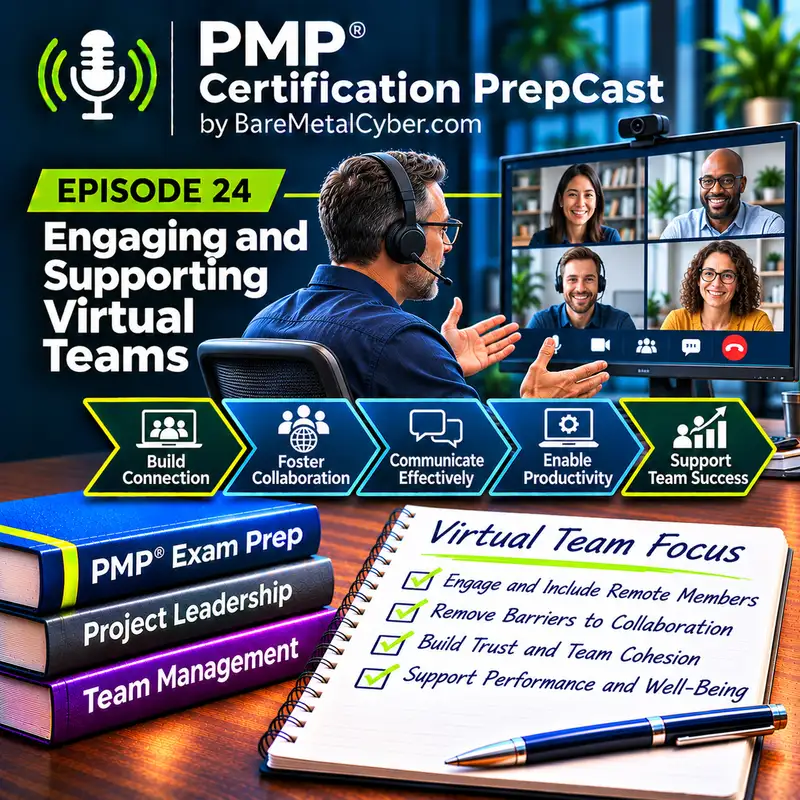
PMP 2026 | 24 | Engaging and Supporting Virtual Teams
A handoff can fail even when both teams work hard, especially when their working hours do not overlap. Supporting a virtual team means making the responsibilities, information, and communication usable across that distance. It is a practice within team leadership and communication in the current People domain, with links to knowledge transfer and issue resolution. Understand locations, availability, accessibility needs, and the work being exchanged. Then design the coordination around those conditions rather than trying to copy an office schedule into a series of video calls.
Welcome to Certified, the P M P prepcast. This is episode twenty four of season one. Today we are exploring how to engage and support people working in virtual teams.
The significance of this task is that project performance depends not only on technical expertise but also on how effectively distributed people stay aligned. A brilliant schedule will falter if one region does not understand deliverables from another, or if tone in an email sparks conflict due to cultural misinterpretation. Predictable flow arises only when distance barriers are managed intentionally. Clear handoffs mean the next region or person receives complete, accurate work without guesswork. Trust grows when teammates know their contributions are respected and visible, even if no one shares an office. On the exam, answers stressing inclusivity and structure usually reflect P M I’s philosophy.
Virtual teams face unique sources of friction compared to co-located ones. Misread tone in written communication can escalate tension. Overlapping edits in shared files cause rework. Lag in responses due to time-zone gaps slows decisions. Tool sprawl, using multiple platforms without standardization, creates version confusion. Security or compliance challenges arise when remote access is not properly governed. The project manager’s task is not to eliminate distance but to manage it so collaboration remains seamless. The P M P exam often presents these problems indirectly, requiring candidates to recognize them as virtual team impediments that demand structured solutions.
Inputs to supporting virtual teams begin with understanding the distribution of locations, time zones, and languages. Accessibility needs must also be considered, ensuring everyone can engage with tools and materials. Signals that performance is slipping include long delays in responses, duplicated or conflicting work, or growing meeting fatigue among team members. Other warning signs include undocumented decisions buried in chat threads and security risks from informal workarounds. The project manager must treat these as structural issues, not individual failings. On the exam, correct answers usually emphasize systemic fixes, clarifying norms, standardizing tools, or documenting decisions, rather than blaming individuals.
One clear signal of virtual team dysfunction is overlapping work. Without clarity on who owns what, multiple people may attempt the same task, often in conflicting ways. Another is rework created when expectations are misunderstood across regions. Meeting fatigue is a less obvious but equally damaging signal. When people spend hours on video calls that span time zones, productivity and morale both decline. Tool sprawl, multiple chat apps, file repositories, or task trackers, adds to confusion. The P M P exam rewards candidates who recognize these as signals of deeper process issues requiring structured remedies, not just “work harder” solutions.
Security and compliance concerns are heightened in virtual contexts. Remote work often requires extended access to systems, but without proper governance, sensitive information may be at risk. Signals here include ad hoc file sharing, requests for unapproved access, or vague accountability for data handling. A project manager must ensure compliance by embedding secure practices into daily routines. On the exam, distractors often suggest shortcuts like bypassing controls for speed. The correct answer emphasizes adherence to security and compliance, even if it requires more effort upfront. P M I consistently reinforces that value delivery must respect governance.
Design communication so people can contribute when they are available, using clear written information and explicit response expectations where that fits the work. Use live interaction when urgency, ambiguity, or the relationship benefits from it; an important decision can also use asynchronous preparation and an authorized recorded response. State the outcome needed, owner, deadline, and location of the current record. Make the format accessible and confirm understanding when it matters. The choice of channel should serve the decision and the people, not a rule that every message must be live or asynchronous.
An asynchronous exchange can support a decision when the evidence, responsibility, and deadline are clear. A live conversation may be better when participants need rapid clarification or an urgent coordinated response. Many situations benefit from a combination: a short decision package in advance, a focused discussion if needed, and a record afterward. Agree on the response route so different time zones do not create indefinite waiting. Ask about individual communication needs and avoid assuming that geography tells you how a person prefers to participate.
Consider a fictional product team with two groups that have only a short overlap in their working day. One group prepares configuration changes, and the other verifies them before release. The preparation group posts a message saying the change is ready, then signs off. The receiving group cannot tell whether ready means ready for review, fully tested, or authorized for release. It also cannot find the exact configuration version. The resulting delay is not evidence that remote workers lack commitment. It is evidence that the handoff does not carry the information the next responsibility requires.
The project manager and both groups define the handoff around a decision. The receiving reviewer needs the specific version, the intended behavior, the checks already performed, the observed results, known limitations, and the action requested. A link should point to an accessible authoritative record rather than a copy that may change independently. The sender identifies who can answer a question and when a response can be expected. This gives the receiver a useful starting point even when the sender is offline.
The team distinguishes acknowledgment from resolution. An acknowledgment means the receiver has seen the handoff and understands what is requested. It does not mean the review has passed or that a release is approved. The team defines how an incomplete handoff is returned and how an urgent blocker reaches the appropriate owner. These distinctions reduce the risk that a short message, such as received or looks fine, is interpreted as a decision it was never intended to communicate.
The first test of the new arrangement uses a real but bounded work item. The receiving group follows the record without relying on a private explanation from the sender. It identifies a missing test condition, so the team improves the handoff before making it the normal process. A template is useful only if the receiver can use it. Publishing a longer form without testing that practical result could simply move the confusion into more fields.
“Document once, link many” is a principle that addresses tool sprawl and version confusion. Rather than storing different versions of documents in multiple places, the project manager ensures a single authoritative version exists, and links are shared wherever needed. This ensures that everyone, regardless of location or tool preference, is working from the same reference. It also supports governance, because decisions and artifacts are visible and auditable. On the exam, the correct answer usually includes consolidating sources of truth rather than proliferating tools or duplicating documents across systems.
The process of supporting virtual teams begins with co-creating norms. This includes agreeing on time-zone windows for overlap, setting expectations for response times (sometimes called service-level agreements, or S L A's), and defining meeting practices. Standardizing tools and file locations prevents confusion and accelerates onboarding. Naming conventions and versioning rules make collaboration seamless. Decision logs and change logs ensure that agreements do not vanish into email threads. Finally, publishing a calendar of rituals, standups, retrospectives, demos, or governance reviews, creates predictable rhythm. On the exam, correct answers often emphasize co-created norms and artifact visibility, not ad hoc fixes.
Involve the team in choosing practical collaboration rules within the requirements it must follow. Members may identify an overlap window for urgent coordination, a way to hand off evidence, and a route for decisions that cannot wait. An example of two shared hours is a possible local arrangement, not a required standard. Review whether the arrangement works after a change in membership, workload, or dependency. Mandatory access or conduct rules still apply even when the team would prefer something more convenient.
Reduce uncontrolled duplication and make the location and owner of each authoritative record clear. Some teams can use one repository; others need several approved systems because of contractual, operational, or access boundaries. Define how the records connect and how current decisions are communicated. Use naming and version practices that people can follow, and include them in onboarding. Review the arrangement when evidence shows confusion or conditions change, rather than assuming one tool or a monthly meeting will solve every coordination problem.
Time references should be unambiguous in the work record. Instead of saying please respond tomorrow morning, the sender can identify the agreed date, time reference, and requested decision. The team also needs to distinguish a person's working availability from an urgent-response arrangement. An ordinary message arriving outside someone's working period should not silently create an expectation of continuous availability. Where urgent coverage is required, the organization should define and support that responsibility explicitly.
A distributed schedule needs to account for waiting at the interface. Suppose a missing clarification causes an item to wait until the sending group next returns. If the same ambiguity recurs at another handoff, the project can lose more time waiting than performing the work. The improvement is not necessarily a longer overlap meeting. It may be a clearer handoff, an authorized decision closer to the work, or better preparation before the overlap begins. The team should investigate the actual source of delay rather than assume distance itself is the only cause.
Some decisions benefit from asynchronous preparation followed by a short live discussion. Participants can read the options and record questions in advance, leaving the shared time for the unresolved trade-off. Other decisions can be made by the authorized owner from a complete written package. The project manager should identify what interaction the decision needs and make the result visible afterward. A live call with no usable record can be less effective than an asynchronous decision that everyone can find and understand.
Availability changes also belong in the coordination design. If the normal receiving reviewer is on leave, a message sent to that person may satisfy the sender's habit while leaving the work unattended. The team needs to identify an authorized coverage arrangement and make it visible before relying on it. A substitute must have the necessary access, capability, and decision authority; simply copying another person does not establish those conditions.
The same care applies when a supplier's working calendar differs from the internal team's calendar. A response expectation should state the relevant working period rather than assume that every organization is available on the same days. When a critical dependency falls outside normal coverage, obtain an explicit arrangement through the responsible owners. This turns an implicit expectation of someone being available into a planned and supportable commitment.
Artifacts and rituals serve as anchors for virtual team alignment. Working agreements record norms on response times, meetings, and communication channels. Shared calendars coordinate across time zones, while handoff checklists prevent dropped work. Asynchronous status updates keep progress visible, while live decision reviews maintain trust and alignment. Demos and retrospectives provide cadence for feedback and improvement. Onboarding playbooks guide new hires through setup, tools, and culture. Virtual social touches, casual check-ins or non-work conversations, build trust and human connection. The P M P exam often rewards answers that include these rituals and artifacts rather than relying only on formal reports.
Trust is the hidden currency of virtual teamwork, and rituals help sustain it. When people feel included in decisions, see their contributions recognized, and experience predictable collaboration, trust grows. Conversely, when handoffs fail, decisions disappear, or access is inconsistent, trust erodes quickly. Virtual social touches, brief time for personal sharing or recognition, compensate for the absence of hallway conversations in co-located teams. On the exam, correct answers often reflect the importance of trust-building rituals, not just technical fixes. P M I stresses that high-performing virtual teams depend on human connection as much as structure.
The first part of the lesson has focused on making coordination usable across distance. The next part examines how that arrangement interacts with delivery frameworks, access controls, and real handoff failures. Keep asking what the receiving person needs to do, what information supports that responsibility, and which conditions change the response.
For a Scrum team, make the required events workable for the distributed participants while preserving their purpose and applicable timeboxes. Other adaptive teams may use different coordination practices. A predictive team can also move routine information to a clear written update and reserve a live conversation for an issue that benefits from discussion. Do not reduce every remote problem to a demand for shorter meetings; sometimes the missing element is access, evidence, or a decision owner. Keep the method connected to the work it must enable.
Participation also needs deliberate design. In the fictional team, one participant consistently contributes useful observations in writing but rarely speaks during a fast-moving call. The manager should ask what would make participation easier rather than infer disengagement. Advance material, a slower discussion pace, a written question route, or a clearer opportunity to contribute may help. The solution should follow the person's needs and the work, not a stereotype about their location, accent, or preferred communication style.
A shared meeting can still exclude people when key discussion occurs afterward among a smaller co-located group. If that discussion changes a decision, the remote participants need the current authorized outcome and its rationale. Otherwise, the formal meeting becomes theater while the real project operates through an invisible channel. The manager should make the decision route explicit and ensure relevant evidence is considered before the decision, not merely announce the result after excluded participants can no longer contribute.
Rotating inconvenient meeting times may distribute a burden more fairly, but it does not make an excessive meeting load useful. The team should first ask who needs to participate and what requires live interaction. It can then agree on a manageable arrangement for the necessary overlap. Accessibility, permitted tools, and confidentiality still apply. A convenient consumer application is not automatically an acceptable place to discuss restricted project information.
Keep the relevant records consistent without assuming every backlog refinement changes a baseline. A clarification or ordering choice within an approved boundary may stay within the team's product process. A change to a committed date, contract, funding condition, or mandatory requirement needs the appropriate decision route. Distributed stakeholders should be able to see which kind of change occurred and which record is current. This protects shared understanding without producing unnecessary parallel changes in unrelated documents.
Use approved access and data-handling arrangements for remote work. Grant the access needed for the role, use the required authentication and device controls, and remove access when it is no longer authorized. Multi-factor authentication can reduce particular access risks but does not guarantee that a session or dataset is safe. Redaction or de-identification must be suitable for the intended sharing and accepted by the responsible data owner or control process; the label alone is not permission. Record required exceptions and approvals and make the rules usable in everyday handoffs.
Offboarding should check whether each access right remains authorized after a person changes role or leaves the work. Unneeded retained access creates exposure even when there is no evidence that it has been misused. Follow the responsible process to remove or adjust it and preserve the required record. The same attention applies to shared links, supplier access, and information posted in communication channels. Make the responsibility explicit so secure handling does not depend on somebody remembering an informal promise.
Consider a scenario: an Asia-based team completes work overnight, but the U S-based team redoes the same task because acceptance criteria were unclear. Options include mandating more meetings across time zones, assigning a liaison to double-check handoffs, creating and publishing an asynchronous acceptance criteria template with examples and scheduling a brief overlapping review slot, or escalating to the sponsor. The best next action is to publish the acceptance criteria template with examples and provide a short overlapping review window. This addresses the root cause, unclear criteria, while protecting time zones. On the exam, correct answers usually favor structural fixes over meeting overload or escalation.
In a predictive version of the handoff problem, use the agreed requirement and acceptance evidence to clarify what the receiving team should inspect. In another approach, that information may be attached to a work item or handoff record. Confirm that the receiving people can find it, understand it, and use it to avoid duplicate work. If the clarification reveals a proposed change to an approved requirement, follow that route separately. The useful fix is a clear and tested handoff, not simply a more formal-looking document.
Now change the handoff facts. The receiving team has the correct version and clear acceptance conditions, but lacks permission to open the test evidence. Rewriting the template again will not solve the access problem. The project manager needs the responsible access or data owner to provide a permitted route. The team should not paste restricted evidence into an open chat simply because the approved repository is inconvenient. A useful coordination improvement preserves the information boundary as well as the delivery objective.
In another variation, both groups can access the evidence, but two authorized systems show different status because one has not been updated. The project manager identifies which record controls the decision, who maintains the linked status, and how updates will be synchronized. The organization may genuinely need both systems, for example because a supplier and an internal team have different access boundaries. Consolidating everything onto one platform is not automatically feasible or necessary. The important outcome is a consistent, traceable account of the work.
A final variation concerns an urgent condition that requires immediate coordinated action under an established procedure. Waiting for the next normal overlap window would be inappropriate. The team should use the designated urgent route and record the relevant actions through that process. This illustrates the limit of any asynchronous-first preference: a collaboration practice must serve the situation and its obligations, not become a rule that delays the response the project actually needs.
Exam pitfalls often center around defaulting to “more meetings” as the fix for every virtual problem. While live meetings are sometimes necessary, relying on them excessively drains productivity and excludes time zones. Another pitfall is allowing tool sprawl, adopting multiple platforms without training or standards, which confuses teams and undermines efficiency. Ignoring accessibility needs or time-zone fairness is another trap; P M I consistently emphasizes inclusivity. Finally, undocumented decisions hidden in chat threads leave teams uncertain and erode trust. On the exam, these pitfalls often appear as tempting shortcuts. Correct answers emphasize structured fixes, inclusivity, and artifact visibility.
If meetings consume too much of the available overlap, examine which exchanges actually need live participation. Some can become clear written updates, while others may need better preparation, fewer participants, or a defined decision owner. Also check whether the selected tools and formats are accessible and permitted. Rotate unavoidable inconvenience fairly and agree on response expectations outside the overlap window. The improvement should address the observed barrier rather than automatically adding meetings or converting every decision into an asynchronous message.
Identify the information and decisions that must cross team boundaries, then agree on accessible channels, response windows, and escalation conditions. Make the current record and its owner easy to find. Verify that tools and access fit the applicable requirements, working with the responsible security or administrative roles. Include the arrangement in onboarding and test it with a real handoff. Inspect the result and adjust what the evidence shows needs improvement, including both the technical process and how people participate.
Remote etiquette is an often-overlooked component of this playbook. For example, clarifying norms about response times, meeting participation, and documentation reduces friction. Training new hires in these expectations prevents early missteps. Etiquette also includes small touches, like pausing for interpretation in mixed-language meetings or avoiding jargon that confuses non-native speakers. These micro-behaviors foster inclusion and reduce misunderstandings. The exam sometimes embeds clues about cultural or linguistic friction. Correct answers emphasize respectful communication and structure that makes remote collaboration sustainable.
For review, take the phrase the change is ready and rewrite its meaning without using the word ready. State what has been completed, what evidence exists, what remains undecided, and what the receiving person should do next. Then identify which statement belongs to technical completion, which belongs to acceptance, and which belongs to release authority. A precise handoff prevents one phrase from carrying three different commitments.
Measure the improvement through the receiving work. Are fewer items returned for missing information? Can reviewers begin within the agreed window? Are decisions recorded where affected people can find them? Is the team avoiding duplicate work without increasing unauthorized information sharing? A shorter message or a smaller meeting calendar is not sufficient proof on its own. The objective is a handoff and decision process that works across distance while respecting the people and controls involved.
Virtual teamwork needs clear responsibilities, usable information, and respectful access to the conversations that matter. Live and asynchronous communication can each help when chosen for the situation. Keep handoff evidence current, confirm important interpretations, and preserve the access and data conditions that govern the work. Test whether the receiving team can actually use the arrangement rather than assuming the tools make it effective. The next episode turns to team ground rules, where these expectations become practical agreements people can apply every day.
For more certification study resources, books, and podcasts, visit Bare Metal Cyber dot com. Thank you for listening to Certified, the P M P prepcast.