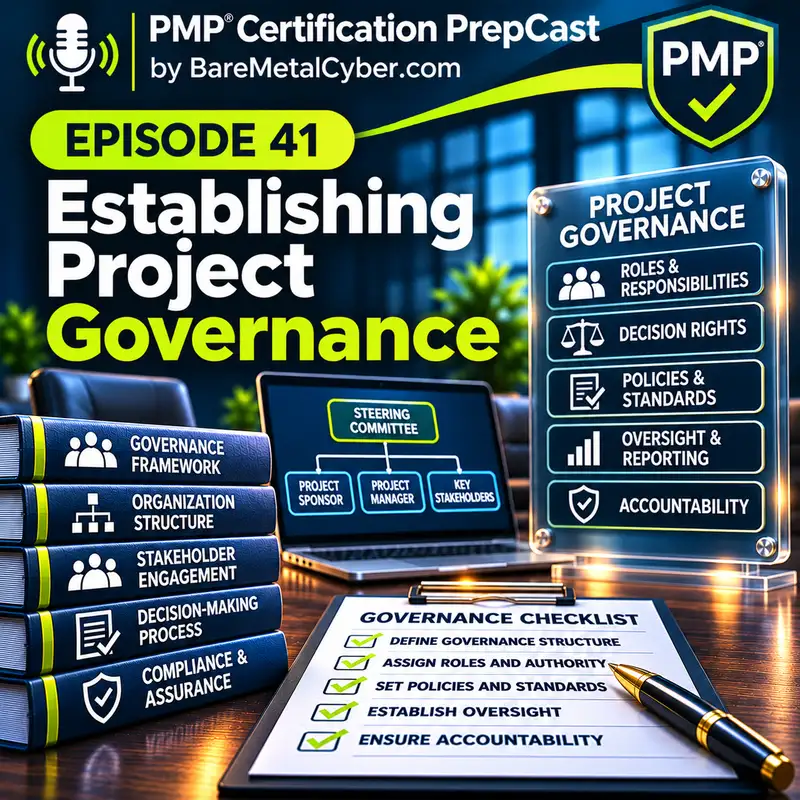
PMP 2026 | 41 | Establishing Project Governance
Governance is the framework of authority and accountability used to direct a project toward organizational goals and intended value. It defines who makes decisions, how those decisions are made, and how performance is monitored. Clear governance can reduce confusion about priorities and changes, but it does not guarantee delivery of benefits or prevent disagreement. Defining and establishing governance is a Business Environment responsibility in the current outline. It provides a basis for decisions, evidence, ethics, and accountability, including a decision to redirect or stop a project when continuing is no longer justified. On the exam, unclear authority or conflicting sponsor directions are reasons to examine the decision rights and resolve the specific uncertainty.
Welcome to Certified, the P M P prepcast. This is episode forty one of season one. Today we are exploring how to establish project governance and clear decision responsibilities.
The purpose of project governance is to create an orderly system where responsibilities are distributed, and escalation paths are visible. It protects the project manager by ensuring decisions happen at the right level, not through improvisation. Governance also protects stakeholders by providing transparency: no one can claim ignorance of how decisions are taken or who has authority. A strong governance structure helps the project survive leadership changes, resource conflicts, and shifting organizational politics. For a scenario, use the available decision rights and the urgency of the situation. A governance record helps clarify authority; it should enable useful action rather than become a reason to postpone an already authorized response.
The project manager’s stance is that of an integrator and steward. You can make decisions within your delegated authority and help the wider governance arrangement function. Sponsorship, release, funding, and other reserved decisions remain with their named owners. That means helping to define bodies such as steering committees, clarifying thresholds for approvals, and maintaining the logs and artifacts that record decisions. It also means coaching stakeholders in their roles: sponsors must sponsor, committees must steer, and change boards must control. P M I emphasizes that governance is as much about behavior as it is about structure. On the exam, the correct answers emphasize setting up systems, not making every decision personally.
Governance structures revolve around clearly defined roles and bodies. The project sponsor is the senior leader who champions the project, secures funding, and provides top-level decisions. The steering committee, sometimes called a governance board, provides cross-functional oversight, ensuring the project aligns with strategy and resolving conflicts that exceed the project’s scope. The change control board, or C C B, focuses specifically on reviewing and approving changes to baselines. These are possible arrangements, not three bodies required on every project. The charter and applicable policy establish which roles or bodies exist and their actual decision rights. Without clarity, committees overlap and waste time. On the exam, when asked “who decides what,” the key is to match the right body to the right decision domain.
The sponsor links the project to organizational priorities and supports decisions beyond the project manager’s delegated authority. Responsibilities can include securing resources, resolving competing priorities, and owning important funding or direction choices. The actual governance arrangement determines those powers. A project manager may make significant decisions inside a clear delegation, while even a low-cost change can require another authority if it affects a protected commitment. Identify the decision and its owner rather than assuming that its apparent size automatically requires the sponsor or a committee.
A steering committee can provide collective oversight when the project's governance uses that arrangement. Its remit may include strategic direction, significant risks, and decisions that cross stakeholder boundaries. Membership, decision rights, conflicts of interest, and escalation routes need to be clear. Bringing several stakeholders together does not by itself prevent domination or produce agreement. The project manager can facilitate discussion and make decisions within delegated authority. Refer a matter to the steering committee when it belongs within that body's remit, and use another authorized route when the governance requires it. On the exam, a multi-stakeholder conflict does not automatically call for a committee meeting; identify the unresolved issue and who has authority to address it.
The change control board, or C C B, focuses specifically on scope, cost, and schedule baselines. It reviews the required impact information and decides within its authority; the team and relevant specialists may prepare that analysis. The C C B prevents scope creep by ensuring every change is deliberate and documented. Smaller projects may use lightweight versions of the C C B, with thresholds for what the project manager can approve. Larger projects may have formal boards meeting on cadence. On the exam, stems that describe uncontrolled additions to scope often test whether you recognize the C C B’s role in protecting baselines.
Decision rights mean clarity about who can decide what, within which boundaries, and with what evidence. A project manager might control sequencing within an approved commitment, while a sponsor controls a public opening date. A release authority might own a mandatory acceptance condition, and a financial owner might approve additional funding. Those are examples, not required roles on every project. A board or steering group may serve a purpose where the organization uses one. Communicate the applicable map and act within it, escalating promptly when the decision sits elsewhere.
Thresholds reinforce decision rights by providing crisp boundaries. The percentages and durations that follow are invented illustrations, not P M I rules or automatic approval limits. A cost variance of five percent may be within the project manager’s authority, while a ten percent variance requires sponsor approval. A schedule delay of one week may be handled by the team, while a month’s delay requires steering committee review. Thresholds prevent ambiguity and ensure escalation happens only when necessary. Without thresholds, either too much is escalated, causing delays, or too little is escalated, causing risks. On the exam, stems about “project manager decides on a million-dollar scope change” are traps. The correct answer emphasizes thresholds and escalation.
Decision rights and thresholds must also extend to change management. Predictive projects use formal thresholds for changes: decisions inside delegated authority follow that route, while protected baseline commitments use their designated approval authority. Agile projects use backlog policies to handle scope, but still set thresholds for governance approvals, such as budget increases. Hybrid projects use both. The point is that governance ensures no one improvises thresholds on the fly. On the exam, correct answers emphasize applying thresholds consistently, not adjusting them ad hoc to satisfy stakeholders.
Governance also requires cadence. Cadence refers to the rhythm of decision-making forums. Steering committees may meet monthly, change boards weekly, and sponsors on demand. The project manager aligns these cadences with project risk and pace. A high-risk project may need more frequent reviews; a stable project may need less. Cadence ensures decisions are timely and predictable. Without cadence, decisions bottleneck or come too late. On the exam, distractors often describe ad hoc decision-making. The correct answer usually emphasizes defined cadences aligned to project needs.
Artifacts anchor governance by recording decisions and keeping them visible. A decision log is essential, showing what was decided, by whom, and with what rationale. Change logs record requests, impacts, and outcomes. Risk and issue logs link to escalations. Meeting minutes from governance bodies capture context and commitments. Together, these artifacts provide traceability and audit readiness. P M I emphasizes that governance is as much about evidence as authority. On the exam, stems describing “stakeholders disagree on what was decided” point to missing decision logs. The correct answer emphasizes updating and referring to governance artifacts.
Governance is not only about efficiency, it is also about ethics. Governance structures must ensure that decisions are made responsibly, respecting fairness, honesty, respect, and accountability. Ethical governance means no hidden deals, no favoritism, and no bypassing thresholds to benefit one party. Transparency is critical. P M I emphasizes that ethics underpin governance just as much as processes do. On the exam, stems about “favoring one stakeholder” or “concealing approvals” test this principle. Correct answers emphasize fairness, transparency, and documented decisions.
Governance assigns responsibility for identifying and addressing applicable regulatory, contractual, and organizational obligations. Depending on the project, these may include audit records, procurement requirements, financial reporting, or adopted industry standards. Relevant specialists and decision owners need reliable information about compliance implications and unresolved gaps. If auditors cannot find evidence, determine what record is required, whether reliable evidence exists elsewhere, and whether the underlying activity actually occurred. A missing mandatory record can itself be a compliance gap, but an unsuccessful search does not by itself prove that the control failed. Correct the verified problem through the applicable process and preserve an accurate account of what is known. On the exam, the facts determine whether the next action concerns retrieval, recording, control performance, or a required notification.
Before applying governance to the book's service-center case, consider a separate fictional volunteer-training program. The project has a sponsor, a project manager, a curriculum owner, a finance approver, and an operations owner who will run future sessions. These people do not form five mandatory committees. They hold different responsibilities that the organization has chosen to assign. The governance question is whether the necessary decisions have clear owners and boundaries, including when one person holds more than one role.
The project manager has authority to sequence approved preparation work and use specified resources within the agreed plan. The curriculum owner approves learning content. Finance authorizes commitments above a stated purchasing limit, and the sponsor decides changes to the public launch date or overall outcome. Operations accepts the continuing scheduling and support responsibilities. This map should describe decisions in usable language. A responsibility chart that says everyone is consulted on everything would not tell the team who can approve a revised lesson or commit money to an additional venue.
Now give the team a proposed decision rather than an abstract chart. A trainer wants to replace one exercise with a more effective activity using the same time and approved materials. The curriculum owner can decide within the stated content authority, with any required checks. If the replacement requires a new paid service, the purchase may introduce a separate financial decision. If it also collects participant information, the relevant information-handling authority may need to assess that use. Approval of educational content does not automatically approve spending or data handling. The manager coordinates the decisions without merging their boundaries.
Suppose the purchasing policy delegates individual purchases up to two thousand dollars, subject to explicit conditions. A vendor offers one integrated package for six thousand dollars and suggests sending three invoices of two thousand. Splitting the paperwork does not change the substance of the commitment. The manager should use the policy's actual aggregation and approval rules rather than treating invoice size as permission to bypass authority. These invented amounts are not P M I thresholds. Their purpose is to show why a threshold must be interpreted with its scope, conditions, and the action it authorizes.
A reporting threshold has a different function. The plan might require notifying the sponsor when forecast cost exceeds the baseline by a specified percentage. Crossing that point triggers the defined notification; it does not necessarily authorize the manager to spend the difference or automatically cancel the project. Likewise, remaining below it does not make an otherwise unauthorized purchase valid. Governance can contain several thresholds for different actions. A useful record distinguishes permission to act, a duty to report, a condition for release, and a trigger for a new investment decision.
The arrangement also needs a route for unavailable decision makers. Imagine that a venue option expires on Friday, but the named finance approver is away until the following week. The manager should identify the latest useful decision date early and use an established deputy or escalation route if one exists. Silence is not approval, and another senior person's casual agreement is not necessarily a valid substitute. If no authorized route exists, surface the gap promptly so the responsible authority can resolve it. Good governance anticipates absences instead of discovering them only when a commitment is about to expire.
A board's procedure can create the same problem. If a decision requires a quorum or a specified specialist's participation, a meeting with insufficient attendance may produce discussion but not a valid approval. Record that distinction. The project manager can circulate the evidence and seek the permitted follow-up decision without reporting that the board approved merely because nobody objected. Where the rules allow a delegated or written decision between meetings, use that route transparently. The goal is timely legitimate decisions, not loyalty to a meeting date that cannot meet the project's needs.
Conditional decisions require particular care. A sponsor may approve a pilot only after operations demonstrates that a qualified facilitator and the required materials will be available. That is not permission for a full launch immediately. Name who verifies the condition, what evidence satisfies it, and what scope the approval covers once effective. If the condition changes, determine whether the original decision still applies. Conditional approval without a verification owner is a common source of contradictory interpretations: one group hears approved, while another assumes work is still waiting.
Leadership turnover should trigger a similar authority check. Suppose the sponsor leaves and a new leader begins questioning previously approved commitments. Preserve the existing decision history, confirm the current authority and any changed direction, and explain the consequences of reopening choices. Do not erase earlier approvals or assume that every decision automatically expires. Equally, do not continue using a delegation that has actually been withdrawn. The organization needs an orderly transition of authority, with open decisions and obligations made visible to the successor.
Oversight should examine whether the project remains worth doing, not only whether it follows its original plan. If the volunteer program's intended audience can no longer attend the proposed schedule, completing the curriculum on time may not produce the expected value. The manager brings evidence, alternatives, remaining costs, and obligations to the appropriate decision owner. Options may include changing delivery, pausing, reducing scope, or stopping. Money already spent is part of the history, not by itself a reason to spend more. The manager supports the investment decision while respecting who is authorized to make it.
There are also boundaries to what a governance body can waive. A sponsor may have authority to accept a stated project risk without having authority to disregard an applicable law, contract, or mandatory organizational control. Where an internal exception process exists, use its actual scope, conditions, and decision owner. Where the obligation permits no such exception, willingness to accept the consequence is not compliance. The project manager should obtain the appropriate specialist input rather than presenting risk acceptance as a universal way to make an inconvenient requirement disappear.
Finally, assess the governance system itself through observable results. Are decisions reaching the right owner? Do requests arrive with enough evidence? Are approval conditions understood? Do teams wait for signatures that are not actually required, or commit work before required decisions exist? These observations can identify a need for clearer delegation, better information, or a faster authorized route. Removing an unnecessary approval can strengthen governance by focusing attention on decisions that matter. The objective is responsible direction with usable evidence and follow-through, not maximizing the number of approvals collected.
A decision threshold also needs a meaning. A variance threshold may trigger a report or a discussion without granting permission to spend money or change the plan. A spending limit authorizes a different action. A release criterion can prohibit release until evidence exists, regardless of how little the remaining work costs. Read the verb attached to the threshold: report, consult, approve, stop, or escalate. Otherwise, a team can see the right number and take the wrong kind of action.
Chapter thirty-six of P M P for Busy People gives us a service-center example that makes these distinctions concrete. The organization wants a better appointment system that reduces waiting, preserves an assisted route for residents who cannot use the website, and controls support costs. All the roles and results in this example are invented teaching data. A release that looks efficient because it removes assisted access would undermine the agreed purpose. The project manager must connect the technical plan with the people the service exists to serve.
The authority record names several different decisions. The Product Owner can order unstarted features inside the approved outcomes and release limits. The sponsor decides any change to the public opening date. A separate release authority confirms that all mandatory release criteria have been met. A named data and tool authority must approve a new A I service before restricted information is sent to it. The steering body decides funding beyond the delegated budget. One person's permission does not cover another person's decision simply because both concern the same release.
Suppose reminder messages could move ahead of a reporting feature. If that ordering remains inside the approved release limits, the Product Owner can use the delegated decision right after reviewing value and dependencies. If the change would also postpone the public opening, the sponsor must decide that commitment. Prepare a joined-up recommendation so the two decisions inform one another, but do not confuse their authorities. Backlog ordering does not silently move a public date, and a sponsor's enthusiasm does not replace the release evidence.
The pilot scorecard contains four different measures. Median check-in wait started at eighteen minutes, with a target of twelve minutes or less by week eight. Current evidence shows eleven minutes across two hundred visits. Assisted-route task success started at eighty percent, with a requirement of at least ninety percent before rollout. The pilot completed seventeen of twenty observed tasks successfully, or eighty-five percent. The faster check-in result is encouraging, but the assisted route has not yet met its stated condition.
Staff independent task success has a separate before-rollout target of at least ninety percent. Its current result is thirty-six successful tasks out of forty, exactly ninety percent; no starting measurement was available. Monthly support demand began at one hundred twenty hours, with a target of one hundred or less after stabilization. The current figure is a forecast of one hundred eight hours, not an observed operating result. Keep the measurement population and timing attached to each number so listeners can tell what the evidence actually supports.
Before calling the project green, identify which decision is due. For rollout, the assisted-route result matters because its requirement applies before rollout. Three of the twenty observed tasks failed. The staff result meets its stated numerical target, but it does not erase that separate access gap. The future support forecast also cannot be presented as a measured achievement. Averaging all four measures into a favorable overall color would conceal differences that the decision owner needs to see.
A bounded recommendation is possible without pretending everything failed. Preserve the waiting-time design that produced the promising result, investigate the assisted-route failures, and arrange another representative check before the wider rollout decision. The responsible lead needs to determine what caused the failed tasks and what correction is appropriate. The release authority then considers the actual evidence under the agreed criteria. If the public date needs to change, bring that connected decision to the sponsor. Each action has an owner and an evidence requirement.
Now consider an attractive shortcut: an A I tool writes that the pilot met its success targets. The project manager must verify that sentence against the four records we just discussed. Did the tool distinguish the assisted-route percentage from the staff percentage? Did it label the support figure as a forecast? Did it preserve the different target dates? The accountable person corrects unsupported claims before the report informs a decision. Permission to use the tool and permission to disclose the underlying data must also be established.
Good governance also keeps disagreement useful. The access lead, operations owner, and sponsor may place different emphasis on the results, but their roles do not justify concealing inconvenient evidence. Ask what decision each person owns, what condition must be satisfied, and what alternatives are available. A mandatory obligation cannot be waived merely because the sponsor is willing to accept risk. Where an internal rule allows an exception, record the authorized scope, conditions, owner, expiry, and verification requirements instead of relying on a broad verbal assurance.
The same discipline applies to conflicts of interest. If an evaluator has a close family connection with a bidder, disclose the relationship promptly and follow the conflict process before influencing the affected decision. Disclosure alone does not automatically authorize continued participation. On the other hand, an openly priced pilot in a supplier proposal is not automatically a personal gift or bribe. Examine the beneficiary, the procurement rules, and the evidence. Fair governance depends on the actual arrangement, not the emotional force of a label.
Finally, test whether decisions arrive in time to matter. A committee that meets after a supplier commitment must be made offers little practical control over that commitment. Set a latest useful decision date, an evidence owner, and an escalation route for delay. If a leadership change leaves authority unclear, confirm and communicate the replacement rather than assuming yesterday's delegation still applies. Periodically review whether people are using the intended route or creating unofficial workarounds because the formal one is too slow.
Governance works when the purpose, evidence, authority, and follow-through remain connected. In the service-center example, that means protecting assisted access as well as reducing waiting, reading each measure in its proper context, and routing feature, date, funding, data, and release decisions to the right owners. Apply that pattern to a new scenario by asking what must be decided now, what the evidence proves, and who can act. A clear decision with an accountable owner is more useful than a reassuring label or an impressive stack of reports.
For more certification study resources, books, and podcasts, visit Bare Metal Cyber dot com. Thank you for listening to Certified, the P M P prepcast.