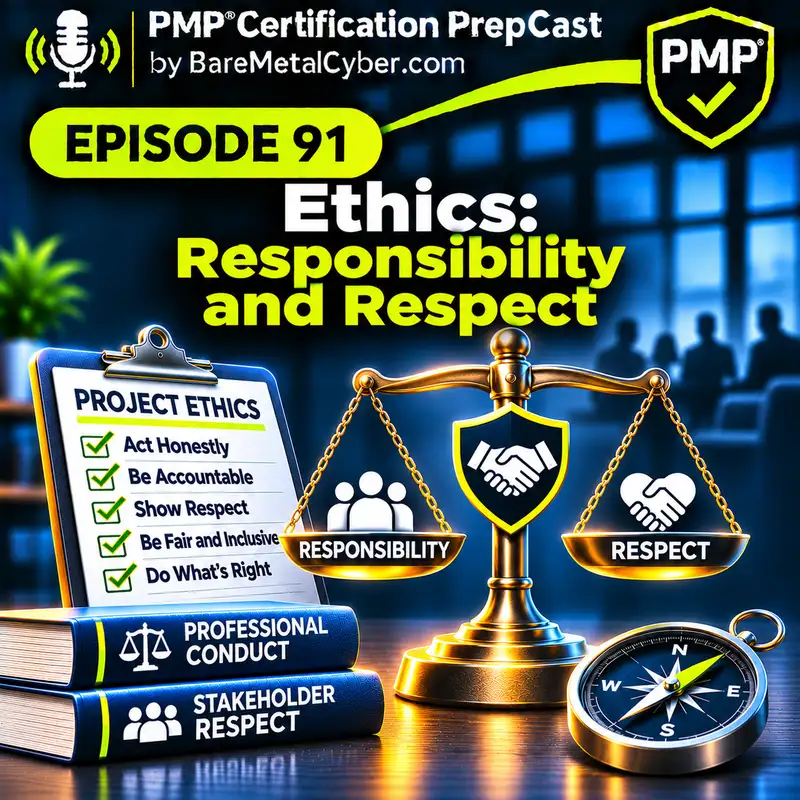
PMP 2026 | 91 | Ethics: Responsibility and Respect
Project decisions affect people as well as scope, schedules and budgets. The P M I Code of Ethics identifies responsibility, respect, fairness and honesty as foundational values. This episode concentrates on responsibility and respect in project situations involving mistakes, pressure and human dignity. These values guide conduct, but their application still requires attention to the actual facts, obligations and role boundaries.
Welcome to Certified, the P M P prepcast. This is episode ninety one of season one. Today we are exploring responsibility and respect in difficult project decisions.
Responsibility in the P M I framework means accepting ownership for the decisions you make, the actions you take, and the outcomes they create. It means you cannot hide behind “the process required it” or “the team decided” when consequences are harmful. True responsibility includes disclosing risks as soon as they are known, identifying constraints honestly, and raising conflicts early so stakeholders can adjust. It also means correcting errors openly and following through on commitments. Responsibility is seen when project managers are transparent about what is possible and courageous about delivering bad news promptly, even when it makes conversations difficult.
Respect, by contrast, is about how you treat people while managing those outcomes. Respect means consistently affirming the dignity of every individual you interact with. It requires creating an environment where people feel safe to speak, where cultural differences are considered, and where language is chosen thoughtfully. In global or hybrid teams, respect is reflected in how meetings are scheduled across time zones, in how feedback is given across cultural lines, and in how disagreements are framed. Disrespect is toxic because it shuts down voices, leading to blind spots and risks that surface too late. Respect is the soil in which responsibility can actually grow.
To see responsibility in practice, imagine you identify a high probability risk late in planning. Responsibility means you disclose it promptly to stakeholders rather than delaying in the hope it will diminish. It also means recording it in the risk register, assigning an owner, and presenting response options transparently. If that risk becomes an issue, responsibility means accepting accountability for the decision path you took, not shifting blame to the team or the vendor. Teams and sponsors may not enjoy hearing bad news, but they will respect you if you demonstrate ownership and a commitment to corrective action.
Responsibility also includes handling commitments. If you promise to deliver a report, responsibility means ensuring it is completed on time and at the expected quality. If delays occur, responsibility means communicating them early, not waiting until the deadline has already passed. And when mistakes are made, responsibility does not mean hiding them, it means admitting them, analyzing root causes, and showing visibly how you will prevent a recurrence. This is what turns errors into trust-building moments. Project leaders who practice responsibility consistently are seen as reliable, even when outcomes are not perfect.
Explore responsibility through an original fictional reporting mistake. A project manager sends a sponsor a forecast showing a two-week recovery. Later that afternoon, the manager discovers that the calculation omitted a required external review. The corrected model no longer supports the promised date. Nobody else has noticed, and a colleague suggests waiting until the team finds a workaround. The ethical question is not whether the manager intended to mislead. It is how to respond now that the report is known to be materially incomplete.
First establish the correction clearly enough to communicate what is known. Identify the omitted review, the affected forecast and the recipients who may rely on the earlier report. Notify the appropriate people promptly with the corrected information and the uncertainty that remains. A recovery option can be investigated in parallel, but its possibility does not make the existing report accurate. Do not quietly replace the file and hope nobody notices that the commitment changed.
A responsible correction can be direct without becoming a public performance of self-blame. Explain that the earlier forecast omitted the required review, state the revised consequence and describe the follow-up. Own the part of the error that belongs to your role. Do not imply that the analyst caused it merely because the analyst assembled the data, and do not claim sole responsibility for decisions controlled by others. Accountability is accurate assignment of responsibility, not shifting blame or taking credit for control you never had.
The sponsor may be angry because a customer briefing already used the original date. That reaction does not justify concealing the correction. Help the sponsor identify the affected commitment and prepare an accurate update through the proper channel. Avoid promising that the team will recover the difference before feasibility is established. An apology is appropriate where warranted, but it does not substitute for correcting the decision information and carrying through the agreed response.
Then investigate how the omission occurred. Perhaps the review existed in a separate supplier schedule that was never integrated, or the reporting template encouraged a single date without showing assumptions. Correcting the particular forecast addresses the instance. Improving integration or review practices addresses a contributing cause. Do not declare the learning complete because an apology was accepted. Verify whether the revised process actually includes the dependency in subsequent forecasts.
Respect in communication begins with active listening. This means making the effort to understand before seeking to be understood. In practice, it looks like summarizing back what a stakeholder has said, asking clarifying questions, and resisting the urge to interrupt. It also means avoiding sarcasm, jokes that rely on stereotypes, or dismissive phrases that can alienate colleagues in remote or cross-cultural teams. Respect in language means choosing neutral, professional words that critique ideas without attacking people. Documenting agreements in neutral language reinforces this respect, because it shows you value clarity and fairness over spin or favoritism.
Consider a situation where a sponsor is frustrated about slippage. Respect in communication means you acknowledge the frustration, demonstrate that you have heard the concern, and then redirect to the evidence in your schedule and risk logs. It does not mean dismissing their concerns or returning frustration with defensiveness. Respect also means ensuring quieter voices are invited into the conversation. In virtual teams, respect is seen when you pause to ask those who have not spoken for their input, or when you check in with colleagues in different time zones whose voices might otherwise be missed. These small moves protect inclusion and balance.
Power differences can make it difficult to raise concerns. A respectful leader invites relevant voices, provides accessible routes to report issues and follows the applicable protections against retaliation. Do not promise anonymity or an outcome you cannot control. Explain who may need to receive information and how it will be handled. Facilitation can help people contribute, while serious allegations may need the designated reporting process. Supporting a safer environment requires action as well as reassuring words.
Explore respect through a fictional distributed design team. A junior contributor says that a proposed workflow will exclude some users, but a senior participant repeatedly interrupts and jokes that the concern is too theoretical. The facilitator has two responsibilities at once: restore a respectful discussion and ensure the substantive concern is evaluated. Simply thanking the junior contributor after the meeting does neither fully. The concern may affect requirements, and the behavior may discourage other useful evidence from surfacing.
For this ordinary meeting interruption, the facilitator can pause the discussion, restate the ground rule and give the contributor space to explain the evidence. Ask what user task fails, under what conditions and how the team can verify it. Avoid treating the contributor's status as evidence against the claim. Also avoid declaring the design defective before the facts are assessed. Respect means making evaluation possible, not automatically agreeing with every concern.
The team can then distinguish a misunderstanding from a real access barrier or a new requirement. If the barrier conflicts with an agreed condition, assign the appropriate assessment and response. If the concern identifies a previously unrecognized need, route it through the relevant product and governance decision. In either case, record the issue without attaching a dismissive personal label to the person who raised it. A neutral description helps future readers understand the work rather than inherit the meeting's social hierarchy.
Now change the conduct. Suppose the message includes a credible threat or an allegation of harassment rather than an ordinary interruption. A group discussion intended to restore harmony may be inappropriate and could expose the affected person further. Use the organization's designated protective and reporting process, preserve relevant information and avoid conducting an improvised investigation beyond your role. Do not require the person to confront the alleged aggressor as a condition of being heard.
Confidentiality needs honest explanation in that situation. You may be required to share information with a designated investigator or responsible authority, so do not promise absolute secrecy. Share only through appropriate channels and distinguish the reported allegation from facts you personally observed. The general project team may need to know that assignments or meeting arrangements have changed, but not the person's private account. Respect protects dignity while allowing the required process to operate.
Take a concern seriously and route it through the applicable reporting process. A project manager can support access to that process and act within their authority against retaliation, but cannot guarantee how every participant will respond. Explain the available channels and avoid dismissing a report as disloyalty. Preserve relevant information while respecting confidentiality and the rights of affected people.
Professional responsibility includes attention to health, safety, reasonable workloads and access to participation. Work with the qualified roles and applicable policies when an arrangement may expose people to harm. Accessibility and time-zone planning should respond to actual needs rather than stereotypes. Raise a concern through the required route without waiting for it to become convenient. The specific legal duty depends on the context; this lesson describes responsible project conduct rather than defining one universal legal duty of care.
To illustrate, consider a project where deadlines are tightening and executives hint that weekend work may be required. Responsibility means you acknowledge the pressure but assess openly whether staff can handle it safely. Respect means you do not assume people will sacrifice personal commitments without conversation. Instead, you surface the concern, review capacity transparently, and if extended work is required, ensure it is safe, temporary, and accompanied by recovery time. Escalating to leadership with evidence shows responsibility; ensuring the message is delivered in a way that protects dignity shows respect.
Responsibility extends to people affected by the project. In a site scenario with an immediate unsafe condition and defined protective authority, use that authority and the reporting route promptly. In a healthcare-system project, confirm that applicable privacy and operating conditions are met before the required release decision. In financial reporting, do not conceal a known defect or material uncertainty to meet a presentation deadline. Involve the qualified owners in each setting. Respect shapes how you communicate without weakening the obligation itself.
Responsible and respectful conduct can support trust, but it does not guarantee that everyone will agree or that a difficult outcome becomes easy. A sponsor may still object to a necessary delay. A team member may still need an independent reporting route. Make the relevant facts and decisions clear, follow through on commitments and respond to concerns without retaliation. Credibility develops through consistent behavior and evidence over time, not through a promise that good intentions always produce trust.
The four ethical values work together. Responsibility connects actions with accountability; respect recognizes the people affected; fairness addresses impartial decisions; and honesty requires an accurate account. There is no need to treat them as stages that must occur in a fixed order. A single difficult choice can involve all four. Consider them together when reviewing a decision under pressure, especially when a convenient process would conceal harm or a conflict.
Keeping those values visible helps a team discuss setbacks without hiding the facts. It cannot remove every disagreement, but it can make the basis for action clearer. Record the relevant decision, communicate within legitimate information boundaries and follow through on the response. Responsibility means owning what falls within your role rather than claiming control of every outcome. Respect means treating affected people with dignity while carrying out the obligations of that role.
A real or potential conflict of interest requires disclosure and a pause in influencing the affected decision until the applicable process resolves it. For example, a family connection to a bidding supplier should not be managed merely by promising to remain objective. Inform the appropriate parties and follow the required recusal or approved mitigation arrangements, including informed authorization where permitted. Do not grade your own impartiality as the only test. The process must protect the decision from improper influence and make the conflict visible to those entitled to assess it.
Confidentiality is equally important. As a project manager, you are entrusted with sensitive information ranging from financial forecasts to health records to personal performance issues. Ethical practice requires that you restrict access to information to those with a legitimate need to know, a principle often called least-privilege access. Avoid gossip and do not present an allegation as an established fact. A credible concern can still require reporting through the authorized restricted channel before it is fully verified; distinguish observations, allegations and uncertainty. Respect in this context means protecting dignity by ensuring people’s information is handled carefully. Responsibility means ensuring compliance with regulatory and organizational requirements. Failing in either damages both trust and compliance, exposing the project and the manager to serious consequences.
Consider a scenario where a colleague forwards you a spreadsheet containing personal information about team members. If that spreadsheet is sent broadly or discussed casually, respect is broken and responsibility ignored. The ethical response is to ensure the data is protected, access is restricted, and any incident is logged and addressed transparently. This is not simply a matter of privacy law, it is also about respecting human dignity. People need to trust that their personal information is safe in the systems you manage. P M I expects you to treat confidentiality not as a compliance burden but as an ethical duty.
Let’s explore a scenario lab to make these concepts more tangible. Imagine an executive pressures you to require weekend work from your team to meet a delivery milestone. The problem: there is no safety plan in place for weekend operations, and resources for supervision are thin. Responsibility here means you cannot simply say yes to appease leadership. Respect here means you cannot simply order your team to work without consultation or protections. The best next action is to state clearly the safety and resourcing concerns, propose a plan that addresses them, or provide alternatives that meet value without unsafe overtime. Involve the required safety, resource or governance owner promptly when the decision or reporting duty belongs to them. Do not wait for repeated pressure if the existing conditions already require referral. Describe the facts and feasible options without assuming authority to accept unsafe work.
Record relevant concerns and decisions in the appropriate controlled records, distinguishing an uncertain future risk from a current unsafe or otherwise unacceptable condition. Personal allegations and sensitive employment details belong in the authorized restricted process, not a broadly shared project log. Communicate the practical effect on work without exposing unnecessary personal information. Identify the owner and any immediate action required. This keeps the response traceable while respecting confidentiality and the rights of affected people.
A third fictional case concerns workload and competence. A sponsor asks an eight-person team to add ten hours each over a weekend. That creates eighty nominal additional person-hours, but only two team members are qualified for the constrained verification activity. Adding hours for everyone does not establish eighty hours of useful progress on that activity. It may instead create more unfinished work waiting for the same two specialists. A capacity discussion should examine skills and dependencies rather than treating all hours as interchangeable.
The resource and operating owners also need to assess the applicable working arrangements, supervision and safeguards. The project manager should not assume that a request is acceptable because people feel pressured to volunteer. Ask about availability and constraints through appropriate channels without demanding private personal explanations in a team meeting. Consider scope reduction, resequencing, additional qualified support or an authorized change to the commitment. These options preserve an honest discussion of feasibility instead of presenting overtime as the only sign of dedication.
Suppose the team can safely perform a limited, authorized weekend task with proper support, and the individuals agree under the applicable arrangements. That is different from an open-ended expectation to absorb every delay through personal sacrifice. State the defined task, responsibility, duration and follow-up rather than turning a temporary arrangement into the new invisible baseline. Recognize the contribution without implying that colleagues who cannot participate are less committed. Fair treatment depends on the actual role and circumstances, not on rewarding the longest hours by default.
Finally, responsibility includes recognizing a competence limit. A project manager asked to certify a specialist safety or technical result should not sign as though qualified merely because the authorized expert is unavailable. Explain the limit and secure the appropriate expertise or decision route. You can still coordinate the evidence, schedule and consequences actively. Respect for expertise and accountability for coordination belong together; neither requires pretending to know more than you do.
Respond promptly when conduct undermines a respectful working environment. A routine interruption may be addressed by pausing and restoring the meeting's agreed ground rules. A threat, harassment allegation or discrimination concern may require immediate protective action and referral through designated channels. Do not treat every serious concern as something to resolve by coaching the participants together. Preserve relevant facts, avoid prejudging the outcome and protect affected people according to the applicable process. The response should match the conduct and the authority of the role.
Documentation is key when disrespect crosses into harassment or discrimination. Responsibility means you record facts accurately and without bias. Respect means you involve H R or compliance teams as required, rather than trying to solve everything alone. You support affected parties by checking in privately and ensuring they have access to appropriate resources. At the same time, you adjust team ground rules, provide refresher training, or create new facilitation practices if needed. These moves show that you are not only reacting but also preventing recurrence. P M I expects you to recognize that ethical leadership is not just about output, it is about protecting people.
In a teaching case, examine whether pressure for results would require concealment, coercion, unsafe action or disregard of an applicable obligation. A professional-sounding process is not a defense for those choices. Identify the appropriate protective or reporting action and preserve accurate information. The response should fit the concern and authority rather than rely on a slogan about people or paperwork.
When coercion, retaliation or concealment appears in a case, identify the people at risk, the applicable obligation and the responsible reporting route. Protect people and disclose the relevant facts promptly to the appropriate recipients. Honesty does not require broadcasting sensitive information to everyone. Use a restricted process when the concern involves personal data or allegations. The ethical response combines accurate reporting, proper authority and respect for confidentiality.
A practical ethics routine is to raise concerns promptly through the appropriate route, describe facts accurately and follow through on required action. Handle personal feedback respectfully, often in private, while correcting a misleading shared report with the people who relied on it. Preserve the relevant history rather than quietly replacing an inconvenient record. Distinguish a routine disagreement from a report that requires specialist handling. Those habits support ethical judgment without promising a particular exam answer from a slogan.
Consistent conduct can make it easier for people to understand the project's expectations. Invite concerns, respond through the appropriate route and follow through on commitments without promising that trust will appear automatically. People may need time and independent channels before they feel able to speak. Evaluate the actual behavior and barriers rather than assuming a positive message has created a supportive culture.
Pressure can expose a conflict between an attractive short-term result and responsible conduct. A deadline does not make a misleading report accurate, and a senior request does not establish authority to disregard a requirement. Practice naming the specific conflict and the responsible next action. The lesson is to use the facts and ethical obligations, not to predict an exam answer from the emotional tone of a scenario.
Use study reminders to ask useful questions. What fact needs correction, who is affected and which role must receive the concern? What information should remain restricted, and what action is within your responsibility? Test those questions on different cases, including one where immediate protection is required. A reminder supports attention; it does not guarantee recall, trust or a particular exam result.
Ethics is not just a domain of theory; it is the discipline that makes governance real. Without responsibility, artifacts become hollow checklists. Without respect, communication becomes transactional and unsafe. But with responsibility and respect, every log, every baseline, and every register becomes a record of honest, people-first leadership. That is the kind of project manager P M I wants you to become, and it is the kind of leader organizations need when stakes are high. Responsibility and respect are not simply values on a poster, they are the behaviors that hold projects, and trust, together.
For more certification study resources, books, and podcasts, visit Bare Metal Cyber dot com. Thank you for listening to Certified, the P M P prepcast.