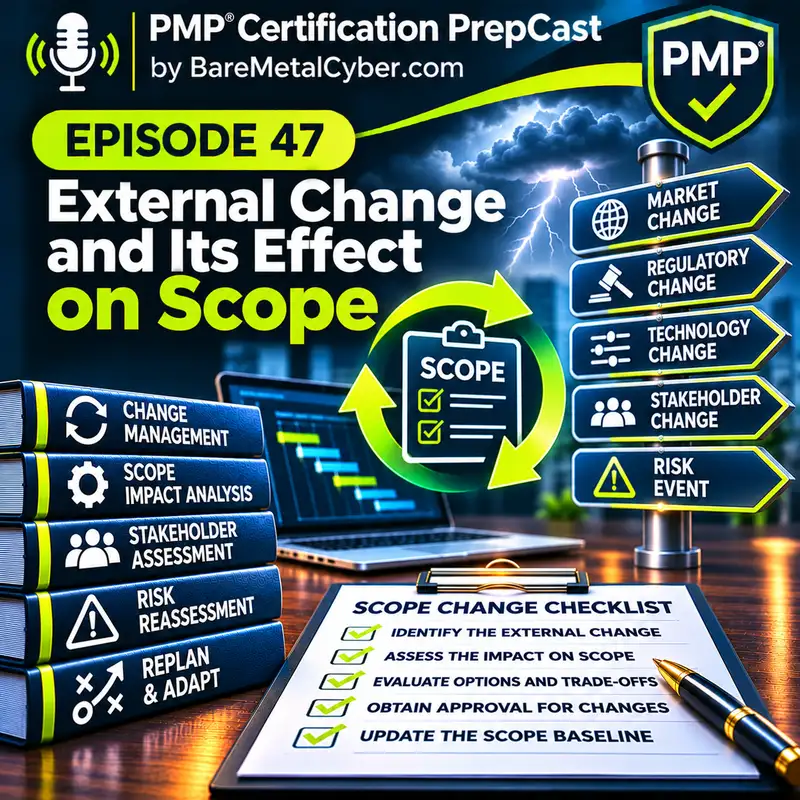
PMP 2026 | 47 | External Change and Its Effect on Scope
Projects rarely exist in a vacuum. External changes, from new laws to market disruptions, can upend carefully built plans in an instant. The objective of this task is to detect these shifts early, analyze their impacts, and decide how they alter project scope and delivery. P M I stresses that external changes are inevitable, and success lies in disciplined response rather than resistance. The project manager’s stance is evidence-seeking: you gather facts, test assumptions, and present options. Outcomes of effective management include timely pivots, transparent approvals, preserved benefits, and a clean audit trail. On the exam, stems that describe “new regulation,” “vendor exit,” or “market shock” are testing your ability to evaluate and respond to external changes with structured discipline.
Welcome to Certified, the P M P prepcast. This is episode forty seven of season one. Today we are exploring how external changes affect project scope and the decisions that follow.
The purpose of managing external changes is not only to protect compliance but also to safeguard value. A project that delivers on time but violates a new regulation fails in the real world. Likewise, ignoring a competitor’s breakthrough technology can leave your project obsolete upon delivery. External change management ensures that projects stay relevant, lawful, and valuable. P M I emphasizes that external forces may expand or reduce scope, alter priorities, or even terminate projects. The project manager must balance compliance, value, risk, and commitments. On the exam, distractors that suggest “ignore until closure” are wrong. Correct answers emphasize early detection, impact analysis, and transparent decision-making.
To succeed, the project manager acts as both observer and translator. You watch credible external sources and convert developments into understandable impacts on scope, schedule, cost, quality, and expected value. Stakeholders may overreact to rumors or headlines, so distinguish a signal from a confirmed change and document what is known. Assess impacts before selecting a discretionary change when circumstances allow. At the same time, follow urgent protective duties, reporting requirements, and delegated emergency procedures when delay would be harmful. On the exam, the best next action depends on the facts and authority in the scenario. Evidence supports a proportionate response; it is not a reason to postpone a required notification or immediate protective action.
External scanning begins with structured frameworks. One common model is P E S T L E, which stands for political, economic, social, technological, legal, and environmental factors. Political shifts might include new policies or trade restrictions. Economic shifts may involve inflation or supply chain shocks. Social changes could be demographic shifts or public sentiment. Technological shifts involve emerging tools, cybersecurity advisories, or obsolescence risks. Legal changes include regulations or court rulings. Environmental changes may involve climate impacts or sustainability mandates. The project manager uses this lens to scan regulators, suppliers, competitors, and technology lifecycles. On the exam, stems about “new regulation announced” or “vendor collapse” test your external scanning discipline.
Signals often arrive subtly before becoming crises. Sudden cost spikes, regulatory memos, or supplier delays may be early warnings. Security advisories, customer protests, or policy drafts can foreshadow disruptive changes. A disciplined project manager creates a watchlist of external signals, links them to risks or assumptions, assigns owners, and reviews them on a cadence. This transforms scanning from a casual activity into a structured process. On the exam, distractors may suggest “deal with changes only when confirmed.” Correct answers emphasize linking signals to risk and assumption logs, with defined triggers that require immediate analysis.
Defining triggers is essential. A trigger is an observed condition that calls for a defined response. Depending on the plan, that response may be assessment, notification, a preauthorized contingency, or an urgent protective action. For example, if inflation rises above a certain percentage, procurement strategy must be reviewed. If a regulator issues a new draft rule, legal review is triggered. These predefined triggers ensure objectivity and prevent delays caused by debate or denial. P M I stresses that proactive triggers protect projects from being blindsided. On the exam, stems about “project caught off guard by external shift” highlight missing triggers. Correct answers emphasize defining triggers tied to risks and assumptions, with owners accountable for monitoring them.
Once a trigger activates, rapid impact analysis begins. The project manager assembles relevant experts to evaluate consequences across scope, schedule, cost, quality, risk, compliance, and contracts. You identify which deliverables, interfaces, or acceptance criteria are affected. This analysis generates options: adapt scope, resequence work, add controls, pause certain activities, or even stop the project if benefits evaporate. P M I stresses that assumptions and data sources must be documented explicitly, decisions must stand up to audit. On the exam, distractors that suggest skipping analysis or acting without evidence are wrong. Evaluate the available evidence while carrying out any time-critical obligations, and use the appropriate authority to select and implement the response.
Impact analysis is not about guessing; it is about structured reasoning. For example, a new privacy law might affect only one module of a system, not the entire project. Proper analysis distinguishes between direct and indirect impacts, ensuring responses are proportionate. Without analysis, teams may overcorrect, delaying the whole project unnecessarily. P M I emphasizes proportionality: address what is affected, not everything indiscriminately. On the exam, stems about “halted entire project without analysis” point to overreaction. Correct answers emphasize analyzing scope boundaries and tailoring responses to actual impacts.
Options generated during impact analysis must be explicit. Adapting scope might mean removing features that no longer comply. Resequencing might mean prioritizing compliant modules first. Adding controls could involve new approval steps or testing requirements. Pausing may protect resources until clarity emerges. In extreme cases, stopping may be the wisest course if benefits vanish. P M I emphasizes that presenting multiple options with evidence empowers sponsors and stakeholders to make informed choices. On the exam, distractors may suggest unilateral action. Correct answers emphasize presenting structured options with clear assumptions and trade-offs.
Decision pathways depend on the organization’s governance and the commitment being changed, as well as the delivery approach. A product owner may reorder unstarted work within delegated product boundaries. A change to a contract, authorized funding, release criterion, or approved baseline can require additional approval even when the team works in sprints. Predictive projects often use a formal change process, but a change control board is one possible authority, not a required committee in every project. Hybrid arrangements need explicit connections between team decisions and wider controls. Identify the affected decision and its owner before choosing a path. An agile label does not create permission to weaken quality or compliance requirements.
Authority rules guide decisions. They may specify limits for cost and timing, but also protected outcomes, contractual duties, safety requirements, data access, or public commitments. A change with little financial cost can still exceed a project manager’s authority. Another change may be substantial yet fall within a clearly delegated decision. Emergency procedures should identify who may act, under which conditions, what must be reported, and how decisions will be recorded. Follow the applicable rules rather than inferring authority from the apparent size of the change. If the route is unclear, seek a timely decision from the accountable governance owner.
When a change is approved, clarify its scope, conditions of acceptance, effective date, and intended result. State whether it applies immediately or after a specified milestone, and communicate the decision and relevant rationale to those affected. Record the decision through the required change or decision process so people can distinguish an approved commitment from a proposal. Documentation is important when it is required, but it is not an automatic exam answer. The scenario may call for an urgent protective action, a mandatory notification, or an authorized decision before further recording. Follow the applicable timing and evidence requirements, and choose the next unresolved action shown by the facts.
Stakeholder alignment is essential once options are generated. The project manager briefs the sponsor and key stakeholders, explaining impacts, options, and trade-offs. Legal and compliance partners are consulted early, ensuring obligations are met. Finance and procurement must be engaged if budgets or vendor agreements are affected. P M I emphasizes coordination across functions, not unilateral decision-making. Brief the relevant decision makers before a discretionary commitment, and notify them promptly when emergency action or a mandatory report cannot wait. Share the known facts and the time when further assessment will be available.
Communication of decisions must be visible and consistent. Once a path is approved, the project manager publishes the updated scope decision in a single source of truth, such as the scope baseline or backlog. Next checkpoints are defined so stakeholders know when progress will be reviewed. This transparency prevents confusion and maintains trust. On the exam, stems about “stakeholders unsure what was decided” highlight communication failures. Correct answers emphasize publishing decisions and maintaining one visible home for updated scope.
A fictional distribution company is preparing to deploy a standard label printer across several sites. Midway through the project, a supplier notice announces that the selected model will stop being sold in ten weeks. The planned rollout continues for twenty weeks, while support for existing units will remain available under stated conditions for another year. Those dates are invented for this example. The notice is an external change, but it does not by itself tell the project manager to cancel every order, replace every installed unit, or ignore the announcement because the original design was approved.
First verify what the notice actually says and which products and agreements it covers. End of sale, end of manufacture, end of support, and loss of a required capability are different events. A distributor's informal warning may be useful as an early signal, but the project needs reliable confirmation before making an expensive discretionary commitment. Check the applicable model, region, order status, support terms, and dates with the appropriate supplier and procurement owners. Preserve the source and any uncertainty so later reviewers can understand the basis of the response.
Then map the exposure across the project. Some sites already have installed units. Others have confirmed orders, while later sites have only planned quantities. The software integration may depend on a driver or output format that the successor model changes. Training and spare-parts plans may assume one common device. Operations may need a longer supported life than the remaining year. The affected scope is therefore more than the printer purchase line. At the same time, unaffected work, such as agreed location preparation, may continue if its assumptions remain valid.
One option is to buy the remaining units before the sale cutoff. That could preserve the current configuration and reduce immediate integration work. It could also tie up funds, require storage, create unused inventory if site plans change, and leave the organization with a shorter supported life than expected. Verify actual availability, acceptance conditions, and ownership of storage and ongoing support. A last-buy opportunity creates a decision deadline; it does not automatically create purchasing authority or make the quantity appropriate. Urgency increases the importance of a clear decision, not the legitimacy of guessing.
A second option is to move future sites to the successor model. That may improve lifecycle support but introduce a mixed fleet. The team should identify changes to interfaces, test evidence, training, maintenance, and spare supplies. A supplier's statement that the new device is compatible is an input to verification, not sufficient proof that every project workflow will behave the same way. Test representative requirements and exceptions with qualified people. The scope of that verification should reflect actual dependencies rather than repeat unrelated work simply because the model number changed.
A third option could be a staged response: complete a limited set of already-committed sites on the current model while testing an alternative before deciding the remaining rollout. This can preserve options when the configuration and operating model allow it. It may be unsuitable if one common device is a binding requirement or support cannot handle both. The project manager should compare feasible alternatives, including their continuing operating costs and benefit implications. A staged choice is not inherently superior; its value depends on the learning obtained before the next irreversible commitment.
The contract review is separate from the technical comparison. Determine what the supplier has already promised, whether confirmed orders remain valid, which notices or remedies apply, and who may agree any modification. Product discontinuation does not automatically prove a breach, and a supplier announcement does not automatically cancel existing obligations. The project manager supplies delivery facts and coordinates with authorized procurement or legal owners. Avoid promising extra payment or asserting rights that the agreement does not support. Preserve the required notices and records while practical options are developed.
The risk and issue records should reflect different states. A confirmed inability to obtain a required quantity is a current issue. Uncertainty about whether the successor will pass integration testing is a risk. The earlier assumption of a uniform supported device throughout rollout needs revision or retirement. Related risks may include training burden or interruption of operations after support ends. Link these records so the same exposure is not counted independently several times when considering reserves or options. The aim is an understandable chain of causes and consequences, not a growing pile of disconnected red entries.
Decision timing matters as much as option quality. Identify the latest date when ordering, testing, or changing the rollout can still protect the relevant outcome. Work backward to the evidence and authorized decisions needed by that point. An analysis completed after the sale window closes may explain the problem perfectly but preserve no choices. Provide preliminary findings with their limitations when a required notification or time-sensitive decision cannot wait for complete certainty. The decision owner should see the cost of waiting alongside the cost and risk of acting.
Suppose the approved response is to validate the successor for later sites while retaining the installed units. Update the affected design references, procurement actions, training plan, risk records, and operating support arrangements. Keep the original baseline and the approved change history rather than replacing old records silently. Explain which sites and dates are affected, what remains unchanged, and what condition would trigger a further decision. A broad message that the printer standard changed could otherwise cause teams to replace functioning equipment that was deliberately meant to remain.
The review does not end when an alternative is selected. Verify that the successor actually meets the required workflow and that operations can sustain the mixed environment. Revisit benefits if the adaptation increases cost or delays deployment enough to change the investment case. In a different variation, the supplier might extend support and preserve order availability, reducing the need for immediate redesign. That new evidence should inform the response just as the original warning did. Managing external change means adapting to confirmed facts and material uncertainty, not defending the first reaction after the environment has changed again.
When external changes affect vendors, contracts become critical levers for adaptation. The project manager reviews relevant clauses to see whether new regulations, market shifts, or supplier conditions require formal change orders. Many contracts include force majeure or compliance clauses that dictate how changes are handled. When a modification is needed, the authorized parties use the contract’s notice and change provisions. A project manager should not assume that issuing a document alone changes the agreement. P M I stresses that informal agreements with vendors create future disputes. On the exam, stems that describe “vendor disagreement over new obligations” point toward failure to follow contractual change paths. Correct answers emphasize reviewing contracts, negotiating formally, and issuing documented change orders.
Renegotiation may be necessary when an external shift changes work or commitments beyond the existing agreement. It is not automatically required whenever a new condition appears. Some contracts already allocate the relevant responsibility, cost exposure, or compliance obligation. Review those terms with procurement and legal specialists, including notice deadlines and any right to direct a change. If an amendment is needed, authorized parties can agree revised scope, timing, price, or incentives. The project manager supplies the delivery evidence and helps assess options. Do not assume that a vendor may ignore an existing obligation until paid more, or that the customer may impose new work without following the agreement.
Vendor evidence must be available through an authorized, controlled route that satisfies the project’s assurance and retention needs. If a vendor claims compliance with new standards, the project manager ensures documented proof, such as certificates, inspection reports, or signed attestations, is retained or securely referenced as permitted by the agreement and information-handling rules. This avoids gaps during audits. Acceptance criteria and quality assurance plans must also be updated to reflect new obligations. Service levels may need revision, with compliance-related metrics added or modified. P M I stresses that vendor management is inseparable from compliance and scope integrity. On the exam, stems about “missing vendor evidence during audit” test this discipline. Correct answers emphasize mirroring vendor documentation and updating acceptance paths.
External changes also demand updates to risk planning. New risks must be added to the register, with owners and triggers clearly defined. Reserves may need adjustment to cover compliance costs, schedule delays, or supply chain instability. Scenario planning becomes a valuable tool here. The project manager works with stakeholders to imagine best-case, most likely, and worst-case outcomes under the new conditions. These scenarios guide decisions about scope adjustments, contract negotiations, and contingency funding. P M I emphasizes that scenario planning provides structured foresight rather than reactive scrambling. On the exam, correct answers highlight updating the risk register and applying scenario thinking, not ignoring new uncertainties.
Scenario planning also protects benefits. External changes can erode or eliminate value even if scope is delivered. For example, a market shock may reduce demand, undermining financial benefits. Scenario analysis allows teams to reconsider benefits and prevent value leakage. Reports must also be recalibrated to highlight deltas driven by external change. For instance, dashboards may flag shifts from baseline benefits forecasts, distinguishing between internal variances and external-driven impacts. On the exam, stems about “benefits no longer achievable due to regulation” test whether the project manager revisits benefits. Correct answers emphasize updating benefits and reporting to reflect external realities.
Consider a fictional scenario in which a newly confirmed privacy requirement takes effect before launch and makes one planned data flow unacceptable. First establish the applicable obligation, deadline, and affected flow with the responsible specialists. If that flow is already operating unlawfully, use the authorized protective and reporting procedures immediately. If it has not been deployed, prevent the noncompliant launch while the team evaluates viable options. A smaller compliant release may preserve value, but it is one option to test, not an automatic answer. Compare its usability, dependencies, cost, and acceptance evidence with alternatives such as a revised design or a changed release date. Bring the recommendation to the appropriate authority, record the decision, and update the affected work and commitments.
The same scenario may affect a cloud provider. Check what the provider already promises, which party controls the affected processing, and what evidence demonstrates compliance. An existing service or contractual control may be sufficient. Otherwise, the authorized parties may need a technical change, an amended agreement, a different service, or a transition plan. Update service expectations and acceptance evidence where the approved response requires it. Internal redesign alone does not resolve a vendor dependency, but an external change does not automatically mean every vendor agreement must be rewritten.
Exam pitfalls in this area are consistent. One is acting without analysis, teams may rush to adjust scope under pressure without understanding downstream impacts. Another is ignoring compliance requirements in the name of meeting deadlines, which creates legal and reputational risk. A third is re-baselining immediately without approvals or rationale, undermining governance. A fourth is treating external change as “out of scope” and doing nothing, leaving the organization vulnerable. P M I stresses that transparency, analysis, and structured decision-making protect both delivery and value. On the exam, distractors typically embody these shortcuts. Correct answers emphasize discipline: analyze, align, and document.
Another frequent pitfall is failing to engage all relevant functions. External changes often affect finance, legal, procurement, and vendors, not just project scope. A project manager who adjusts deliverables without looping in finance may miss cost implications. One who acts without legal input may expose the organization to penalties. On the exam, stems that describe “finance surprised by unapproved costs” or “legal blindsided by compliance risk” test whether the project manager engaged stakeholders. Correct answers emphasize holistic engagement, not narrow adjustments. External changes ripple widely, and stakeholder alignment is the antidote.
A useful review pattern begins with monitoring credible sources and defining the conditions that warrant attention. When a condition occurs, establish urgency and any immediate duty, assess the affected commitments, and involve the people with the needed expertise. Develop feasible options, including the consequences of delay, then use the decision rights that apply. Update the relevant risks, assumptions, benefit forecasts, plans, and agreements after the decision. Communicate both what changed and what remains uncertain. These activities can overlap, especially during a fast-moving event. Their purpose is a timely, informed response, not completion of a rigid checklist before anyone is allowed to act.
In conclusion, evaluating and addressing external changes is about vigilance and structured response. The project manager acts as sentinel and translator, scanning the environment, identifying triggers, performing disciplined analysis, and guiding decisions through governance. External changes may force pivots, but projects remain resilient when compliance, value, and benefits are protected. Exam pitfalls include rushing to act without analysis, ignoring compliance, re-baselining first, or failing to engage key functions. Strong responses combine proportionate analysis, timely protective action when needed, stakeholder alignment, clear authority, and transparent communication. P M I’s message is clear: projects cannot control the external world, but they can control how they adapt.
For more certification study resources, books, and podcasts, visit Bare Metal Cyber dot com. Thank you for listening to Certified, the P M P prepcast.