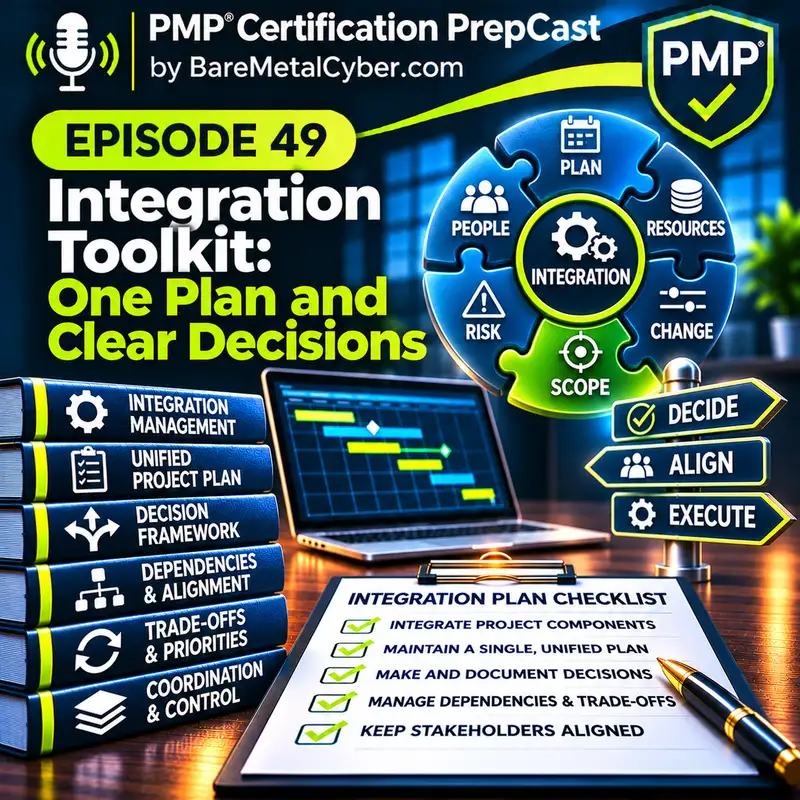
PMP 2026 | 49 | Integration Toolkit: One Plan and Clear Decisions
Integration management is the discipline that keeps all pieces of a project connected and coherent. Its purpose is to produce and sustain a single integrated project management plan that guides decision-making, trade-offs, and change control. This toolkit applies whenever a project requires multiple subsidiary plans to function together rather than as isolated documents. The focus is a coherent set of commitments, reliable shared information, and clear decision pathways. Related plans and records can be held in several controlled tools when their owners, versions, and interfaces are clear. When used well, outcomes include a coherent plan, baseline integrity, visible decision rights, and predictable management of changes. Integration is relevant in predictive, agile, and hybrid contexts; the toolkit is simply tailored to the delivery mode.
Welcome to Certified, the P M P prepcast. This is episode forty nine of season one. Today we are exploring practical tools for integrated planning and clear project decisions.
Project managers use the integration toolkit as a trade-off engine. Scope, schedule, cost, risk, quality, and resources rarely align perfectly. Integration allows transparent decisions about which element flexes and which must be protected. For example, when cost rises, schedule or scope may need adjustment. Without integration, each plan operates in isolation, creating contradictions. The project manager ensures that the integrated plan reflects deliberate trade-offs agreed by governance, rather than silent or accidental shifts. On the exam, stems that describe “unsynchronized plans” test whether you recognize the need for integration to protect coherence and traceability.
Outcomes of effective integration include baseline integrity, clarity of decision rights, and predictability of changes. A coherent plan allows stakeholders to align around a shared truth, reducing confusion. Clear decision rights ensure everyone knows who can approve changes, preventing paralysis or unauthorized adjustments. Predictable changes follow a defined path from intake through analysis, approval, and implementation. P M I emphasizes that integration is not a one-time act at planning but a continuous discipline throughout the project. On the exam, distractors that suggest “file the plan and move on” are incorrect. Correct answers emphasize integration as active stewardship.
To build the integrated plan, project managers first map subsidiary plans. These typically include scope, schedule, cost, quality, resource, communication, risk, procurement, and stakeholder plans. Each describes a vital slice of project control. Beyond these, overlays such as benefits alignment and compliance obligations also require integration. Identifying owners for each plan clarifies accountability. Integration points between plans are also noted, for instance, schedule and procurement must align when external vendors are required to deliver critical items. On the exam, stems about “baseline contradiction” often highlight missing integration points. Correct answers emphasize mapping all plans and clarifying interfaces.
Integration requires keeping assumptions and constraints visible. Too often, assumptions underpinning estimates or commitments are buried within individual plans. If they are not visible at the integrated level, decisions rest on shaky foundations. For example, an assumption that vendor approval will take only two weeks affects both schedule and procurement plans. If this proves false, multiple plans collapse. The project manager maintains an assumptions register as part of integration. On the exam, distractors that suggest “move forward without validating assumptions” are traps. Correct answers emphasize linking assumptions and constraints visibly into the integrated plan.
Building the integrated plan means consolidating subsidiary plans into one approved whole. Baselines are defined for scope, schedule, and cost, and change paths are established. Integration explicitly expresses trade-offs, for example, clarifying whether scope or schedule takes priority if conflicts arise. Performance measures and reporting cadence are chosen deliberately to provide visibility into progress. Finally, the project manager ensures stakeholders know where the integrated plan lives and how changes will be applied. P M I emphasizes that integration requires transparency and accessibility. On the exam, stems that describe “multiple competing versions” highlight failure of integration. Correct answers emphasize single-source visibility.
Tradeoffs must be expressed explicitly in the integrated plan. Scope, time, cost, quality, and risk are interdependent, but not every constraint is available to exchange. Mandatory quality, safety, compliance, and contractual conditions remain boundaries unless the applicable authority can lawfully change them. If a date is fixed, explore feasible scope, sequencing, capacity, and delivery options within those boundaries. A cost cap does not authorize reducing a required quality level. Sometimes no option can meet all current commitments, and the responsible decision maker must resolve that conflict. Record the assumptions, consequences, and authority for the chosen response.
Performance measures and reporting cadence also form part of the integrated plan. Teams need consistent conventions: how progress is measured, when it is reported, and which artifacts serve as the single source of truth. For example, schedule performance might be measured weekly, cost monthly, and risks at governance checkpoints. Dashboards and reports should draw from the same integrated data. Without this, stakeholders see different pictures. P M I emphasizes that one truth builds trust. On the exam, clues about “conflicting reports” highlight failures of integration. Consistent definitions and clearly stated reporting periods matter more than forcing every measure onto one cadence. Cost, operational outcomes, and work flow may update at different rates when those differences are visible.
Baseline integrity means preserving the approved reference and controlling changes to it. Scope, schedule, and cost baselines are related, but a change to one does not automatically require changing all three. Assess the effects and update each affected baseline only through its applicable authority. A forecast can change while the approved baseline remains the comparison point. Version control preserves the history, and a clear status date shows when performance was measured. For a scenario, distinguish an approved commitment, a current forecast, and actual performance before deciding which record needs to change.
Guarding against shadow documents is another aspect of baseline integrity. Shadow documents are unofficial versions of the plan that teams create for convenience. While they may help locally, they create confusion when decisions rely on outdated or inconsistent data. Use links, controlled copies, synchronization, or another suitable method so people can identify the current authoritative information. Local working views are legitimate when they do not create conflicting commitments or conceal stale data. Teams must also be taught how to read and use the integrated plan, preventing accidental misalignment. On the exam, stems about “team working from outdated plan” highlight this risk. Correct answers emphasize eliminating shadow documents and ensuring teams know where to find the truth.
Version control provides structure for maintaining baselines. Every change is documented with version numbers, dates, and author information. Historical versions are archived but not used for current work. This ensures accountability and supports audits. Teams and stakeholders can see how the plan evolved over time, reducing disputes about “what was agreed.” P M I emphasizes that without version control, integration collapses into chaos. On the exam, distractors that suggest “keep only the latest copy with no history” are wrong. Correct answers emphasize structured version control with accessible audit trails.
Data date conventions help readers interpret performance correctly. A data date identifies the point through which a set of results has been measured. Calculations that compare planned value, earned value, and actual cost need a consistent reporting basis. Other measures may legitimately update at different rates, provided their periods, definitions, and limitations are explicit. Reconcile differences before drawing a combined conclusion rather than forcing every source to appear equally current. When cost and delivery reports disagree, investigate the actual data and assumptions before changing an approved baseline.
Change control integration ensures that when baselines shift, they do so predictably and transparently. The process follows a structured path: intake of change requests, impact analysis across all affected plans, routing through the correct approval pathway, implementation of the approved change, and updating of all artifacts. P M I emphasizes that this process must be consistent and visible to prevent ad hoc or unauthorized changes. On the exam, distractors that describe “change implemented without analysis” are incorrect. Correct answers emphasize structured change control integration across all plans.
Delegated authority and escalation routes are part of integrated change control. Decision limits can concern funding, timing, scope, protected outcomes, contracts, or other obligations. The apparent size of a change does not establish who may approve it. A change control board is one possible arrangement, while another project may assign the relevant decision to a sponsor or another named owner. Emergency procedures can authorize prompt action under stated conditions, with the required notification and record. They are not permission to implement any urgent request and seek retroactive approval. Make the route clear before the team needs it.
After a decision, update the affected plans and supporting records through their controlled routes, then communicate the effective change to the people who need it. One approved decision may require corresponding updates in a schedule, backlog, contract record, risk register, or operating instruction. The objective is consistent information, not literally editing only one document. Retain the rationale and approval, and confirm that the team is working from the current direction. This is how integration connects governance decisions with actual delivery.
Let us assemble a compact integration toolkit for a fictional employee-onboarding project. The intended result is that a new employee receives the agreed access, equipment, instructions, and support by the required start point. The project has a workflow team, an equipment supplier, an identity specialist, and an operations owner. Instead of beginning with a demand for more documents, identify the decisions these people must make together. The toolkit should let them find the authorized outcome, current delivery forecast, unresolved dependencies, and next required decision without reconstructing the project from private conversations.
Begin with a short commitment view. It states the approved outcome, included employee groups, required completion conditions, protected dates, and authorized budget. It also points to the authoritative scope, schedule, and cost references rather than copying them into an uncontrolled summary. A reader should be able to distinguish a firm approved commitment from a planning assumption. If a summary says equipment arrives before a start date, its supporting schedule and supplier agreement should explain the basis of that statement. The summary is useful only while those links and meanings remain trustworthy.
Add an interface record for the handoffs that can break the outcome. The supplier needs an approved equipment order; the identity specialist needs verified employee information; the help desk needs current instructions before taking support calls. For each important handoff, identify the producer, receiver, required input, readiness evidence, and needed date. This is not a requirement to document every ordinary conversation. Focus on interfaces where ambiguity can produce delay, rework, or an unmet obligation. A missed handoff should then point to an owner and decision, not a general complaint that teams need to communicate better.
An assumption record complements those interfaces. Suppose the plan assumes that a shared identity specialist will be available for twenty hours during the final preparation week. A resource owner later confirms only twelve. The eight-hour gap is now a known capacity issue, while the extent of the delivery effect still needs analysis. Link the issue to the affected tasks and options. Possible responses include resequencing, obtaining qualified capacity, or changing an authorized commitment. Do not leave the original twenty-hour assumption in the plan merely because it was true when the first schedule was written.
Use a decision brief when the gap exceeds local authority. A useful brief states the decision required, the latest useful decision date, verified facts, uncertainty, feasible options, consequences, and recommendation. It points to the evidence rather than burying the choice beneath every working detail. In this example, the sponsor might need to choose between a later rollout and funding qualified capacity, while the resource owner confirms feasibility. Those are related decisions, not necessarily one signature. Record conditions and follow-up owners so an approval becomes an executable direction rather than a vague expression of support.
Now check the performance view with invented earned-value data. At a Friday status date, planned value is twelve thousand dollars, earned value is ten thousand, and actual cost is eleven thousand. The project uses an agreed rule for crediting completed work at its budgeted value. Cost variance is earned value minus actual cost, or negative one thousand dollars. Schedule variance is earned value minus planned value, or negative two thousand. These are budget-based performance measures. The schedule variance is not a statement that completion will be two thousand days or two days late.
The cost performance index is ten thousand divided by eleven thousand, approximately zero point nine one. The schedule performance index is ten thousand divided by twelve thousand, approximately zero point eight three. These figures describe the measured position under the stated rules. They do not replace the dependency-based schedule forecast or show realized employee productivity benefits. If a Monday cost file includes additional spending while earned value remains frozen at Friday, combining them without reconciliation creates a different and potentially misleading comparison. Preserve a consistent basis for a calculation or explicitly explain why figures cover different periods.
A current forecast can also differ from a simple projection of past efficiency. Suppose the team provides a justified remaining-cost estimate of eight thousand dollars, with its assumptions and full remaining scope documented. Added to eleven thousand of actual cost, that produces a nineteen-thousand-dollar completion forecast. Against an approved twenty-thousand-dollar budget, the forecast is one thousand lower, even though current cost variance is adverse. That combination is possible if remaining work is expected to perform differently, but it requires credible evidence. The manager should challenge the estimate, not reject or accept it solely because one performance index looks unfavorable.
The change record then connects decisions to the working system. If additional specialist capacity is approved, the resource plan, current cost forecast, relevant schedule tasks, and access arrangements may need updates. Whether a baseline changes depends on the actual decision and authority, not the number of files affected. Record which references were updated and verify that their owners received the effective direction. A change can be approved in the decision log while still not implemented in the scheduling tool. Integration requires detecting that gap before teams make conflicting commitments.
Finally, use an exception-oriented review to ask what needs action now. The shared specialist gap may be resolved, but equipment acceptance evidence may still be due before rollout. A green cost forecast does not erase that readiness condition. Keep each measure and condition attached to its purpose and decision owner. The review can acknowledge completed work while directing attention to the unresolved dependency. The practical toolkit is therefore a set of connected, usable views: commitments, interfaces, assumptions, decisions, performance, and changes. Its success is measured by the quality and timeliness of decisions it enables, not by the size of the document collection.
An integrated plan is only as strong as the logs that support it. Two of the most critical are the decision log and the assumption log. A decision log records who made a decision, what was decided, when it was made, why it was chosen, and what evidence supported it. This transparency prevents disputes later when memories fade or stakeholders change. An assumption log captures the guesses and conditions on which the plan rests. High-impact assumptions must be validated early because if they prove false, they can derail the project. On the exam, distractors that ignore logs or rely on memory are misleading. Correct answers emphasize structured logging as part of integration discipline.
Decisions are not static entries; they have ripple effects. Each decision should link back to affected baselines, risks, and benefits. This allows teams to see consequences clearly and trace accountability. Without logs, undocumented decisions become shadow governance, leaving teams confused about direction. The assumption log also requires active stewardship. When an assumption changes, assess its consequence. An established problem may be an issue, a future uncertain consequence may be a risk, and some corrected assumptions may have no material project effect. Link the relevant records without mechanically relabeling every assumption. This continuous monitoring keeps the integrated plan realistic and credible. On the exam, stems about “assumptions never revisited” or “decisions undocumented” highlight these pitfalls. Correct answers emphasize maintaining living, searchable logs.
Searchability is often overlooked but essential. Logs must be easy to access, filter, and review, not buried in long documents. A decision log that is inaccessible fails to guide behavior. P M I emphasizes usability over volume: a concise, searchable log adds more value than a massive archive no one reads. A digital register, linked dashboard, or another accessible controlled record can work with any delivery approach. Regardless of format, the goal is the same: provide quick clarity on what was decided, what assumptions remain, and what has changed. On the exam, correct answers highlight visibility and searchability, not hidden or outdated logs.
Integration also extends into performance reporting. Predictive projects often rely on variance reports that compare actuals against baselines. Schedule variance and cost variance provide numerical insight into whether performance aligns with plan. Adaptive projects rely more on cadence-based reporting, showing velocity trends, throughput, or cumulative flow diagrams. Hybrid dashboards often combine both, offering earned value measures like cost performance index alongside agile indicators such as backlog burn-downs. P M I stresses that integration means aligning reporting to the project’s governance mode while keeping all stakeholders oriented to the same truth. On the exam, stems that describe “conflicting reports” test whether reporting was integrated.
Performance reporting must also be actionable. Reports should not flood stakeholders with noise but highlight exceptions and decisions needed. For example, a dashboard can make milestones needing a decision prominent while retaining enough context to understand overall progress and upcoming commitments. Likewise, agile boards should not simply display tasks but highlight flow impediments. Integrated reporting ties metrics back to decision-making. P M I emphasizes that effective integration translates data into clarity about what needs action. On the exam, distractors that suggest “more reports for transparency” are misleading. Correct answers emphasize exception-based, decision-oriented reporting.
Consistency of reporting is a hallmark of integration. Stakeholders need to understand where an authoritative figure comes from, the period it covers, and who maintains it. A unified dashboard may help, but a single viewer link is not a universal requirement. A finance system and a delivery board can both be valid sources when definitions, dates, and reconciliation are clear. Tailor access to the audience and protect restricted information. Investigate conflicting figures before republishing them, then repair the data or explanation at the source.
Governance cadence underpins integration. The steering committee rhythm, change control board schedule, and team ceremonies must align so decisions flow predictably. If team events expose risks weekly but governance meets monthly, critical delays can occur. Decision rights and thresholds must be published so all participants know who can act at what level. Training approvers on how to interpret artifacts ensures governance bodies do not become bottlenecks. P M I stresses that governance effectiveness must be reviewed periodically, with adjustments made as projects evolve. On the exam, distractors that ignore governance rhythm are incomplete. Correct answers emphasize aligned cadence, clear thresholds, and periodic review.
Decision rights protect both speed and accountability. Without thresholds, project managers may escalate trivial issues unnecessarily, slowing progress. Without clear decision ownership, consequential changes may be implemented without the required authority. That ownership can sit with a named person or a body, depending on the governance arrangement. Publishing thresholds clarifies when to escalate and when to decide locally. Training approvers ensures that when escalations occur, governance bodies make informed, consistent choices. Integration demands both discipline and adaptability: governance must be light enough not to smother delivery but real enough to maintain accountability. On the exam, stems about “unclear decision authority” highlight governance gaps. Correct answers emphasize clear thresholds and well-trained approvers.
Reviewing governance effectiveness is part of integration. A project may begin with frequent C C B meetings, but if volume of changes drops, cadence may be reduced. Conversely, if external changes accelerate, governance may need to meet more often. Integration is dynamic: the governance system itself must adapt as projects evolve. P M I emphasizes periodic reflection on whether governance supports decision-making or delays it. On the exam, distractors that suggest governance cadence is fixed are incorrect. Correct answers emphasize adaptability while keeping accountability intact.
Consider a project whose completion forecast has moved while its cost report still assumes the old timing. Establish whether the project manager updated a working forecast or approved a baseline change within delegated authority. Examine the actual cost consequences; a later forecast does not prove that the cost baseline must change. Correct the current forecast and its assumptions so the reports are consistent. If an approved commitment needs to change, obtain the required decision before revising that baseline. If an earlier approval already covers the affected records, implement it accurately rather than repeating it without a reason. Communicate the resulting position and the variance from the approved reference.
In an agile variant of this scenario, backlog changes must cascade into updated release plans and stakeholder dashboards. Updating only the backlog without adjusting release forecasts or reporting leads to the same confusion as in predictive projects. Integration in agile means translating backlog changes into visible updates for stakeholders. P M I stresses that agile does not escape integration, it simply applies it through different artifacts. On the exam, stems describing “backlog updated but release plan outdated” highlight this trap. Correct answers emphasize synchronizing agile artifacts as part of integrated change management.
Pitfalls in integration management are well known. One is unsynchronized baselines, where schedule, cost, and scope drift independently. Another is conflicting unofficial commitments or stale working copies. A team spreadsheet or dashboard is not inherently a problem when it uses the controlled information and its purpose is clear. A third is missing decisions, where undocumented choices leave confusion. These pitfalls erode trust and create inefficiency. On the exam, distractors often embody these errors. Correct answers emphasize integration practices that eliminate shadow plans, synchronize baselines, and log decisions visibly. P M I highlights that integration is about trust as much as process.
A quick playbook anchors integration practices. First, maintain one integrated plan, consolidating all subsidiary plans with visible baselines. Second, state trade-offs explicitly so priorities are transparent. Third, enforce a disciplined change path, intake, analysis, approval, implementation, and update. Fourth, keep decision and assumption logs searchable and visible. Fifth, centralize reporting with exception-based dashboards. Sixth, align governance cadence with project rhythm and review effectiveness periodically. Finally, teach the plan: ensure teams know how to read it and use it, not just where it is stored. On the exam, correct answers echo this structured discipline rather than shortcuts or silos.
In conclusion, the integration management toolkit ensures projects operate with coherence, clarity, and predictability. By consolidating subsidiary plans, protecting baseline integrity, embedding change control, and maintaining transparent logs, project managers create a system of trust. Performance reporting and governance cadence reinforce alignment, while scenarios show why integration is necessary. Exam pitfalls include shadow plans, unsynchronized baselines, and undocumented decisions. Correct answers emphasize integration as active stewardship: one plan, one truth, and clear decisions. P M I stresses that integration is not a document, it is the discipline that holds the project together.
For more certification study resources, books, and podcasts, visit Bare Metal Cyber dot com. Thank you for listening to Certified, the P M P prepcast.