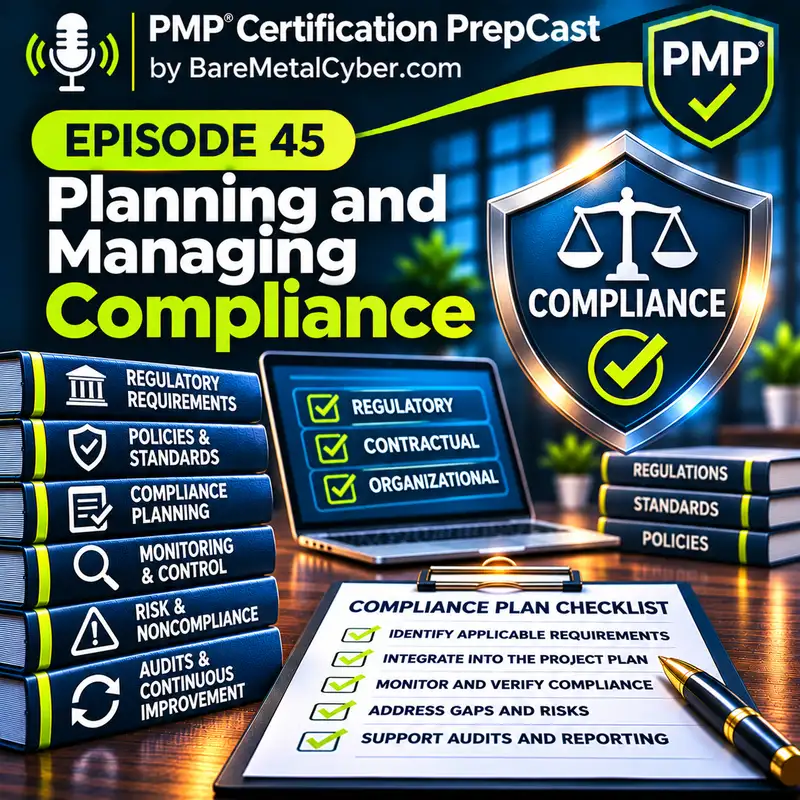
PMP 2026 | 45 | Planning and Managing Compliance
Compliance and quality overlap but answer different questions. Compliance asks which legal, contractual, regulatory, and internal obligations apply and whether they have been met. Quality asks whether the output and the way it is produced satisfy the relevant requirements and intended use. A stakeholder's approval does not prove that every obligation is satisfied, and compliance with one rule does not prove the product is useful. A test or audit may support both responsibilities. Identify the source of the requirement and the decision being asked rather than assuming that a word such as audit selects only one topic.
Welcome to Certified, the P M P prepcast. This is episode forty five of season one. Today we are exploring how to translate compliance obligations into project work and evidence.
The purpose of compliance management is twofold: first, to identify obligations that apply to the project; and second, to plan, execute, and document activities that demonstrate adherence. Unlike optional best practices, compliance obligations are mandatory. Failing to meet them can halt the project, trigger penalties, or cause reputational damage. P M I emphasizes that project managers may not be lawyers, but they are stewards of governance. That means knowing when compliance requirements exist, ensuring they are translated into actionable controls, and maintaining evidence of adherence. On the exam, distractors often suggest “ignore unless an issue arises.” The correct answer emphasizes proactive compliance planning.
The project manager’s stance is neutral facilitator: you do not invent compliance requirements, but you ensure the project team understands and follows them. This may involve coordinating with legal, compliance, or audit functions in the organization. It also involves documenting how compliance obligations map onto project activities and deliverables. The key is integration, compliance is not an afterthought bolted on at the end, but a thread woven through planning, execution, and closure. On the exam, stems that describe “surprised by noncompliance at delivery” usually highlight the failure to integrate compliance early. Correct answers emphasize embedding compliance from the beginning.
The first step is building an inventory of obligations. These may come from laws, regulations, industry standards, contracts, or internal policies. A regulated product, a system processing personal information, and a construction project can face different obligations. The qualified owners determine applicability, jurisdiction, scope, and effective dates for the actual work. Internal obligations might include financial reporting, procurement procedures, or sustainability policies. The project manager creates an obligation inventory, ideally linked to each work package or deliverable. On the exam, stems about “no clear list of compliance needs” point to this step. Correct answers emphasize identifying and documenting obligations comprehensively.
An obligations inventory must also include owners. Each requirement should have someone accountable for monitoring and fulfilling it. Without ownership, compliance falls through cracks. Some obligations may be owned by specialized functions, such as legal or finance, while others belong to project leads. The project manager ensures that obligations are visible, mapped to activities, and assigned to responsible parties. A compliance register or obligation matrix is a common artifact. On the exam, distractors may suggest leaving ownership ambiguous. Correct answers emphasize documenting owners clearly and ensuring responsibilities are tracked.
Obligations may change during a project as regulations, contracts, and internal policies change. Maintain the obligations inventory through scheduled reviews and when a relevant change becomes known. Work with the appropriate specialists to check applicability, effective dates, affected work, and the responsible decision owner. Updating the inventory records the change; it does not implement a new control or make the project compliant. Assess and complete the required changes to plans, practices, training, or evidence within the applicable time limits. In a scenario involving an outdated policy, check what already changed and what action remains due, rather than assuming a periodic document update resolves the exposure.
Once obligations are identified, the project manager works with the team and specialists to plan controls and evidence. A control is a measure intended to prevent, detect, or address noncompliance, such as an approval, test, checklist, or separation of duties. Its presence does not guarantee that it operates effectively. Evidence is reliable information supporting a conclusion about what occurred, such as a signed form, an observation, or a system log. Check its authenticity, relevance, and coverage before relying on it. Plan how the control will operate and be verified, and what evidence must be retained. Missing evidence may prevent a claim of compliance from being demonstrated, and a missing required record can itself be a gap. Distinguish that problem from a verified failure to perform the underlying activity, then address the actual issue.
Controls should be simple, effective, and integrated into existing workflows. Overly complex controls slow progress and breed circumvention. For example, requiring dual signatures on financial transactions above a certain threshold is a straightforward control. Logging every conversation about a requirement may be excessive. Evidence should also be proportional: high-risk areas require detailed evidence, while low-risk areas may require summaries. The project manager balances efficiency with assurance. On the exam, distractors often describe either “no controls” or “excessive controls.” The correct answer emphasizes proportional, efficient compliance planning.
Evidence management requires clear ownership and repositories. Documents, logs, and approvals must be stored in accessible systems with version control and retention policies. Ad hoc storage in personal folders undermines compliance. The project manager ensures a single source of truth for compliance evidence, often within the organization’s document management or audit systems. On the exam, stems about “missing records” point to failures in evidence management. Correct answers emphasize defined repositories, access control, and retention schedules. P M I’s philosophy is that compliance is only as strong as the evidence trail supporting it.
Integrate applicable compliance work into the delivery plans so its dependencies, resources, and decision points are visible. For example, a required regulatory approval may constrain a milestone, while a mandated safety inspection needs an owner, time, and suitable evidence. Include these commitments in the planning approach the project uses, whether predictive, adaptive, or hybrid. Some assurance activities or external reviews may run alongside delivery and may need to remain independent. Integration means coordinating their requirements and consequences, not removing that independence. On the exam, an overlooked obligation may call for updating the work and dependencies as well as the records; choose the action that addresses the actual gap.
Integration also means educating the team. Team members must understand which activities are compliance-driven and why they matter. Awareness prevents accidental violations. A culture of compliance begins with making obligations clear and accessible, not hidden in legal documents. The project manager may provide training sessions, visual job aids, or reminders in project dashboards. On the exam, distractors may suggest keeping compliance knowledge within management. Correct answers emphasize making compliance visible and accessible to the team. P M I stresses compliance is a shared responsibility, not a managerial secret.
Integrating compliance also requires assigning time and budget. Controls and evidence take effort, and failing to plan resources leads to shortcuts. The project manager estimates the effort for compliance activities and ensures they are reflected in cost and schedule baselines. This avoids the perception of compliance as “extra” work. On the exam, clues like “compliance tasks delayed due to lack of resources” highlight this failure. Correct answers emphasize including compliance in baselines, not leaving it as unfunded overhead.
Monitoring compliance means checking whether obligations are being met throughout execution. This involves periodic audits, status reviews, and evidence checks. Monitoring prevents surprises at the end and allows corrective action early. Auditing may be internal, performed by the project team or compliance function, or external, depending on requirements. The project manager ensures findings are documented and addressed. On the exam, distractors often describe “waiting for regulators to check at the end.” Correct answers emphasize proactive monitoring and internal audits during execution.
When a gap is found, distinguish correction from corrective and preventive action. A correction addresses the observed problem, such as completing a missed required inspection where that remains possible. Corrective action addresses the cause of an actual nonconformity to prevent recurrence. Preventive action addresses the cause of a potential nonconformity before it occurs. Use the applicable quality or compliance process, record the evidence, and verify whether the response worked. Naming an action corrective does not demonstrate that its cause was understood or removed.
Consider a fictional supplier-onboarding project governed by an internal information-handling policy and a signed customer agreement. The policy requires an authorized review before restricted project information is sent to a new external service. The agreement separately specifies which onboarding records must be retained and made available for review. These are invented obligations for the teaching case, not statements of a particular law. The project manager's first task is to distinguish their sources, scope, effective conditions, and owners rather than combine them into a vague instruction to be compliant.
The requirement register should make each obligation actionable. For the external-service review, record what information and services fall within scope, who may decide, what evidence demonstrates a valid decision, and when the control must operate. For retention, identify the covered records, the relevant period and event that starts it, the custodian, and any authorized disposal conditions. The appropriate specialists confirm the interpretation. A sentence copied from a policy is useful source material, but the project still needs work, ownership, and evidence that show how the requirement will be fulfilled.
Translate the review obligation into the actual workflow. A team proposing a new service provides the information needed for assessment before sending restricted data. The authorized owner records a decision with any conditions. The delivery team verifies those conditions and keeps a retrievable reference to the approval. Merely adding a checkbox labeled reviewed does not show that the right person reviewed the right use. A valid approval for one dataset or purpose may not cover another. Compliance depends on the defined scope of the permission, not just the presence of a favorable word in a log.
During an internal check, two approval records cannot be found among six external-service uses. Start by determining what is missing and what reliable evidence exists. For one use, the authorized approval is located in the controlled decision system and predates the transfer. The project index was broken, but the underlying approval can be substantiated. Fix the index and assess any requirement concerning accessible evidence. For the other use, no reliable prior approval can be established. These findings are not identical and should not be reported as though they prove the same failure.
The second case requires the responsible owners to assess the actual exposure and required response. An approval obtained today does not prove that the earlier transfer was authorized. Record the true timeline and use the applicable reporting and protective procedures. The project may need to restrict further use while the authorized assessment occurs, depending on the facts and existing authority. Do not fabricate a historical approval or treat a later signature as a way to erase the gap. Correcting the present state and accounting honestly for the past are separate responsibilities.
Suppose the team discovers that the workflow allowed a service to be activated before the review field was completed. Correcting that one use addresses the observed instance. Changing the workflow, clarifying authority, and verifying that the control operates at the right point may address the cause of recurrence. Training alone may be insufficient if the system still makes bypass easy and no one owns the check. Conversely, a technical lock alone may be inadequate if users cannot tell which activities require review. Select the response from the verified cause rather than prescribing the same remedy for every finding.
Evidence coverage matters when interpreting the check. Reviewing six uses may show what occurred in those six cases, but does not automatically prove the status of every service used by the organization. State the population, selection method, period, and limitations. If the applicable process requires broader assurance, the responsible owner determines the additional work. A small sample with no detected problems is not a universal compliance certificate. A sample with a problem is a reason to assess its significance and possible wider extent, not to invent a total failure count without evidence.
Now suppose the organization revises its internal policy with a future effective date. The manager verifies which current and planned services the revision covers and whether any transition arrangements are explicitly allowed. The policy update may require new assessments, training, changes to the workflow, or different evidence before that date. Updating the register alone does not perform those activities. Integrate them into the delivery plan with dependencies and resources, and identify decisions that must occur before the new rule applies. Do not assume existing services are exempt unless the actual policy says so.
Supplier evidence needs similar scrutiny. A vendor may present a certificate or report that is authentic but covers a different service, location, period, or control scope. Ask the qualified owner whether it supports the requirement at issue. An impressive document is not necessarily relevant evidence. The project should obtain what the agreement and applicable process require, protect confidential material, and record any limitations. Avoid demanding unrelated records simply to make the evidence pack larger. Assurance is strengthened by relevance and reliability, not by the number of attachments collected.
Compliance work must remain effective during adaptive delivery. If a new feature introduces a different external processing service, the team needs the relevant assessment before using restricted information, even if the feature is planned for the current iteration. The Product Owner can order work but does not acquire every compliance authority by doing so. The team can continue unaffected work, use permitted synthetic data, or choose another authorized path while the decision is pending. This protects progress without pretending that delivery cadence suspends the obligation.
At transition, transfer the continuing control and evidence responsibilities to accepted operating owners. They need to know which services are authorized, what conditions remain, when reviews are due, and where the records can be retrieved. A project that meets its requirements on launch day can still leave a weak operating arrangement if no one maintains those conditions. Conversely, do not keep the project open indefinitely when a valid ongoing ownership arrangement satisfies the closure criteria. The aim is a defensible, maintained chain from obligation to action, evidence, and accountable operation.
Compliance does not stop with the project team. Vendors and third parties often introduce additional obligations, either through contracts or through the industries in which they operate. A subcontractor may need to meet labor laws, data protection requirements, or environmental standards. If they fail, the sponsoring organization can still be held liable. The project manager therefore ensures that contracts explicitly define compliance requirements and that vendors are monitored against them. This may include requiring certifications, audits, or evidence of training. On the exam, stems describing “vendor caused regulatory violation” point to failures in procurement compliance. Correct answers emphasize including compliance clauses in contracts and verifying vendors fulfill them.
Managing vendor compliance also requires oversight. Service-level agreements may include compliance elements such as response times for incident reporting, requirements for secure handling of data, or adherence to safety regulations. The project manager works with procurement and legal teams to define, monitor, and enforce these expectations. Vendor performance reviews should assess not just technical delivery but also compliance performance. When vendors fall short, corrective actions or penalties may be necessary. On the exam, distractors that suggest “trusting vendor assurances” are incorrect. Correct answers emphasize monitoring and enforcement, not blind trust.
Vendor compliance also connects to project closure. At the relevant acceptance and payment milestones, the project manager helps verify the evidence required by the contract with the authorized procurement and compliance owners. This might include receiving audit certificates, inspection reports, or signed compliance checklists. Without this diligence, organizations may pay vendors and only later discover noncompliance. P M I emphasizes that contract closeout must validate compliance as much as deliverables. On the exam, stems describing “vendor paid before compliance validated” test this discipline. Correct answers emphasize validating evidence and enforcing closure requirements. Compliance is not negotiable; it must be demonstrated.
Data privacy and security require explicit attention when project information includes personal, confidential, or otherwise restricted material. Determine the applicable obligations with qualified specialists, including permitted use, access, transfer, retention, and incident reporting. Select controls that meet those obligations and produce the required evidence. Encryption, access restrictions, and data minimization may help, but naming a control does not prove it has been implemented effectively or that all duties are satisfied. The project manager coordinates the work and keeps accountability visible.
Security obligations often extend to vendors and cloud providers. A project may outsource hosting but remain accountable for data protection. The project manager ensures that contracts include data handling clauses, access controls, and incident reporting requirements. Compliance in this area also involves training: teams must understand what data can be shared, how it must be secured, and what to do if a breach occurs. P M I emphasizes accountability: outsourcing does not absolve the project team from compliance responsibility. On the exam, distractors that suggest “vendor is responsible alone” are incorrect. Correct answers emphasize shared accountability and oversight.
Privacy and security compliance must also be balanced with workflow. Excessive restrictions can slow progress, but insufficient controls create risk. The project manager balances this by tailoring security measures proportionally to data sensitivity and project risk. Choose controls with the security owner against applicable requirements and the actual threat and risk context. A low-sensitivity label does not automatically justify password-only access or waiver of a required control. P M I’s philosophy is proportionality: sufficient controls without creating undue burden. On the exam, stems that describe “team bypassed controls because they were too burdensome” highlight poor tailoring. Correct answers emphasize balanced, workable compliance measures.
Compliance looks different in agile versus predictive environments. Predictive projects often embed compliance in baselines, stage gates, and formal sign-offs. Compliance milestones may include audits, inspections, or documented approvals. Agile projects, by contrast, integrate compliance into cadence events, using definitions of done to include compliance checks or embedding compliance roles in teams. The philosophy is the same: compliance is planned and evidenced. The difference is cadence and artifact style. On the exam, stems that describe “compliance checks only at closeout in agile project” highlight misunderstanding. Correct answers emphasize embedding compliance into iterations, not deferring to the end.
Hybrid projects must bridge the two. A hybrid approach may use agile practices for delivery but defined compliance checkpoints for required approvals. For example, a software development project may iterate features in sprints while maintaining a predictive compliance schedule with regulators. The project manager translates agile artifacts, such as backlog items and demos, into evidence that satisfies the actual obligations. P M I stresses that hybrid governance must clarify which compliance items follow predictive paths and which follow agile cadence. On the exam, distractors often suggest picking one mode entirely. Correct answers emphasize integration and translation.
Compliance in agile often relies on definitions of done. Teams may expand the definition of done to include compliance checks such as code reviews, data encryption, or accessibility validation. By doing so, compliance is verified continuously, not retroactively. Predictive environments, meanwhile, often rely on inspection points at milestones, which carry risk if compliance issues accumulate undetected. P M I emphasizes early and continuous validation regardless of methodology. On the exam, stems about “noncompliance discovered late” test whether compliance was embedded earlier. Correct answers emphasize integrating compliance checks into cadence, not deferring.
Suppose an audit cannot locate evidence for required tests. Identify the missing records, verify whether reliable evidence can be recovered, and assess the affected acceptance or compliance claim. If the required proof cannot be established, the qualified owners determine whether tests must be repeated or another permitted verification is needed. Record the true dates, scope, results, and reason for the remedial activity. A transparent retrospective account is different from fabricating or backdating a record. Required notifications and protective actions proceed according to the seriousness of the gap.
Another scenario: a vendor assures the project manager that safety inspections were completed, but no documentation is available. Options include accepting assurance, escalating immediately, requiring documented evidence before proceeding, or paying vendor and hoping to avoid dispute. The correct choice is requiring documented evidence and halting acceptance until it is provided. Determine whether the missing record is itself required and whether the inspection can be substantiated through acceptable evidence. A verbal assurance alone cannot satisfy a stated documentary acceptance condition. On the exam, clues like “vendor assurances” highlight this trap. Correct answers emphasize evidence, not verbal claims.
Exam pitfalls in compliance are predictable. One is confusing quality with compliance, assuming that if deliverables are acceptable to stakeholders, they must also be compliant. Another is failing to document evidence, leaving the organization exposed during audits. A third is treating vendor compliance as the vendor’s problem rather than the project’s responsibility. A fourth is ignoring data privacy or security obligations because they seem technical. P M I stresses that compliance is mandatory and collective. On the exam, distractors often involve shortcuts or assumptions. Correct answers emphasize structure, evidence, and accountability.
Another common pitfall is treating compliance as an afterthought. Teams may focus on speed or stakeholder satisfaction while neglecting regulatory or contractual obligations. This leads to costly rework and reputational harm. P M I emphasizes that compliance must be integrated from initiation through closure. On the exam, clues about “compliance failure discovered at the end” highlight this mistake. Correct answers emphasize early planning, integration into baselines, and continuous monitoring.
A quick compliance playbook helps anchor the task. Step one: identify all obligations and create an inventory with owners. Step two: plan controls and evidence proportionally to risk. Step three: integrate compliance into schedules, baselines, and definitions of done. Step four: monitor with audits and apply corrective and preventive action. Step five: enforce vendor compliance through contracts and evidence. Step six: protect data privacy and security with proportional measures. Step seven: tailor agile and predictive compliance processes appropriately. Make each compliance claim traceable to evidence that meets the applicable requirement. On the exam, correct answers reflect this structured, transparent approach.
In summary, planning and managing compliance requires vigilance, integration, and evidence discipline. The project manager identifies obligations, plans controls, embeds them in workflow, monitors continuously, and enforces accountability with vendors and teams alike. Data privacy and security stand out as critical areas where compliance cannot be assumed. Agile and predictive methods differ in cadence, but both require continuous evidence. On the exam, pitfalls include ignoring compliance until late, trusting assurances without documentation, or confusing quality with compliance. Correct answers emphasize proactive identification, structured evidence, and transparent enforcement.
For more certification study resources, books, and podcasts, visit Bare Metal Cyber dot com. Thank you for listening to Certified, the P M P prepcast.