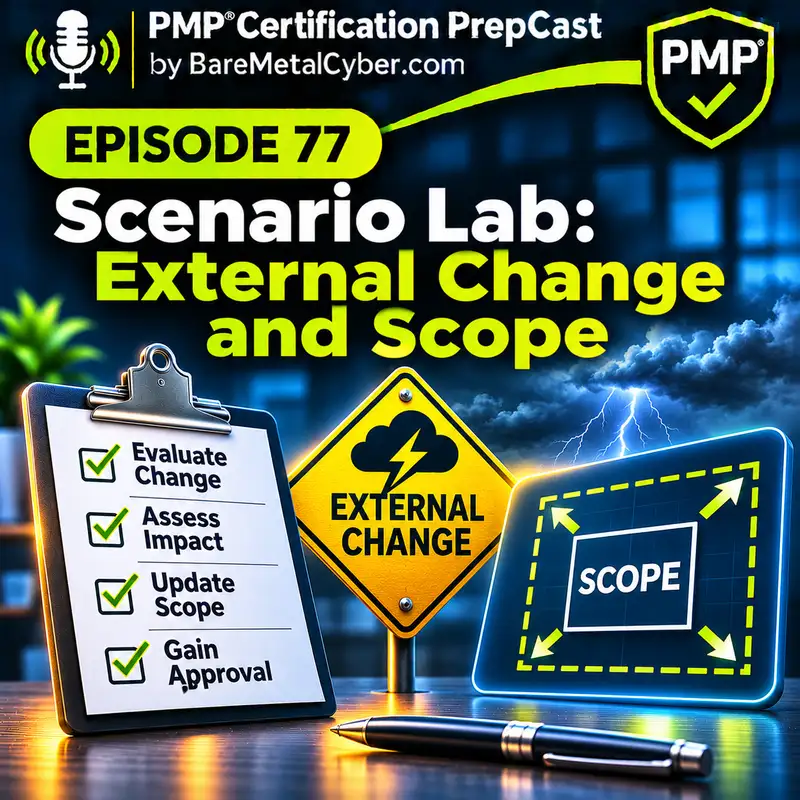
PMP 2026 | 77 | Scenario Lab: External Change and Scope
Projects never operate in a vacuum. External environments change constantly, and these shifts create pressure on scope, compliance, and delivery. Project managers must learn to detect signals early, analyze their impact, make decisions through the correct governance path, implement changes carefully, and update artifacts for traceability. This cycle, detect, analyze, decide, implement, update, is the discipline that keeps projects stable when the outside world is turbulent. It allows teams to adapt without descending into chaos, and it shows governance bodies that change is being managed responsibly. In every case, evidence and traceability remain the anchors.
Welcome to Certified, the P M P prepcast. This is episode seventy seven of season one. Today we are exploring how external changes affect scope and project decisions.
The most useful artifacts in these situations include the compliance register, the risk register, relevant contracts, and the documented change path. The compliance register captures regulations and how they are being addressed. The risk register allows managers to treat environmental changes as risk events, recording triggers and responses. Contracts define vendor obligations and protections, while the change path outlines how requests are raised, reviewed, and approved. Together, these artifacts prevent reactive improvisation. They create a system where adjustments are deliberate, documented, and defensible. Without them, projects risk losing credibility with both stakeholders and regulators.
Coordination with legal, finance, and vendor management is essential whenever external forces shift. Legal interprets regulatory or contractual changes. Finance clarifies impacts on budgets and business cases. Vendor management ensures partners respond consistently to new obligations. In large programs, failing to involve these functions early often creates gaps: contracts are misaligned, budgets are inaccurate, and regulators find inconsistencies. By bringing these functions into the loop immediately, the project manager demonstrates stewardship across the organization. This is how compliance and delivery remain balanced when outside conditions change.
Our first external-change scenario is fictional. The qualified legal and compliance owners have confirmed that a new privacy obligation applies to this release before go-live, six weeks away. It affects retention requirements and consent flows, and a vendor operates part of the data pipeline. The project manager needs a coordinated response based on the confirmed obligation, effective date and affected records. Those assumptions belong to this example. In a real project, a headline about a law would first need an applicability assessment from the responsible specialists.
The artifacts most relevant are the compliance register, which must be updated with the new regulation and planned responses, contract clauses, which define how vendors must comply, and process maps, which show where data retention and consent flows must be altered. By consulting these artifacts first, the project manager can see the scope of impact, the contractual obligations, and the process points that must change. Without this evidence base, decisions risk being arbitrary or incomplete. With these artifacts, decisions become defensible and aligned to governance.
Run a rapid impact assessment with the legal, technical, operating and procurement owners. Determine which processes and contract obligations are affected, what evidence will demonstrate the required outcome, and which options can meet the obligation before release. A limited release may be feasible if it genuinely meets every applicable condition and the required owners approve it. It is not automatically the right answer. If no acceptable option is ready, recommend delaying or pausing the affected release through the proper authority, while useful unaffected work continues where permitted.
A promise to fix a confirmed release obligation later is not a substitute for meeting it. Moving data to an unapproved location can introduce another problem. At the same time, there is no need to halt unrelated work solely because an assessment is under way. Compare feasible choices, including a narrower authorized release, a different implementation or a pause. The organization must understand the evidence and consequences of each. Protecting the announced date is one consideration within the decision, not an overriding requirement.
In a hybrid setting, iteration results can provide evidence for a required gate. A team might demonstrate a revised consent flow and its related records while the qualified owners assess whether the applicable conditions are met. The increment is a source of evidence, not automatic proof of compliance. Plan the necessary review and decision without assuming that an agile cadence either bypasses or duplicates every governance activity. The specific obligation and authority determine what is required.
Avoid rebaselining before the impact and authority are understood. Include vendor work, user preparation and operating evidence in the assessment, because a technical change can leave a process gap. Define what must be verified before release and who will make that determination. If an acceptable limited release is available, document why it meets the conditions. If it is not, state that clearly and present the required decision. A smooth delivery rhythm is useful only when the resulting service is acceptable to operate.
A new obligation may leave the original project feasible, require a major redesign, or undermine its justification. The outcome depends on the actual requirement and remaining options. Engage the responsible functions early, assess continuing value and keep decision records current. A project manager helps the authorized owners choose with evidence. The manager does not promise that every external change can be absorbed without a pause or closure.
The project manager’s leadership in this scenario lies not in doing everything personally, but in orchestrating functions. Legal interprets, vendors adapt, training addresses staff, and finance updates forecasts. The project manager ensures that all contributions are connected through artifacts and documented in governance records. This shows that external shocks are absorbed systematically, not reactively. It is leadership through facilitation, coordination, and traceability.
Keep the compliance record current as the responsible specialists establish the requirement, applicability, owner and evidence needed. Distinguish a confirmed obligation from an issue still under interpretation. Record the planned response and later the verification result. This helps reviewers understand what was done, but a register is not proof that implementation works or a legal defense by itself. Readiness depends on the actual controls and the applicable acceptance decision as well as the record.
Review the supplier agreement with the authorized contract and legal owners. Some agreements already address changed obligations; others may require a negotiated modification or a different response. The project manager should identify the work and coordination needed without assuming a right to rewrite the contract or invoke a remedy. An amendment also cannot displace an independently applicable legal obligation. Record the authorized decision and verify that the vendor's delivered work meets the agreed conditions.
Process maps complete the artifact set. They show where consent flows are altered, where retention periods change, and where evidence is captured. Updating these maps ensures that both teams and auditors can see the scope of change. They also support training, because staff can visualize where new steps apply. By ensuring compliance register, contracts, and process maps are aligned, the project manager creates traceability across legal, operational, and technical domains. This triad is the backbone of defensible compliance adaptation.
The second scenario in this lab examines a market shock. Midway through building a feature parity plan, a competitor launches a product that accelerates expectations in the marketplace. Your organization has a fixed marketing date already announced, and capacity is limited. Stakeholders are worried: if you stick to the current build, you may launch too late and appear behind. If you expand scope drastically, you risk burning the team out and missing the date anyway. This is where disciplined benefits thinking and governance pathways become essential. The external environment has shifted, and scope must be reassessed carefully.
The artifacts most relevant to this situation are the benefits management plan, the product roadmap, the backlog of prioritized items, and the risk log. The benefits management plan highlights which outcomes matter most to stakeholders, whether cost efficiency, market adoption, or customer satisfaction. The roadmap shows sequencing and timing, while the backlog holds the building blocks that make the release possible. The risk log captures the potential threats, such as losing market credibility. Together, these artifacts anchor a pivot conversation. They help teams and sponsors decide which elements of scope must be delivered first and which can be deferred.
Reassess the business case with the product and benefit owners before deciding that feature parity or differentiation is the answer. Compare the remaining cost, likely customer benefit, risks, available capacity and timing of several options. A smaller differentiating release may still create enough value, but the evidence might support a different target market, a pause or closure. Use the appropriate authority for changes to controlled commitments, and keep backlog decisions with the accountable product owner. Then update forecasts and communicate what changed and why.
Continuing the old plan without examining the new evidence can waste remaining investment. Adding people immediately may add coordination work before it adds capacity. Canceling reflexively would also skip the comparison. However, cancellation is not automatically an overreaction: it can be responsible when no remaining option justifies its future cost and risk. Money already spent is part of the history, not a reason by itself to spend more. Evaluate prospective value and seek the decision from the authorized owner.
This scenario illustrates the importance of linking benefits realization to scope management. Features are not value by themselves; they only matter if they advance strategic benefits. When the market shifts, assess the benefit assumptions with the relevant owners and recommend a response. Reprioritize only where the evidence and decision rights support it; the appropriate outcome may instead be monitoring, a different strategy, a pause or authorized closure. By doing so, the team avoids busy work that does not matter in the new environment. The backlog becomes the pivot tool, the roadmap is re-sequenced, and the benefits register is updated. Risk registers also capture the competitive threat, ensuring governance sees the adjustment as a risk response, not a random deviation.
Explain any authorized pivot in terms of its evidence, changed scope, revised forecasts and remaining uncertainty. Identify which commitments have changed and which still stand, and give affected stakeholders a practical next step. The communication should not imply that every audience has the same information needs or that a documented decision guarantees compliance. Tailor the message while keeping the underlying facts consistent.
The third scenario brings a different kind of external shock: a vendor exit. A key supplier suddenly announces bankruptcy, and your interface depends on them. The contract is still in force, but its value is rapidly diminishing, and alternate suppliers are limited. Time is critical, as your milestone is approaching. Stakeholders are alarmed, governance bodies are nervous, and the team is uncertain about next steps. This is a true external event that tests contract management, risk management, and scope planning all at once. The project manager must respond with both speed and compliance discipline.
Use the contract and statement of work to identify the affected deliverables, and involve the authorized procurement and legal owners in reviewing the supplier's status. Revisit sourcing assumptions and available alternatives. Because the supplier exit has occurred, record it as an issue with an owner and response; related future uncertainties remain risks. Possible contractual rights depend on the agreement and the applicable situation. A clause's presence does not guarantee that a particular remedy can be exercised immediately or will recover the project's loss.
Coordinate promptly with the contract owner, legal advisers and the technical team. Protect access to required project information through authorized arrangements, assess immediate continuity needs, and compare feasible alternative sourcing or redesign options. Have the appropriate owners determine which notices, rights or remedies apply. Present the remaining cost, schedule, quality and value implications to the decision maker. The project manager coordinates this work and keeps the issue record current without claiming independent authority to invoke every clause or commit to a new supplier.
Waiting without assessing continuity needs would leave the team exposed, while immediately rewriting the system could commit resources to the wrong response. Coordinate the supplier issue through the authorized owners, compare credible alternatives and preserve the evidence needed for decisions. Some options may be unavailable or may not preserve the original schedule. Report those limits directly rather than promising that a structured process will make every external shock recoverable.
Revisit contracts, sourcing assumptions and delivery dependencies when a supplier's position changes. The issue record should show the event, owner, actions and decisions, while the risk register captures remaining uncertainties. Evidence may support alternate sourcing, redesign, a pause or a recommendation to close. A systematic response improves the decision; it does not guarantee that the original project remains viable. Make those limits visible so the sponsor can act on the current situation.
The lesson also underscores the importance of maintaining strong relationships with vendor management and legal teams. External shocks often require rapid coordination across disciplines. By involving these functions early, the project manager avoids ad hoc responses and ensures policy is followed. Governance sees that decisions are coordinated, traceable, and defensible. Vendors see that accountability is real but fair. The team sees that leadership is structured, not chaotic. This builds confidence even in turbulent moments. Professionalism in external shock management is measured by calm, documented, coordinated action.
Consider a separate fictional expansion project for a regional repair depot. Its new testing station depends on an imported component, and the supplier has announced that the usual shipping route may become unavailable. The announcement is not yet a confirmed cancellation. A news report, a supplier's planning warning and a written notice about your actual shipment are three different kinds of evidence. The project manager asks the procurement owner to establish which statement applies, when a decision is required and what options remain available without making a new commitment.
The distinction changes the project record. A credible possibility of disruption belongs in the risk assessment with an owner and a review trigger. A confirmed missed shipment is a current issue, even though its final consequence may remain uncertain. The team can maintain linked risk and issue records without pretending that the event is still merely hypothetical. Neither label settles the response by itself. What matters is whether there is enough time and authority to reduce the effect on the project objective.
The supplier confirms that the original route is closed for this order. Under the current estimate, the component will arrive in week ten instead of week eight. Installation then takes two weeks, and verification takes another two weeks after installation. Assuming those tasks must be sequential and all resources remain available, the expected finish moves from week twelve to week fourteen. The project has a protected opening commitment in week thirteen. It would be misleading to report only a two-week shipping delay without showing the one-week conflict with the opening commitment and the loss of the prior buffer.
Do not restore the old date by simply overlapping tasks on a chart. Ask whether any verification preparation can genuinely occur before installation and what still requires the installed component. Preparing instructions or test data early may reduce later work, but it does not prove that the equipment functions. The technical owner might identify a legitimate resequencing opportunity; alternatively, the dependency may be unavoidable. A schedule model should represent an executable approach rather than a visual attempt to make the deadline disappear.
A verified alternate shipping route is estimated to restore the week-eight arrival at an additional cost of eighteen thousand dollars. A locally available substitute costs seven thousand dollars more than the original component and needs an estimated ten thousand dollars of adaptation work. Its preliminary schedule suggests completion in week thirteen, but compatibility evidence is incomplete. The third option retains the original component on the delayed route and requests an opening change. These are feasible candidates for assessment, not three equally authorized choices. The substitute must still satisfy technical, quality and contractual conditions.
The adaptation and price premium total seventeen thousand dollars, only one thousand less than the alternate shipping premium. That small apparent advantage does not establish that the substitute is cheaper overall. It excludes uncertainty in compatibility, extra support requirements and any additional testing that the assessment identifies. Compare equivalent cost boundaries and disclose exclusions. When alternatives are close numerically, a weak assumption can dominate the difference. Presenting seventeen thousand against eighteen thousand without explaining those boundaries would create false precision.
The opening date is connected to a customer commitment, not merely an internal preference. The commercial owner therefore evaluates the consequences of changing it, while the contract owner confirms what can actually be purchased or rerouted. The project manager cannot waive the customer condition in exchange for a lower estimate. Nor should the project manager assume that the most expensive option is automatically justified because it preserves the original date. The authorized decision needs the relevant cost, consequence, feasibility and uncertainty together.
Timing of the decision is another dependency. Suppose the alternate-route booking must be confirmed by Thursday, while the substitute's compatibility review is not expected until Friday. Waiting for complete information about the substitute would remove the shipping alternative. The decision brief should make that deadline explicit and ask whether a permitted reservation or other limited action can preserve the option. Such a reservation might have a cancellation cost or may not be available at all. Gathering more information is useful only when the organization understands what choices will be lost while it waits.
A reversible preparatory action is different from an irreversible commitment. The team may be authorized to obtain a quotation, review drawings or prepare a contingency schedule without authorizing a purchase. It should label those actions accordingly so the supplier does not interpret a technical discussion as an order. This matters when an external event creates pressure for informal promises. Clear wording can preserve cooperation without implying commercial authority that the project manager does not hold.
After the decision, external monitoring continues. A rerouted shipment may require a different receiving arrangement, an earlier customs review by the responsible specialists or revised installation staffing. These are possibilities to establish in the case, not assumptions that every shipment has identical requirements. The response can create new dependencies even while reducing the original delay. Assign ownership of those dependencies and verify that the chosen route remains available under the actual order conditions.
Now change one fact. The affected component is for an optional training demonstration, while the depot can open and meet all binding service conditions without it. The same shipping event may no longer threaten the protected opening. A permitted scope deferral and a later installation window could be proportionate, provided the relevant owners authorize the affected commitments. The physical event has not changed, but its connection to the project objective has. This is why external-change questions cannot be answered by matching the word disruption to an automatic full-project escalation.
Change a different fact instead. The component is essential, and no shipping or substitute option can meet a mandatory readiness condition. A recommendation to pause the affected opening may now be the responsible choice. The project manager should identify useful work that can continue, resources that should be protected and commitments requiring specialist attention. Calling the pause a failure of agility would confuse speed with sound judgment. Adaptation can include a controlled stop when the remaining alternatives are unacceptable.
The final communication should distinguish the external fact from the management choice. The route closure is confirmed; delivery estimates remain forecasts; the selected response is an authorized decision; successful installation is still future work. Use those different labels in the update so an estimate is not repeated later as a promise. At transition, transfer any continuing supplier-monitoring responsibility to a named owner with access to the notices and decision history. The project may end before every external dependency does.
One further control prevents churn: name a trigger for reopening the decision. For example, the selected route may be reconsidered if the supplier cannot confirm dispatch by an agreed checkpoint or if the expected arrival moves outside the remaining installation window. The trigger should reflect a meaningful decision opportunity, not every routine tracking message. Record who checks it and who decides the response. That makes monitoring actionable instead of turning the project into a sequence of anxious status meetings.
Reopening the decision does not erase the cost of switching. A canceled booking, partially completed adaptation or unavailable specialist may change the remaining options. Assess those future consequences with the current facts, while keeping money already irrecoverably spent separate from the reason to continue. An earlier decision can have been reasonable on the evidence then and still need revision now. Honest decision history allows that distinction without assigning blame merely because the environment changed again.
Across new obligations, market shifts and supplier exits, notice the same decision questions. What changed, which assumption or commitment does it affect, what value remains, and who can decide the response? Gather reliable evidence while taking any required immediate protective action. Compare the available options and implement what is authorized. Update the plan, backlog and operating expectations as appropriate. Resilience can mean adapting the delivery, but it can also mean stopping an investment whose justification has disappeared.
Ignoring an external change and reacting without analysis are both weak habits. A full halt may be unnecessary when only one component is affected, but it may be necessary when the whole release is unacceptable. A scope expansion may create value or may consume resources without enough benefit. The distinguishing evidence is the impact, feasibility and authority, not the label attached to the option. Practice explaining what fact would make each alternative appropriate before choosing the next action.
Chapter forty-three connects external change to continuing project value, and episode one hundred three develops that comparison further. Keep the project records current, involve the owners of specialist obligations and give decision makers a clear account of their choices. Do not use the original date or money already spent as a substitute for justification. The aim is an authorized response that reflects the situation now. That can preserve a delivery plan, change it substantially, or bring it to a responsible close.
For more certification study resources, books, and podcasts, visit Bare Metal Cyber dot com. Thank you for listening to Certified, the P M P prepcast.