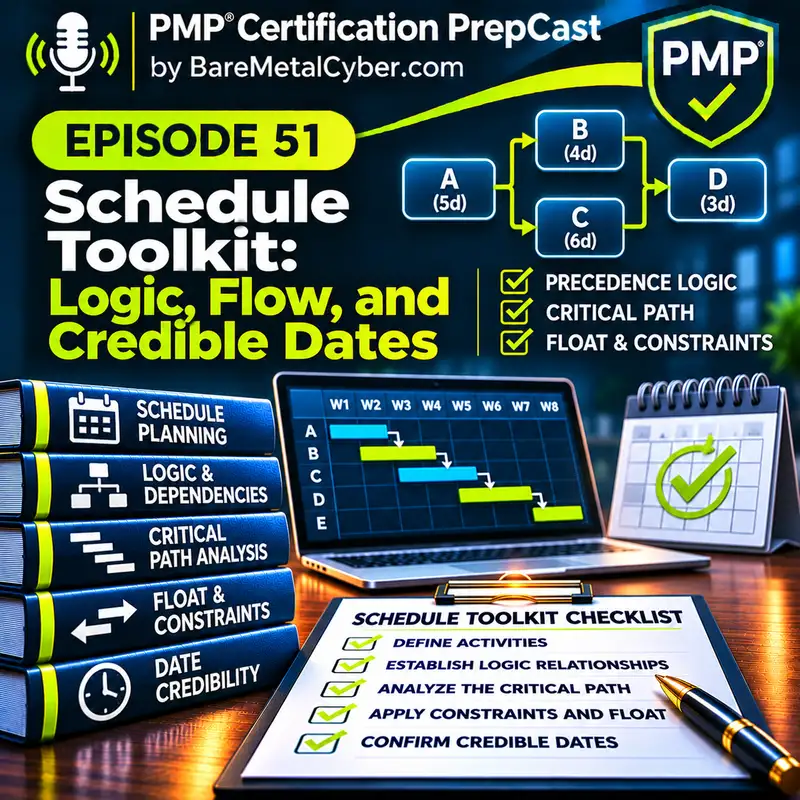
PMP 2026 | 51 | Schedule Toolkit: Logic, Flow, and Credible Dates
The purpose of schedule management is to build, communicate, and control reliable schedules that stakeholders can trust. A schedule is not just a set of dates, it is a model of how the project will flow, showing relationships, dependencies, and assumptions. This toolkit provides structure to create credible schedules that survive scrutiny and support decision-making. Outcomes include visible logic that stakeholders can follow, defendable dates backed by clear assumptions, and predictable adjustments when changes occur. Whether working in predictive, agile, or hybrid modes, schedule discipline remains essential. The artifacts may differ, but the principles are the same: clarity of logic, honesty in estimates, and visibility of progress.
Welcome to Certified, the P M P prepcast. This is episode fifty one of season one. Today we are exploring practical tools for schedule logic, delivery flow, and credible forecasts.
A strong schedule produces outcomes that matter to both teams and executives. Stakeholders gain confidence when they see how milestones are connected rather than just hearing dates. Teams benefit when they understand the flow of work and can anticipate upcoming dependencies. A credible schedule allows early detection of slippage, giving managers time to act before deadlines collapse. Predictability is the hallmark of schedule discipline. On the exam, stems that describe “missed milestones, conflicting calendars, or opaque logic” test whether the project manager created a defendable, integrated schedule. Correct answers emphasize transparency, logic, and predictability over optimistic promises.
The toolkit applies across delivery modes. Predictive projects often use detailed schedules with dependencies, milestones, and baselines. Adaptive projects may forecast from backlog order, available capacity, throughput, cycle time, or a stable team’s velocity. These are chosen practices rather than requirements of every agile approach. Hybrid projects combine both, using timeboxed sprints or iterations mapped against milestone forecasts. Tailoring ensures that regardless of method, the project has credible dates that can be defended and adjusted systematically. P M I emphasizes that a schedule must be more than a document, it is a living model that informs decisions daily. On the exam, distractors that suggest “backlog means no schedule” or “baseline means no flexibility” are incomplete.
Inputs and assumptions shape every schedule model. At the foundation are scope documents or work breakdown structures in predictive projects, or product backlogs in agile contexts. Calendars provide working and non-working days, including holidays, weekends, and planned shutdowns. Constraints may include immovable deadlines, compliance reviews, or blackout windows where no work can occur. Resource assumptions, such as availability of specialized staff or equipment, influence activity sequencing. Interfaces and external dependencies must also be captured early, since they often drive critical path uncertainty. On the exam, stems about “schedule slippage due to missed dependency” highlight poor identification of inputs. Correct answers emphasize mapping scope, resources, and constraints clearly.
Compliance and blackout windows deserve careful attention. For instance, an organization may prohibit a financial system upgrade during fiscal close, and a project may have regulatory hold points that must be built into its schedule. Confirm which restrictions actually apply. External vendors may also provide their own calendars, which must be reconciled with internal plans. These constraints are not inconveniences; they are part of reality. Data date discipline is also critical, reports must consistently identify the point in time up to which actuals are measured. Linking assumptions to an assumption log ensures they are reviewed and updated. On the exam, distractors that treat assumptions as static are traps. Correct answers emphasize ongoing review and integration.
Building the schedule model begins with sequencing activities and defining the actual dependency. In a finish-to-start relationship, the successor cannot start until its predecessor finishes, subject to any stated lag or lead. In a start-to-start relationship, the successor cannot start until the predecessor has started; their starts need not be simultaneous. A finish-to-finish relationship constrains the successor’s finish by the predecessor’s finish, without requiring both to finish at the same moment. The less common start-to-finish relationship constrains the successor’s finish by the predecessor’s start. Leads and lags refine these relationships, but they must represent defensible work logic and visible risk. For example, beginning a suitable test activity before all development ends may create rework if its inputs later change.
Milestones give shape to the schedule by marking significant points in time. They may represent contractual delivery dates, governance reviews, or key handovers. Milestones are zero-duration markers that provide clarity for stakeholders without cluttering detail. Working and non-working time must also be set correctly, failure to account for weekends, holidays, or shift schedules creates misleading forecasts. Resource assumptions are captured at this stage for later leveling or smoothing. This ensures that preliminary logic is grounded in resource reality rather than unlimited capacity. On the exam, distractors that assume “resources always available” highlight unrealistic modeling. Correct answers emphasize calendars and resource assumptions as integral to schedules.
Resource assumptions deserve explicit recording. For example, if a specialist is assumed to be available full time, but in reality they are shared across projects, schedule slippage is likely. By documenting these assumptions, project managers can revisit them during leveling or smoothing and adjust accordingly. P M I emphasizes that ignoring resource constraints produces fragile schedules that collapse under scrutiny. On the exam, stems about “specialist unavailable but not reflected in plan” highlight this risk. Correct answers emphasize recording and testing resource assumptions explicitly. This strengthens schedule credibility and prepares the team for realistic planning conversations.
Estimating durations is another core step. One-point estimates assign a single value to activity duration, while three-point estimates account for uncertainty by defining optimistic, most likely, and pessimistic values. These estimates are often combined into expected durations using weighted averages. Reference classes and historical data provide reality checks by comparing planned durations to actuals from similar projects. Addressing optimism bias is critical; teams often underestimate time required, assuming best-case scenarios. Tie estimates to the relevant completion and verification conditions, using a Definition of Done when the chosen framework calls for one. On the exam, correct answers emphasize transparency in assumptions.
Historical data helps counter optimism bias. For example, if previous testing cycles averaged three weeks, a one-week estimate without significant changes is suspect. Project managers use such comparisons to challenge assumptions and create more reliable durations. Three-point estimates also help communicate uncertainty, showing that durations are ranges rather than absolutes. This allows stakeholders to understand risk and plan contingencies. P M I emphasizes that estimating is not about precision but about credibility. On the exam, distractors that suggest “assume optimistic case” are misleading. Correct answers emphasize data-driven, transparent estimates tied to quality standards.
Tie estimates to the work’s actual completion conditions. If code review, integration testing, documentation, or qualified inspection is required, include that effort in the estimate. In Scrum, the Definition of Done describes the quality state required for an Increment; item-specific acceptance criteria and any contractual acceptance process serve related but distinct purposes. Do not assume that all three are interchangeable or that a stakeholder meeting is always required before work can meet the Definition of Done. Hidden review or handover work creates unreliable estimates when it is left outside the plan.
Once sequencing and durations are established, the project manager creates a schedule baseline. This baseline represents the approved plan for how the project will unfold over time. It must align with scope and cost baselines so that changes across one baseline cascade correctly into others. Without alignment, inconsistencies arise, cost forecasts may assume different dates than schedule forecasts. P M I emphasizes that integration across baselines is essential for credibility. On the exam, distractors that suggest “independent baselines with no synchronization” are incorrect. Correct answers emphasize establishing and aligning a schedule baseline with other core baselines.
Communicating the baseline requires using appropriate visuals for different audiences. Network diagrams reveal logic, showing how tasks connect and where critical paths emerge. These are useful for project teams and analysts. Gantt charts or timeline views provide clarity for stakeholders who prefer a more accessible format. Both serve important purposes, logic for analysis, timeline for communication. P M I stresses that tailoring visuals increases understanding and stakeholder confidence. On the exam, stems about “stakeholder confusion due to technical diagrams” highlight this. Correct answers emphasize using both logic-driven and stakeholder-friendly views to communicate the baseline.
Schedules should also communicate uncertainty rather than promise false precision. Instead of saying “this project will finish exactly on September fifteenth,” a project manager may share a forecast range, such as “between mid-September and early October.” This range reflects uncertainty while still providing stakeholders with credible planning data. Communicating uncertainty openly builds trust and prevents disappointment later. P M I emphasizes that honesty about uncertainty is part of professional schedule management. On the exam, distractors that assume exact dates are always reliable are misleading. Correct answers emphasize ranges, forecasts, and early-finish windows.
Controlling and forecasting schedules requires steady cadence and discipline. Project managers track not only completed work but also remaining durations and near-critical paths. The critical path is the longest-duration path through the schedule model and determines the earliest possible project finish under that model. In a simple unconstrained example it has zero total float; imposed dates and constraints can produce different float conditions. Near-critical paths with little float also need attention. Forecasting must be updated on a clean data date, meaning all reports refer to the same “as of” time. Without this, conflicting reports create confusion. Regular updates reveal slippage early and allow corrective action before deadlines collapse. On the exam, distractors that suggest “wait until major slippage” are wrong. Correct answers emphasize monitoring continuously and updating forecasts predictably with a focus on early detection.
Schedule forecasts must be communicated before dates drift into crisis. A project manager who sees tasks slipping communicates impacts with options, rather than waiting until stakeholders discover problems. For example, if a key milestone appears to be slipping by two weeks, the P M presents choices: accept the delay, add resources, resequence work, or reduce scope. By showing impacts and trade-offs clearly, stakeholders can make informed decisions. Use enough impact assessment for the decision, while taking any immediate action already required or authorized. On the exam, stems about “hiding slippage” highlight weak governance. Correct answers emphasize analyzing, communicating options, and updating forecasts with transparency.
Forecasting is not about perfection but about credibility. Project managers should avoid giving overly precise dates and instead focus on reliable ranges based on evidence. Communicating uncertainty openly prevents over-commitment. For example, saying “we expect completion between mid-July and early August” is more credible than promising “July fifteenth” with no buffer. Stakeholders appreciate transparency, especially when paired with clear reasoning. P M I stresses that credibility builds trust, which is more valuable than artificial certainty. On the exam, distractors that equate precision with accuracy are misleading. Correct answers emphasize forecasting with realistic ranges, tied to actual performance trends and assumptions.
Network analysis uses a forward pass to calculate early start and early finish values and a backward pass to calculate late start and late finish values. For a consistently defined activity and calendar, total float is late start minus early start, or late finish minus early finish. It describes how much an activity may slip without delaying the relevant project finish or violating the applicable schedule constraint. In a simple unconstrained network, the longest-duration path has zero total float and determines the earliest project finish. Do not assume every real schedule must show zero float on that path: imposed completion dates and other constraints can create positive or negative float. Check the stated network assumptions before interpreting the numbers.
Work through a fictional equipment commissioning schedule without a diagram. The model starts at elapsed day zero, uses a seven-day working calendar, and assumes adequate independent resources unless we change that assumption explicitly. Design takes four days. After design, fabrication takes six days while site preparation takes three days in parallel. Installation takes two days and cannot start until both fabrication and site preparation finish. Commissioning takes three days after installation. These conditions are part of this example, not rules for every project.
The forward pass starts with what can happen earliest. Design finishes at day four. Fabrication then finishes at day ten, while site preparation finishes at day seven. Installation must wait for both inputs, so it starts at day ten and finishes at day twelve. Commissioning finishes at day fifteen. The route through design, fabrication, installation, and commissioning therefore determines the fifteen-day earliest finish. The other route takes twelve days, but it cannot deliver the project by itself because fabrication is still required.
Now calculate backward from day fifteen. Commissioning must start by day twelve, and installation must start by day ten. Fabrication must therefore start by day four to finish by day ten. Site preparation, which takes three days, could start as late as day seven and still finish by day ten. Its early start is day four and its late start is day seven, giving three days of total float. This calculation makes the flexibility explicit instead of describing site preparation vaguely as not urgent.
Suppose the site team reports a two-day delay to its start. Its finish becomes day nine, still before installation can begin at day ten. The project finish does not change in this model, although two of the three available float days have been consumed. A four-day start delay is different. Site preparation would finish at day eleven, installation would finish at day thirteen, and commissioning would finish at day sixteen. The site route now controls completion. The manager must recalculate the network rather than continue treating fabrication as permanently critical.
Float belongs to the connected schedule, not to an individual manager as spare time to spend without coordination. The site manager may see three free days while a shared equipment supplier is also assuming those same days provide delivery protection. Those are not necessarily two separate cushions. Discuss how decisions consume the available flexibility, update the forecast, and keep the relevant owners informed. A task can remain within its own late finish while still increasing exposure elsewhere if resource or delivery assumptions change.
Return to the original model and consider a compression offer. Fabrication can be shortened from six days to four by paying eight thousand dollars for an additional qualified production shift. Its finish moves to day eight. Site preparation still finishes at day seven, so installation starts at day eight and commissioning finishes at day thirteen. The offer buys two days in this model. The simple incremental cost is four thousand dollars per day saved, but that ratio is useful only after confirming that the shift can actually deliver the proposed reduction without unacceptable quality or fatigue risk.
A second offer would shorten site preparation by two days for three thousand dollars. That is cheaper per day of activity reduction, but the original project would still finish at day fifteen because fabrication continues to control installation. The comparison is not eight thousand versus three thousand for apparently similar acceleration. It is eight thousand for two days of project improvement versus three thousand for more float on a noncontrolling route. Additional float can have risk value, but the manager should describe that benefit honestly rather than sell it as an earlier completion date.
The sponsor then asks for a day-twelve finish. The fabrication offer alone cannot achieve it. Perhaps commissioning can be shortened safely, but that requires evidence from the people responsible for the work. Perhaps a limited operational handover can provide useful capability before full commissioning, but only if the requirements, safety conditions, and acceptance authority allow it. A contractual date does not make an infeasible network feasible. Show the remaining gap and the available decisions rather than force the software to display the requested finish with an unexplained constraint.
Change the resource assumption next. Suppose the same specialist must perform site preparation and supervise fabrication, and cannot do both simultaneously. The parallel logic remains technically possible, but the available resource makes the current plan infeasible. One feasible sequence is fabrication followed by site preparation, pushing installation later; another may involve securing a qualified alternate. Resource leveling resolves overallocations and can change the finish date. Resource smoothing tries to adjust use within available float without changing the controlling completion date. Neither technique creates qualified capacity merely by moving bars on a screen.
Calendar details can overturn an apparently correct calculation. Our fifteen days were elapsed days on a seven-day working calendar. If fabrication operates only weekdays while commissioning requires a weekend shutdown, simply adding fifteen calendar days to the start date will be wrong. Model each applicable calendar and the actual shutdown opportunity. A three-day slip could miss a monthly access window and create a much larger delivery delay. The network must represent that restriction rather than conceal it in an unexplained duration allowance.
At the next status date, fabrication reports that half its calendar duration has elapsed. That does not establish that half the work is complete or that the original remaining duration is still credible. Ask what has been produced, what remains, whether any rework is required, and what evidence supports the new forecast. Completed actuals should not be moved into the future to improve the picture. Future work should not be left in the past simply because nobody updated its forecast. A common data date makes these discrepancies visible.
The resulting communication can be brief but precise. The original finish was day fifteen, a fabrication option can reduce it to day thirteen, and the desired day-twelve finish still lacks a supported route. The estimate assumes independent qualified resources and the stated calendars. Identify who must decide about the extra cost and when that decision is needed to preserve the option. That report gives stakeholders usable choices while preserving the distinction between a target, a model-based forecast, and an authorized commitment.
Float analysis also identifies near-critical paths. These are activities with very little float, perhaps one or two days. While not officially critical, they are dangerous because minor delays can push them onto the critical path. Project managers track these paths closely and protect them from risks. P M I emphasizes that protecting logic comes before compressing durations. Understanding where float exists allows managers to prioritize corrective action. On the exam, distractors that suggest “ignore near-critical” are incomplete. Correct answers emphasize monitoring both critical and near-critical paths, since both can threaten schedule predictability if left unattended.
When schedules slip, compression techniques may provide options. Crashing uses additional resources or spending to shorten feasible work, usually at increased cost. Fast-tracking overlaps activities that were planned in sequence and can increase dependency and rework risk. Compare the achievable schedule benefit, cost, resource availability, dependencies, and risk of the feasible options. The cheapest option and the lowest-risk option may be different, so select an acceptable tradeoff through the applicable authority. Check the whole network because shortening one path may leave another controlling the finish. On the exam, use the assessment already provided, or obtain the missing assessment, rather than choosing crashing or fast-tracking automatically.
Adaptive and hybrid delivery still need credible schedule forecasts. A stable team may use velocity, meaning completed estimation units per iteration, or throughput, meaning completed items per unit of time. These are different measures; cycle time measures elapsed time for an item through a defined workflow. Burnup, burndown, and cumulative flow diagrams can support the forecast when their units, boundaries, and completion rules are clear. No metric removes dependencies, mandatory reviews, or uncertainty. Choose the method that fits the work instead of assuming every agile project must use the same cadence or chart.
Hybrid projects may combine iterative delivery with planned milestones and external commitments. Map the actual work and verification to those commitments, and coordinate decision timing with the teams. Keep a stable iteration length when using Scrum, but do not assume that every hybrid project uses Sprints or that governance must preserve every existing cadence. Tailor the arrangement to the work and obligations, with clear authority for changed commitments.
Consider a vendor delay that threatens a milestone. The team is considering overlapping dependent work, which could shorten the schedule but also create rework. First establish which path controls the milestone, how much float remains, and whether any already approved response applies. Compare targeted options: resequence suitable work, add qualified resources where duration can actually be reduced, agree a phased delivery if it remains useful and permissible, or accept a revised date through the appropriate authority. Present the achievable time gain and the cost, quality, and risk consequences. A list of recovery techniques is not itself a decision, and changing scope or an external commitment still requires its authorized decision path.
This scenario illustrates the importance of combining schedule logic with value thinking. Instead of rushing to protect every deliverable, project managers focus on delivering slices of value on time, even if lower-priority elements are delayed. By sequencing to protect benefits, credibility is maintained. Selective compression, such as crashing low-risk tasks, reduces cost and risk compared to blanket approaches. P M I emphasizes that project managers must balance urgency with discipline. On the exam, stems about “protecting dates without analysis” test this principle. Correct answers emphasize impact analysis, phased delivery, and careful selection of compression tactics.
A schedule forecast can change when evidence changes without waiting for permission to report the truth. An approved schedule baseline changes only through its applicable control process, with its history retained. Do not hide a variance by moving the baseline, but do not confuse preserving the baseline with freezing the current forecast. Another pitfall is treating leads, lags, or imposed dates as substitutes for explainable logic. Show the actual dependency and the authority behind a constraint so the next decision rests on a credible model.
A quick playbook for schedule management begins with modeling logic carefully: sequence activities with dependencies, leads, and lags. Next, estimate durations honestly, using historical data and tying estimates to acceptance criteria. Establish baselines aligned with scope and cost, and communicate them through appropriate visuals. Monitor performance by tracking actuals, remaining durations, and near-critical paths. When slippage occurs, check its cause and controlling path, then compare feasible responses within the available authority. Compression is one option, not an automatic requirement. Communicate forecasts honestly, using forecast ranges with clear assumptions. Finally, maintain clean data dates, synchronize baselines, and update stakeholders predictably. On the exam, correct answers echo this rhythm rather than shortcuts or promises without analysis.
In summary, the schedule management toolkit ensures credible, defendable dates by emphasizing visible logic, realistic estimates, and disciplined forecasting. It reinforces math concepts like float and compression while adapting tools for agile, predictive, and hybrid environments. P M I emphasizes that schedule management is not about rigid dates but about credible models that guide decision-making. Pitfalls like unsupported promises, premature re-baselining, or hidden dependencies undermine trust. A defensible response uses schedule logic, transparent evidence, and the authority appropriate to the situation. A well-managed schedule gives the project its heartbeat, steady, predictable, and credible, enabling value delivery with confidence.
For more certification study resources, books, and podcasts, visit Bare Metal Cyber dot com. Thank you for listening to Certified, the P M P prepcast.