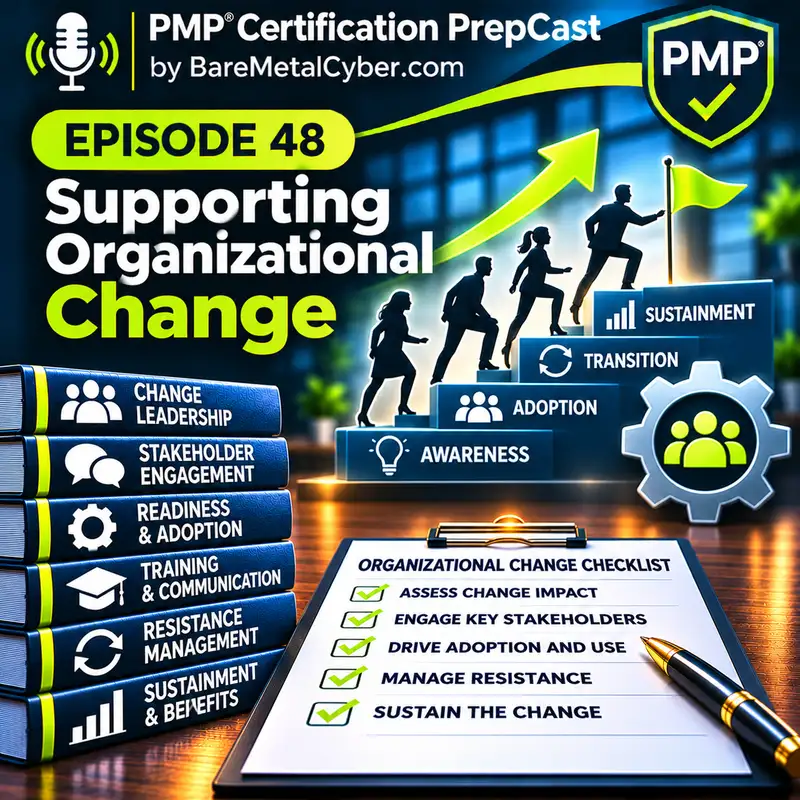
PMP 2026 | 48 | Supporting Organizational Change
Projects change organizations, and organizational changes also reshape projects already in progress. A project may introduce a new workflow whose benefits depend on adoption. A merger, reorganization, leadership transition, or strategy change can also alter the people, authority, resources, and assumptions supporting that same project. The current Business Environment task covers both directions, including organizational culture and the effects of change on the project. The project manager partners with sponsors, managers, and affected people to make the transition workable. That requires more than a training plan. It requires evidence of what changed, who can now decide, what capacity remains available, and whether the intended outcome still makes sense.
Welcome to Certified, the P M P prepcast. This is episode forty eight of season one. Today we are exploring how to support organizational change and its effect on project delivery.
Supporting organizational change requires readiness assessments. Change cannot be forced effectively if stakeholders are unprepared. A readiness assessment identifies which groups are impacted, how they will be affected, and whether they have the knowledge and ability to succeed. It also evaluates saturation, how many other changes are already competing for attention. Identify people who can support the transition and people raising concerns, then verify their working conditions. Avoid attaching a permanent resistor label to someone whose objection may reveal a missing resource, an access barrier, or an unrealistic expectation. Understanding incentives and fears helps craft messages and interventions. Readiness assessments allow project managers to anticipate barriers instead of reacting late. On the exam, distractors that suggest “just deliver and people will adapt” are incorrect. Correct answers emphasize readiness planning.
Readiness also involves assigning ownership of risks. If a group shows high resistance potential, a risk entry should be created with a named owner and mitigation plan. Timing is equally important, launching change during peak operational periods or fiscal close can create unnecessary resistance. The project manager aligns change timing with the organization’s calendar to minimize disruption. This kind of foresight strengthens adoption and demonstrates empathy. On the exam, stems describing “resistance due to poor timing” highlight failures in readiness assessment. Correct answers emphasize mapping readiness, capturing risks, and aligning schedules to stakeholder realities.
Once the impacts are understood, choose a change strategy that fits them. One optional model is A D K A R, which considers awareness, desire, knowledge, ability, and reinforcement. Awareness concerns understanding why change is needed. Desire concerns willingness to participate and support it. Knowledge concerns what people need to know, ability concerns applying it in practice, and reinforcement concerns sustaining it. The model can help diagnose a gap, but it is not a required P M I sequence or a guarantee of adoption. Training may help a knowledge gap. It will not restore a specialist allocation that a reorganization has removed. Match the intervention to the observed condition.
A phased strategy can begin with a small viable behavior change when the operating conditions permit it. Some transitions require coordinated changes or minimum readiness across every affected group, so test the feasibility of a staged introduction. Instead of overwhelming people with a massive shift, change is broken into digestible steps. For example, adopting a new system might begin with using one feature consistently before migrating everything. Visible sponsorship is also crucial, leaders must show support not just in words but in actions, attending demos, and modeling usage. Peer advocacy amplifies messages, as people often trust colleagues more than formal communications. The project manager ensures the pace of change aligns with delivery cadence, reinforcing adoption step by step. On the exam, correct answers highlight pacing and sponsorship.
Communications are the backbone of change adoption. A communication plan must address the “why, what, when, and how” of change, along with a vital question: “what support will I receive?” Messages should explain purpose, timing, impacts, and benefits. Communications must be multi-channel and ongoing, emails, meetings, town halls, and dashboards reinforce the message. Equally important is feedback: questions and concerns should be tracked and addressed. P M I emphasizes that communication is dialogue, not one-way broadcasting. On the exam, distractors that describe “sending one mass email” are incorrect. Correct answers emphasize structured, two-way communication.
Training is another critical component. A well-designed training mix includes demonstrations, job aids, micro-lessons, pairing opportunities, and formal sessions where required. Training must be relevant, practical, and timed to when people actually need the skills. Accessibility is important, materials should be clear, jargon-free, and adapted to diverse audiences. Office hours or drop-in questions and answers sessions provide additional support. Questions raised during training should be captured and incorporated into updated job aids or frequently asked questions. On the exam, correct answers emphasize practical, accessible training embedded in the workflow, not one-time theoretical sessions.
Language and inclusivity are important in both communication and training. Leveling language ensures all participants can understand, regardless of technical or organizational background. Using plain terms, translated examples, and inclusive visuals avoids alienation. Accessibility also includes considering disabilities, time zones, and cultural differences. A successful change plan ensures all impacted groups can participate fully. P M I emphasizes inclusivity as part of ethical stewardship. On the exam, stems describing “some groups left behind due to inaccessible training” highlight this failure. Correct answers emphasize inclusivity and accessibility in planning.
Adoption must be reinforced and measured. Deployment is not the end, measuring usage, error rates, cycle times, or satisfaction indicates whether people are truly adopting. Reinforcement mechanisms include recognition, coaching, and ongoing feedback loops. Plan the retirement of old paths deliberately. A parallel period, fallback route, assisted service, or retained record may still be required. Retire a legacy path only when the authorized transition conditions, continuity needs, and retention duties are satisfied. Updating procedures, incentives, and performance metrics ensures that new behaviors are embedded. The project manager works with managers and sponsors to publish progress transparently, showing adoption metrics and highlighting value realized. On the exam, distractors that declare “change complete at deployment” are incorrect. Correct answers emphasize measuring and reinforcing adoption.
Reinforcement also involves celebrating small wins. Recognizing early adopters and acknowledging progress builds momentum. Coaching helps late adopters feel supported rather than punished. Feedback loops ensure adjustments are made based on real experiences, not just assumptions. Publishing adoption progress maintains stakeholder trust and ensures accountability. If adoption metrics show value leakage, corrective actions can be taken early. P M I stresses that reinforcement is ongoing, not a one-time action. On the exam, stems describing “team reverted to old process” test whether reinforcement was addressed. Correct answers emphasize sustaining adoption through reinforcement.
Adoption metrics provide objectivity. Usage statistics, error rates, or customer satisfaction scores reveal whether behaviors are changing. These metrics should be visible and tied back to benefits. If adoption lags, value realization lags as well. For example, use by only half the intended staff may threaten savings, but the size of that effect depends on their work volume and how the benefit is produced. Usage counts are a signal to investigate, not proof of a proportional financial shortfall. The project manager monitors adoption metrics and escalates risks when value is threatened. On the exam, correct answers emphasize using adoption data, not assumptions, to measure success. Data-driven adoption measurement anchors change management in evidence.
Competing processes can undermine adoption, but retiring them requires an operating decision. Ask why people still use the old route. It may be habit, a missing feature, an accessibility need, or an approved fallback. Repair the actual gap, then work with the accountable owners on the cutover, support, and retirement plan. Update procedures and incentives so normal work supports the intended behavior. Making an old path harder without making the new path usable can hide failure and increase exposure. The objective is a reliable transition with appropriate access and support, not a usage statistic produced by removing every alternative.
Adoption is not purely about compliance, it is about ensuring benefits flow. If people revert to old ways, benefits vanish, even if technical delivery was flawless. Project managers therefore link adoption metrics directly to benefit realization. For example, adoption rates of a new tool may be tied to productivity gains or cost savings. By connecting adoption to value, the project manager demonstrates why reinforcement matters. On the exam, stems that describe “we shipped but no value appeared” test this principle. Correct answers emphasize connecting adoption to benefits realization.
A fictional facilities organization introduces a digital work-order process. Leadership expects better visibility into maintenance demand, fewer lost requests, and clearer priorities. The application is technically deployed and every supervisor has attended a demonstration, yet many requests still arrive by telephone and are completed without a digital record. The manager should not begin by assuming that staff are lazy or hostile to change. The observed behavior establishes an adoption gap. It does not yet explain whether the cause is usability, access, workload, incentives, trust, or a legitimate operational exception.
Observe representative work with the affected people. A technician on an early shift may share a device that is unavailable when jobs are assigned. A supervisor may receive urgent calls while away from a desk. Another team may not understand which requests belong in the new process. These conditions need different responses. Access and equipment problems call for operational enablement. Ambiguous scope calls for clearer instructions and examples. A skill gap may need guided practice. Repeating the same introductory presentation for everyone would consume time without necessarily changing the barriers.
The behavior to be adopted should be explicit. In this example, eligible requests are recorded with enough information to prioritize them, assigned through the agreed process, and closed with a usable completion record. Logging in once a week does not establish that behavior. Nor does entering old requests in bulk at month-end provide the same planning visibility as recording them when work is assigned. The change team should agree which steps matter to the intended outcome and how the timing and quality of use will be measured.
Suppose two hundred requests were eligible during a pilot period. One hundred twenty appeared in the new system, giving sixty percent coverage. Only ninety contained the information and timely updates needed for the intended workflow. That is forty-five percent effective use across the eligible population. It is also seventy-five percent completeness among the one hundred twenty recorded requests, but those percentages answer different questions. State the denominator instead of selecting the most flattering number. These invented results reveal both a participation gap and a quality-of-use gap, which may need different interventions.
The pilot should also examine operational outcomes. Are fewer requests lost? Can supervisors prioritize work with the available information? Are technicians spending excessive time on duplicate entry? A high recording percentage would not prove value if staff still rely on a separate private list for every real decision. Conversely, a temporary parallel record may be an authorized safeguard during transition. Establish why the extra route exists and what condition will allow it to end. Removing all alternatives merely to force a better adoption statistic can conceal an unusable process.
Manager incentives can explain persistent behavior more clearly than another training survey. Imagine supervisors are rewarded only for the number of jobs completed each shift, with no time allowed for the agreed completion record. They tell staff to use the system while privately encouraging them to skip the record when busy. The project manager needs to raise that conflict with the responsible managers and sponsor. Adjusting priorities, workload expectations, or measures may require authority beyond the delivery team. Staff should not be blamed for responding to contradictory directions that leadership has not resolved.
Visible sponsorship then becomes specific action. A sponsor can use the agreed work-order information in a review, ask about missing records without humiliating individuals, and support a realistic time allowance for the new process. Supervisors can demonstrate the exception route and explain when an urgent call must still be recorded afterward. These behaviors give the change credibility. A promotional email from a senior leader is much weaker if everyday decisions continue rewarding the old process. Reinforcement aligns the organization around the behavior instead of simply repeating that change is important.
Choose a pilot boundary that can actually operate. One site may be suitable if its requests and support arrangements are sufficiently independent. If several sites share a dispatcher and equipment pool, changing only one may create conflicting rules that invalidate the test. Assess those dependencies before assuming a small pilot is always safer. Give the participating group clear support, feedback channels, and an agreed way to report problems. A pilot is an opportunity to learn about the whole workflow, not a demonstration arranged only with enthusiastic users and unusually favorable conditions.
Now change the organization around the project. During rollout, two facilities teams are merged and the supervisor who owned acceptance moves to another role. Confirm the effective change, current authority, and resource commitments. The merger does not automatically invalidate all earlier decisions, but it may change who can make new ones or support the service. A training plan aimed at the old roles may no longer fit. Update the impact assessment and involve the people now accountable rather than continuing to seek approval from someone who no longer holds the decision right.
Change saturation can make the revised plan unrealistic. The same staff may also be learning a new roster system and preparing for a seasonal workload peak. Assess the combined demands with their managers. Options might include different sequencing, additional support, or a narrowed initial scope, subject to the project's commitments. Do not silently assume that staff will absorb unlimited change through overtime or enthusiasm. Supporting adoption includes making capacity and trade-offs visible so the appropriate owners can choose a workable transition.
Before retiring the old normal process, verify the agreed readiness and continuity conditions with operations. Staff should be able to perform representative tasks, obtain support, and handle the defined exceptions. Preserve records and fallback arrangements where required, and communicate which route is authoritative after the cutover. Continue measuring effective use and outcomes during stabilization. If people revert, investigate the reason rather than immediately treating the reversion as misconduct. The receiving manager then owns sustained behavior and improvement, while the project closes its transition work under an accepted handoff.
Leadership, especially middle managers, plays a central role in organizational change. Sponsors often provide vision, but it is the managers closest to frontline staff who shape daily behaviors. Equipping managers with the right tools, talking points, frequently asked questions, and coaching scripts, allows them to guide their teams confidently. Performance goals and rewards must also be aligned with the new way of working. If a manager’s metrics reward legacy behaviors, their teams will be reluctant to adopt the change. The project manager partners with human resources and sponsors to ensure alignment. On the exam, distractors that suggest “leave managers out” are traps. Correct answers emphasize enabling and equipping managers as change multipliers.
Managers must also model the change visibly. When leaders demonstrate the desired behaviors, using new tools, attending training, and reinforcing messaging, employees follow. Conversely, mixed messages erode trust. A manager who promotes a new system in meetings but privately instructs teams to “just keep using the old process” sabotages adoption. To prevent this, project managers establish forums for candid manager conversations, where concerns can be raised and blockers addressed privately. This enables managers to feel supported rather than caught between conflicting pressures. On the exam, stems about “conflicting manager behavior” highlight the need for visible role modeling. Correct answers emphasize consistency and safe spaces for alignment.
Resistance management is another critical component of organizational change. Not all resistance is negative; sometimes it highlights valid risks or overlooked impacts. The project manager diagnoses resistance to determine whether it stems from belief gaps (“I don’t see the value”), skill gaps (“I don’t know how”), capacity gaps (“I don’t have time”), or trust gaps (“I don’t believe leadership will support me”). Each requires a different intervention. Listening and clarifying value address belief gaps. Training and practice address skill gaps. Resource adjustments ease capacity gaps. Trust gaps demand credibility and sponsorship visibility. On the exam, distractors that suggest “mandating compliance” are too simplistic. Correct answers emphasize diagnosing and tailoring interventions.
Addressing resistance often requires patience and layered strategies. Coaching sessions, job aids, and peer mentoring can help resisters move forward gradually. Some resistance is situational rather than permanent. For example, an employee overwhelmed with other initiatives may embrace the change once their workload stabilizes. Escalation should be respectful and follow the decision rights and thresholds that apply. A capacity conflict, missing authority, material benefit risk, or leadership incentive problem can also require a timely decision beyond the project team. Documenting outcomes ensures transparency and creates accountability. P M I emphasizes that resistance is not ignored but managed systematically. On the exam, stems describing “persistent resisters” test whether you escalate with respect and documentation rather than bypassing the issue.
Another key to resistance management is celebrating progress when resisters turn into adopters. Recognizing small shifts demonstrates that resistance can be overcome and encourages others to follow. It also reinforces the principle that adoption is a journey, not a one-time mandate. P M I stresses that supportive reinforcement, rather than punishment, sustains momentum. On the exam, distractors that focus on punishment over coaching are misleading. Correct answers emphasize patience, reinforcement, and measured escalation when necessary.
Consider an operations team that keeps reverting to the old tool after a new deployment. Usage data establishes the pattern, but it does not explain the cause. Talk with the affected users and observe representative tasks. If they understand the process but cannot get the required access, another class is unlikely to solve the problem. If a revised step is unclear, targeted coaching and an improved job aid may help. If a manager still rewards the old process, involve that manager and the appropriate leader. Agree the support, responsibility, and follow-up measure, while maintaining any required operating safeguards. A mandate alone does not diagnose the gap, and a declared launch does not establish adoption.
Where applicable obligations require training, competence, or procedure records, plan the evidence and keep it current. Attendance can prove that someone participated, while an independent task demonstration provides different evidence about capability. A policy acknowledgment alone does not show that someone can handle an exception correctly. Work with the responsible assurance specialists to establish which records are required, who may see them, and how they must be retained. Missing required documentation can be a compliance gap in its own right, but its absence does not by itself prove that every activity failed to occur. Report the actual gap and resolve it through the approved process.
Exam pitfalls in organizational change are common. One is treating change as a single communication blast rather than a continuous, multi-channel dialogue. Another is conducting training once and assuming adoption will stick, without reinforcement or measurement. A third is ignoring managers, allowing conflicting incentives to undermine adoption. Finally, a frequent mistake is declaring the change “done” at deployment rather than at adoption. P M I emphasizes that projects succeed when benefits are realized, and benefits only flow when adoption is sustained. On the exam, distractors often embody these pitfalls. Correct answers emphasize dialogue, reinforcement, manager alignment, and sustained adoption.
Another trap is confusing activity with adoption. Sending emails and running training sessions does not guarantee behavior change. Adoption requires evidence in metrics: system usage, cycle times, error rates, and satisfaction levels. Without data, leaders may assume change is complete when people quietly revert to old behaviors. P M I stresses that metrics protect against illusions of progress. On the exam, stems that describe “team still using old process despite training” test this. Correct answers emphasize measuring adoption and reinforcing behaviors, not assuming activity equals change.
Projects sometimes overlook the human side of benefits realization. Deliverables may technically enable benefits, but unless people adopt new processes, the value never materializes. A system built to reduce errors saves nothing if staff avoid using it. Link adoption evidence to outcome measures to test whether the expected contribution is appearing. A correlation can support further investigation without proving that behavior change caused every observed benefit. On the exam, distractors that suggest “deliverable complete equals benefits realized” are incomplete. Correct answers emphasize adoption as the bridge between delivery and benefits.
When the organization changes around the project, confirm the decision, effective date, and uncertainty before changing commitments. Trace its effects through sponsor and acceptance authority, benefit ownership, qualified capacity, information access, and operating support. A newly appointed manager does not automatically invalidate prior approvals, but a departed manager may no longer be able to make new decisions. Preserve the history and establish an interim authority where necessary. If a promised specialist allocation shrinks, quantify the gap and compare feasible resource, sequencing, or commitment options with the people who can authorize them. Do not silently assume overtime or count unqualified staff as interchangeable capacity. Then update the affected plans and communicate the new arrangements.
Culture becomes visible in ordinary decisions: what leaders reward, what happens when someone reports bad news, and whether people can question an unworkable target. Examine those conditions without inferring an individual’s attitude from a profession, country, age, or location. Supporting change combines that understanding with practical enablement, clear decision rights, and representative readiness evidence. Confirm continuing ownership before the project team disbands, and distinguish completed transition work from benefits that still require observation. Organizational change is managed well when people can perform the new work and the project can adapt to the organization’s changed conditions with honest commitments.
For more certification study resources, books, and podcasts, visit Bare Metal Cyber dot com. Thank you for listening to Certified, the P M P prepcast.