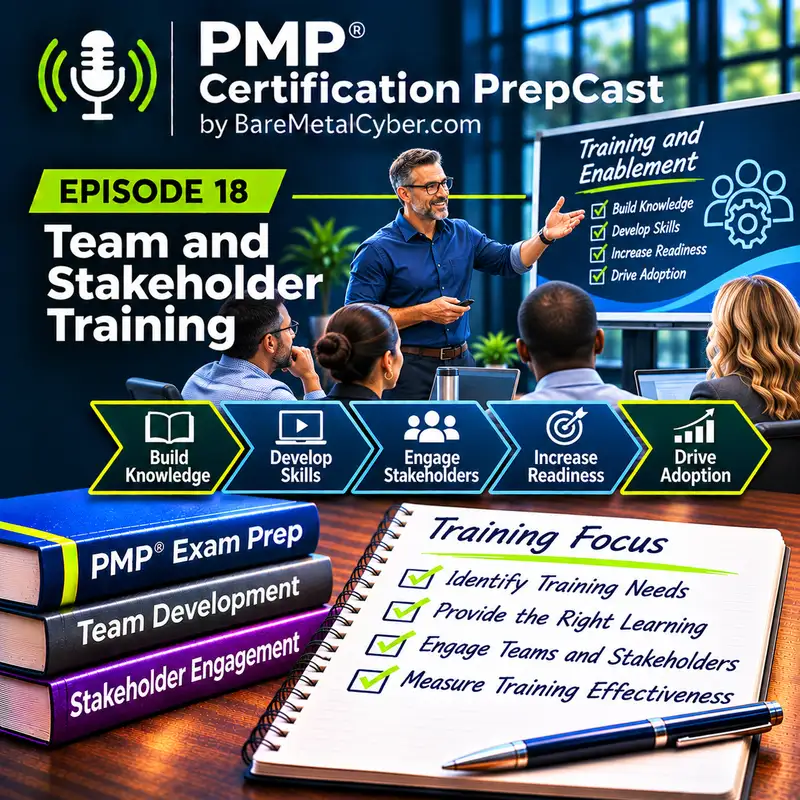
PMP 2026 | 18 | Team and Stakeholder Training
A person can attend a training session and still be unable to perform the work safely or independently. Adequate training therefore begins with the responsibility the person must carry out and the evidence that would show readiness. This supports leading the project team and helping ensure knowledge transfer in the current People domain, with connections to quality, compliance, and organizational adoption. Identify a genuine capability gap, select the support suited to it, and verify the result. The objective is prepared people, not simply a completed calendar event.
Welcome to Certified, the P M P prepcast. This is episode eighteen of season one. Today we are exploring how to identify and meet team and stakeholder training needs.
The outcomes of effective training are visible in several ways. Competence ensures work is completed to standard without repeated corrections. Quality improves when people understand both the process and the tools they are using. Safety and compliance are reinforced when required practices are communicated clearly and reinforced with evidence. Speed increases because fewer errors occur, and onboarding new members becomes smoother. Training is not an overhead cost but a value driver when linked to delivery outcomes. On the P M P exam, training questions often connect back to quality, risk, or adoption, reminding candidates that learning enables success rather than distracting from it.
The project manager coordinates the expertise, time, and support needed for learning. Define the intended result before choosing the method. A required qualification may establish permission to perform a task; a demonstration may show that a new operator can complete it correctly; refresher practice may preserve an existing capability. Faster delivery or fewer defects can be useful results, but they are not the only legitimate objectives and cannot always be attributed to training alone. Verify the capability relevant to the work and keep the evidence the requirement calls for.
Inputs to the training process include understanding upcoming work, assessing roles, and aligning with the risk profile. A skills matrix can highlight existing capabilities and reveal gaps against upcoming tasks. For example, if the team is about to implement a new security protocol, the matrix may show that no one has adequate expertise in that area. Signals of training need include repeated rework caused by misunderstandings, misuse of tools, or slow onboarding. Stakeholder readiness is another input: users adopting new systems or processes may need orientation to succeed. Regulatory or contractual requirements also drive training, such as mandatory safety certifications or compliance sessions.
Repeated errors can indicate a training need, but they can also reflect unclear instructions, defective tools, workload pressure, or conflicting requirements. Examine the returned work and observe the task before choosing a remedy. Slow onboarding may involve missing access rather than missing knowledge. Low adoption may reflect an unsuitable workflow rather than users who need another presentation. Training is useful when it addresses the supported gap; otherwise it can consume time while the actual barrier remains.
Consider a fictional organization introducing a new expense-request system. Requesters must submit the necessary information, reviewers must apply the organization's approval rules, and system administrators must manage access. A single demonstration of how to log in will not establish readiness for all three roles. The project manager begins by identifying the tasks each role must perform and what evidence would show that the person can perform them within the relevant responsibility.
For requesters, the training may include completing an ordinary request, correcting a returned request, and recognizing when a required detail is missing. Reviewers need to apply the approved rules and route an exception to the designated owner rather than invent their own exception. Administrators need the authorized access procedure and the checks their role requires. These are illustrative tasks for the fictional system, not financial or legal advice. The important point is that the training objective comes from the role and the approved process, not from the features the trainer finds easiest to demonstrate.
A pilot reveals that some users repeatedly select the wrong cost center. The team observes the task before assuming a knowledge gap. In one version, the instructions are unclear and a worked example may help. In another, the interface displays duplicate labels and the user cannot distinguish them reliably. In a third, the person's correct cost center is absent because access data has not been updated. Only the first version is primarily an instruction problem. Training everyone again would leave the other two causes unresolved.
Compliance-driven training is non-negotiable. In many industries, regulatory bodies or contracts mandate training for safety, security, or legal reasons. For example, a healthcare project may require training on patient privacy laws, while a construction project may require safety certifications before entering a work site. These requirements must be documented, scheduled, and verified, not treated as optional. The P M P exam frequently includes compliance as a training driver, expecting candidates to recognize that failure to provide required training can expose the organization to fines, lawsuits, or reputational damage. Training is therefore both a performance enabler and a risk management tool.
Combine instruction, supported practice, feedback, and reference material according to the skill and risk involved. A short demonstration may be enough for a familiar low-risk task, while a safety-critical or regulated responsibility may require a specified course, assessment, supervised practice, or qualification. No fixed percentage split between workplace learning, coaching, and classroom time establishes adequacy. Choose the mix that meets the actual requirement and helps the person apply the knowledge. Then check performance rather than assuming the method guarantees it.
Adult learning principles recognize that people learn best when training is clearly relevant and immediately useful. Adults value autonomy and prefer to understand why they are being asked to learn something. Practical exercises, demonstrations, and real-world examples help knowledge stick. Spaced repetition, returning to key concepts over time, prevents forgetting, while immediate application reinforces skills. Project managers who apply these principles create training experiences that feel valuable rather than burdensome. On the P M P exam, scenarios that emphasize relevance, practicality, and application usually reflect the right approach. P M I discourages approaches that treat training as seat time or formality alone.
Provide enough training and supported practice for the responsibility, including every mandatory element. The useful question is not how little instruction you can provide, but what the person must know and demonstrate before acting independently. Avoid irrelevant material that distracts from that objective, while planning deeper development when the role requires it. A concise job aid can reinforce a well-understood process; it cannot substitute for a required qualification. Match the depth and timing to the task, consequence, and continuing needs.
The process of ensuring adequate training begins with gap assessment. Comparing required skills to upcoming work and known risks reveals where training is needed. Once gaps are identified, the project manager selects methods that fit the context. Pairing team members spreads expertise informally. Micro-lessons or demonstrations can cover focused topics quickly. Workshops or vendor-led sessions may be used for complex tools. The next step is scheduling training so it minimizes disruption and protects cadence. Finally, effectiveness must be verified through observation, performance measures, or feedback, with adjustments made if training falls short. This cycle ensures training remains purposeful.
Pairing and short demonstrations can help with a focused practical gap, while a workshop or structured course may be appropriate for deeper understanding or a required qualification. Both consume capacity and should be planned honestly. An experienced person who teaches may need time away from other commitments, and learners need opportunities to practice. Select the method for the evidence of readiness required. Protect delivery by integrating learning into the plan, not by assuming it takes no time or that the smallest intervention is always best.
Verifying training effectiveness closes the loop. This can be done by monitoring whether performance improves after training, defects decrease, handoffs become smoother, or adoption rates increase. Feedback forms provide input but should be tied to observed outcomes rather than satisfaction alone. Adjustments may be needed if training fails to close the gap. For example, if onboarding remains slow after an orientation session, the project manager may introduce job aids or coaching. On the P M P exam, answers that include verifying effectiveness and adjusting plans are stronger than those that assume training is complete once delivered.
The training designer works backward from a practical demonstration. A requester receives a fictional transaction with the necessary supporting information and must enter it correctly in a safe practice environment. The reviewer receives a different example that contains an exception requiring a specific route. The observer checks the result and asks the learner to explain the decision. This tests more than copying the trainer's clicks because the learner must recognize the condition that changes the response.
The examples should include ordinary work and the important exceptions the person is expected to handle. They should not overload the learner with every administrator function or every rare event in the organization. A clear boundary also identifies when the learner should stop and obtain help. Readiness includes recognizing that limit. A person who completes a familiar example quickly but improvises beyond their authority when the facts change may need additional practice before independent use.
Feedback should identify the actual gap. If a reviewer routes an exception correctly but records an incomplete rationale, the trainer can focus on the required evidence rather than repeating the entire course. If a requester cannot distinguish two similar categories, contrasting examples may be useful. If an administrator lacks authorized access to the practice environment, the project must resolve that prerequisite. The training plan should respond to these different conditions instead of treating all unsuccessful attempts as the same failure.
Assessment and attendance evidence should be kept distinct. A participant can attend every session and still need supported practice. A capable participant may already know most of the system but still need the specific formal completion evidence required by the organization. The project manager should not substitute one for the other. The relevant requirement defines which records must be retained, and the demonstrated capability informs whether additional support is needed.
Artifacts and logistics make training visible and structured. A skills matrix documents capabilities and helps plan who needs what support. A training plan outlines sessions, timing, and budget. Calendars keep training integrated with project cadence. Budgets ensure resources are allocated appropriately. These artifacts support planning and transparency, allowing stakeholders to see that training is not ad hoc but part of the delivery strategy. The exam often highlights whether candidates use structured artifacts to manage training or rely on informal memory. Correct answers usually emphasize visibility and planning.
Job aids, checklists, recorded demonstrations, and standard operating procedures extend training into daily work. These resources allow people to refresh their memory without attending repeated sessions. For example, a job aid might summarize the steps to configure a tool correctly, reducing errors. Attendance records and completion certificates provide compliance evidence when required. Feedback forms, tied back to performance outcomes, ensure that training translates into results. The exam reflects these practices by rewarding answers that emphasize both documentation and practical reinforcement. Training that is not reinforced risks fading quickly, leaving gaps unresolved.
The training approach should now be clear: identify the capability the work requires, establish what is missing, and select instruction and practice that meet the need and any mandatory conditions. Account for the time and support involved, provide usable guidance, and verify that the person can perform the task. Retain required evidence and assign responsibility for keeping knowledge current. This connects learning with readiness instead of measuring success only by attendance, duration, or the smallest possible intervention.
Training methods can be used in predictive, adaptive, or hybrid projects. A predictive team can learn through pairing and frequent feedback, and an adaptive team can need formal instruction or certification. In Scrum, a Sprint Review inspects product outcomes; it is not a substitute for every training requirement. A bounded research task can reduce technical uncertainty, while a skills gap may require guided practice. Select and schedule the learning according to the need, risk, prerequisites, and resource availability rather than the delivery label alone.
Make learning visible in the team's capacity and commitments. If a specialist will mentor another person for several sessions, account for both participants' time and the support needed afterward. If vendor instruction or assessment has a fixed date, connect it to the activities that depend on readiness. Review feedback as people apply the skill and adjust the support where gaps remain. Continuous learning can occur in any approach, while required evidence and approval conditions continue to apply.
Capacity planning makes the learning feasible. Suppose a qualified reviewer will teach two groups and then support users during the first week of operation. That reviewer cannot simultaneously perform all of the review work originally assigned for those same hours. The project manager should account for preparation, delivery, practice support, and follow-up, not just the time shown on the classroom invitation. Ignoring that load can cause training to be canceled at the moment it is most needed.
Timing also matters. Training on a workflow that is still changing substantially may produce confusion unless the team clearly identifies the version being taught and how updates will be handled. Waiting until the evening before launch may leave no time to address failed practice tasks. The team should connect training to the readiness of the process, the availability of the practice environment, and the decision about independent use. A schedule dependency can exist between demonstrated readiness and operational rollout, not merely between a presentation and the launch date.
Accessibility and distribution affect the method. Some participants may need a usable written guide, a recording with appropriate support, or a different time window. A live session can provide immediate questions, while reference material can support later use. The team should verify that the chosen method actually reaches the people who must perform the work. Sending the same invitation to everyone is not enough when some users cannot access the platform or the material.
Make learning commitments visible in the work plan and keep the evidence required for the responsibility. A board can show a training or assessment task, a schedule can reserve the necessary capacity, and a competence record can show a verified qualification. If a completion condition includes a specific training requirement, preserve it through the applicable authority rather than adding or removing it informally. The record helps people coordinate and demonstrate readiness, while supported application shows whether the learning is actually usable.
Stakeholder readiness requires as much attention as team readiness. Users adopting a new system or process cannot succeed without targeted training. Waiting until the end to train stakeholders often leads to delays, resistance, or rework. Instead, training should begin early, with pilot groups testing deliverables and feeding back insights. Champions, stakeholders who are trained first and then help others, spread adoption more effectively than project managers alone. Floor-walking support, where experts circulate to answer questions, builds confidence. On the exam, the correct answer usually includes stakeholder training, not just team training, reinforcing the idea that value is only realized when stakeholders adopt changes.
People need to understand the purpose of a change as well as the steps required to use it. Explain the problem being addressed, provide a way to ask questions, and observe whether the person can complete the relevant task. Login counts may show access, but they do not prove correct use, useful outcomes, or effective training. Combine usage information with task evidence and feedback from the people receiving the service. That gives a clearer basis for deciding whether to improve instruction, the workflow, or another part of the rollout.
Suppose defects rise after the introduction of a new tool and the team says it is too complex. Review examples and observe the work to distinguish an instruction gap from a configuration defect, missing access, or an unsuitable process. If people are making the same avoidable error because a step is unclear, a demonstration, supported practice, and a tested job aid may be a useful response. If the tool itself behaves incorrectly, involve the relevant technical or supplier role. Compare later results using consistent measures and retain required controls while evaluating the change.
In a regulated or otherwise controlled setting, identify the exact training and evidence requirements. They may call for attendance, successful assessment, supervised practice, qualification, or a combination. Keep the required records, but do not assume an attendance certificate establishes competence or satisfies every obligation. Practical improvement and formal evidence answer related but different questions. Verify that the person can do the work and that the organization can demonstrate whatever the applicable requirement actually demands.
After rollout, the organization measures how the system is being used. A high number of logins shows that people can access it, but not that requests are correct or approvals are appropriate. Useful evidence might include returned requests, the types of recurring errors, and whether exceptions reach the correct owner. Those measures need context. A group handling more complex requests may have more exceptions without being less capable than a group handling only ordinary cases.
The project manager asks the operating owner to identify which errors indicate a learning gap and which reflect a process or system problem. If people complete the practice task correctly but cannot apply the workflow in their real role, the training may have omitted an important condition. If the system behaves differently in production, the technical owner may need to investigate. If the approved procedure itself is impractical, process ownership and change control become relevant. Training effectiveness is therefore evaluated through both observed capability and the conditions under which it is applied.
The handover should identify who maintains the job aid and who decides when a process change requires updated learning. A guide that was correct on launch day can become misleading after a later change. The ongoing owner needs a way to retire obsolete material and notify affected users. The project should also avoid creating a single point of dependence on the one expert who delivered every session. A prepared backup or a clear support route can help the organization sustain the capability after the project team leaves.
Several pitfalls commonly appear in exam questions about training. One is scheduling training that disrupts project cadence unnecessarily, such as halting delivery for lengthy seminars without assessing real needs. Another is over-training, offering extensive sessions that cover more theory than the team requires, while the root cause of issues remains unaddressed. A third pitfall is focusing solely on the project team while ignoring stakeholders and users, which undermines adoption. Finally, failing to verify training effectiveness or maintain compliance evidence leaves the project exposed. On the exam, these pitfalls often appear as distractors; the best choice avoids them by emphasizing targeted, outcome-focused, and documented training.
Avoid training that is poorly matched to the role, timing, or demonstrated need. That is different from assuming that all learning beyond an immediate task is excessive. A complex handover, emerging responsibility, or formal qualification may require preparation well in advance. Plan reinforcement and supported application so knowledge remains usable when it is needed. The sound choice is sufficient, relevant learning with evidence of readiness, not automatically the shortest course or the least disruptive session.
Start by identifying the required capability and the evidence of the present gap. Choose a method that meets the consequence, prerequisites, and any mandatory training conditions. Schedule the learner and expert time in the delivery plan, reinforce the work with usable guidance, and check that the skill can be applied. If the result falls short, examine whether the training or another condition needs to change. Record completion and competence evidence appropriate to the requirement, then assign ownership for keeping the guidance current.
Reinforcement is the final step that ensures training lasts. Celebrating improvements, such as fewer defects or faster onboarding, encourages teams and stakeholders to sustain behaviors. Recognition builds confidence that learning investments are valued. Updating artifacts such as training plans, risk logs, or skills matrices closes the loop. This shows training is not ad hoc but part of project governance. On the exam, answers that emphasize reinforcement and documentation usually represent best practice. Adequate training is not finished at the end of a session; it continues through application, feedback, and reinforcement in daily work.
To review this case, design one readiness check for a requester and another for a reviewer. State the task, the important exception, the evidence of a correct response, and the limit beyond which the person must seek help. Then explain how you would distinguish a failed training attempt from a missing-access problem. Your answer should not begin with schedule another course until the nature of the gap is established.
Finally, separate the three claims a project might make: the session occurred, the participant demonstrated the required task, and the operating outcome improved. Each claim needs its own evidence. The first is about delivery of instruction, the second about capability, and the third about results in context. Keeping them distinct lets the project manager support learning without overstating what a certificate, a survey, or a favorable short-term metric actually proves.
Adequate training connects a specific responsibility with verified readiness to perform it. The method and duration should fit the skill, risk, and requirements, while the plan accounts for the time and support involved. Stakeholders and operational users can need preparation just as much as the project team. Keep the necessary evidence and check the result in actual work. The next episode considers building the team that must carry out those responsibilities, including its capability, capacity, and working arrangements.
For more certification study resources, books, and podcasts, visit Bare Metal Cyber dot com. Thank you for listening to Certified, the P M P prepcast.