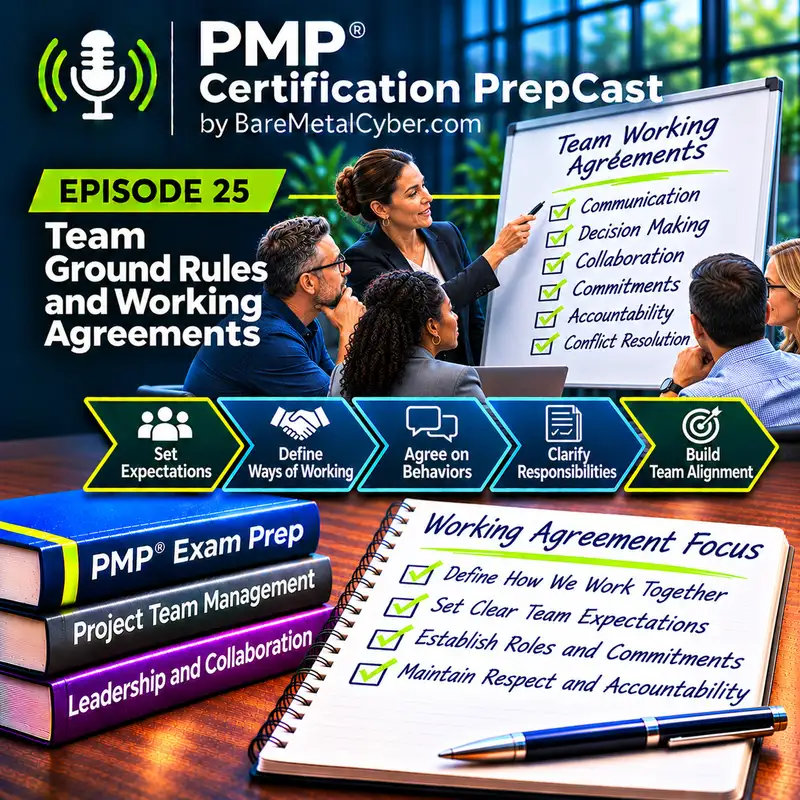
PMP 2026 | 25 | Team Ground Rules and Working Agreements
A team can lose time because nobody knows when to respond, where to record a decision, or how to raise a concern. Ground rules make those everyday expectations explicit. They support team leadership, conflict management, and communication in the current People domain. Involve the team in the rules it can shape, using practical language and examples. Organizational conduct, safety, contractual, and other mandatory requirements remain part of the boundary. The aim is an agreement people can use, with clear responsibilities when a matter needs more than a local reminder.
Welcome to Certified, the P M P prepcast. This is episode twenty five of season one. Today we are exploring how to develop and maintain useful team ground rules and working agreements.
When ground rules are well-defined, the team avoids wasting energy on preventable misunderstandings. People know how to prepare for meetings, when to expect responses, and where decisions will be recorded. This predictability creates trust and reduces unnecessary conflict. Without them, projects may stumble into avoidable problems, endless email threads, duplicated work, or arguments over communication styles. P M I emphasizes that shared behavioral norms allow projects to focus energy on delivery rather than friction. On the exam, the correct answers usually emphasize co-creation and visibility of norms, not unilateral imposition by the project manager.
The purpose of ground rules is not to control but to enable. Teams perform best when they have clarity about boundaries and consistency in collaboration. Just as traffic signals create safety and flow without dictating every action, ground rules set shared expectations without micromanaging. For example, if a team agrees that decisions must always be documented within twenty-four hours, there is less confusion later about commitments. On the P M P exam, answers that stress practical, behavior-based ground rules often represent P M I’s preferred approach. Vague aspirational statements like “be professional” are not sufficient.
Inputs to defining ground rules include understanding the team’s composition, distribution across time zones, and history of prior conflicts. Teams that have worked together before may already have implicit norms, while newly formed groups need explicit ones. Compliance requirements also influence ground rules. For instance, data security projects may require rules around handling sensitive information. Signals that ground rules are missing include recurring misunderstandings, scope creep through informal side channels, or meetings with no clear purpose. Burnout and disengagement also point to the absence of clarity, people are drained by constant friction. On the exam, clues often appear in these signals.
Recurring misunderstandings often surface in simple phrases like “I thought you meant…” or “I assumed…” These indicate that expectations were never clearly agreed upon. Scope creep via side channels, where commitments are made outside the official change path, is another red flag. Meetings that lack agendas, end without outcomes, or produce invisible decisions signal weak or absent rules. Burnout may show up in complaints about wasted time or unclear ownership. P M I stresses that the project manager must treat these as systemic signals, not personal failings. On the exam, the best choice often involves establishing or revisiting ground rules rather than escalating or punishing.
Ground rules also help reduce hidden sources of disengagement. For instance, when some team members dominate conversations while others remain silent, inclusivity suffers. Without explicit norms, quieter voices may go unheard, leading to missed insights. Teams that lack response-time expectations may frustrate one another when delays cause bottlenecks. Tool usage is another area of confusion: if one group stores documents in one location while another uses a different system, alignment suffers. The exam frequently hides these problems in scenarios, and the correct answer often involves clarifying norms about participation, response, and tool usage.
Principles for creating effective ground rules include focusing on specific, observable behaviors rather than vague intentions. Saying “be respectful” is less helpful than agreeing, “no interruptions during meetings, and listen fully before responding.” Fewer, clearer rules are better than long lists that no one remembers. Rules should include explicit examples so that expectations are concrete. Defining consequences and appeal paths up front avoids confusion later about enforcement. Finally, norms should evolve. Scheduling periodic reviews ensures they remain relevant as project conditions change. On the exam, answers that stress specificity, clarity, and adaptability usually align with P M I’s intent.
Specific, observable behaviors ensure that rules can be tested. For example, instead of “communicate clearly,” a rule might state, “summarize key decisions in three bullet points after meetings.” This leaves little room for interpretation. Including non-examples can further clarify boundaries. A rule about timely responses might be paired with the example “acknowledge emails within twenty-four hours” and the non-example “waiting a week before replying.” This behavioral framing makes rules easy to understand and enforce. On the exam, vague norms without examples are usually incorrect distractors.
Define how concerns about a rule will be addressed and who is responsible. An ordinary missed coordination norm may call for a reminder or a private conversation. A serious safety, conduct, or reporting concern may require the designated channel immediately. The team cannot replace that route with a promise to coach first. Review practical norms when they no longer fit the work, while keeping required protections intact. Fairness means a response suited to the concern and consistent with the applicable responsibilities.
The process of defining ground rules begins with facilitation. The project manager invites the team to brainstorm norms based on past experiences and anticipated challenges. Clustering similar themes organizes the conversation. Together, the team drafts rules that are specific and testable. These rules are then stress-tested with scenarios. For example, “What happens if a stakeholder bypasses the team and gives work directly to a developer?” This allows the team to refine rules with practical examples. On the exam, correct answers often involve co-creation and scenario testing, not the project manager writing rules alone.
Stress-testing rules ensures they hold up under realistic conditions. Drafting is only the first step; validating rules with practical examples ensures they prevent confusion. Non-examples are especially valuable here. For instance, if the rule is “capture all decisions,” the team can clarify that verbal approvals in hallways do not count unless recorded in the log. Agreeing on enforcement and exception handling further strengthens the system. Publishing the rules in visible places, like a team charter, project site, or onboarding guide, ensures everyone knows them. On the exam, correct answers emphasize visibility and integration, not informal or hidden agreements.
Let us build a working agreement for a fictional cross-functional project launching an internal knowledge service. The team has experienced three recurring problems: requests arrive through private messages, decisions are scattered across chat threads, and reviewers receive incomplete work. Rather than begin with a long list of ideal behaviors, the facilitator asks for concrete examples of those failures and the effect each has on delivery. The proposed rules should address the observed problems and remain within the organization's existing authority and information requirements.
For incoming work, the team agrees that a request affecting planned delivery is recorded in the shared intake route with its purpose, requester, and needed date. Receiving a private request is not itself forbidden; the important behavior is to bring the commitment into the visible decision process before promising it. This distinction prevents the rule from becoming unrealistic. People will still talk informally, but an informal conversation should not create hidden authorized work.
For decisions, the team agrees that a material decision record identifies the question, the authorized owner, the outcome, the conditions, and the next action. The record points to supporting evidence where appropriate. Routine implementation choices need only the level of recording the project requires. The team does not attempt to document every conversation in a separate log. The goal is to preserve decisions people depend on, not generate an administrative history of every sentence spoken.
For handoffs, the team agrees what evidence a reviewer needs before work is described as ready for review. The sender identifies the version and the requested action, while the receiver acknowledges whether the handoff is usable within the agreed response window. A returned item states the missing condition rather than simply saying not good enough. This gives both sides observable responsibilities. It also separates readiness for review from approval, so a completed handoff is not mistaken for accepted work.
The team stress-tests these rules with a realistic exception. A senior manager sends an urgent request directly to a developer and asks for an immediate promise. The developer can acknowledge the need and identify the proper decision route without being dismissive. The relevant owner can then assess priority, capacity, and authority. The working agreement should support that behavior and identify how a genuinely urgent matter is handled. It should not force the developer to choose between silently accepting unauthorized work and ignoring a legitimate business concern.
Integrating ground rules into onboarding is another step that reinforces their value. New team members must be introduced to norms from day one, preventing drift or inconsistent behavior. Ground rules only work when everyone abides by them consistently. Making them part of onboarding checklists ensures that as the team grows, clarity is preserved. On the P M P exam, questions often present problems with new members who are unaware of expectations. The correct answer usually involves revisiting and reinforcing ground rules rather than blaming individuals for not knowing.
Typical ground rules cover a range of collaboration basics. Response time bands define expectations, for example, “acknowledge requests within one business day.” Meeting etiquette might include starting on time, following agendas, and capturing outcomes. Recording decisions visibly ensures accountability. Rules about escalation paths define when issues must move upward versus when teams can act autonomously. Documentation standards clarify how to use tools and where to store artifacts. Respectful communication norms ensure inclusion, such as “one speaker at a time” or “rotate facilitators.” On the exam, answers often highlight these specific, behavior-based examples as good practice.
Respect and inclusion should always be visible in team rules. Explicitly defining norms around turn-taking, language-leveling, and active listening makes collaboration fairer. Rules around documentation and decision recording prevent disputes later. Escalation thresholds, knowing when to resolve internally versus involving leadership, speed decision-making without bypassing governance. The P M P exam often includes scenarios where teams struggle with missed handoffs or undocumented decisions. Correct answers usually involve strengthening or revisiting ground rules to restore clarity and predictability.
Response expectations need enough precision to be usable. A rule that everyone replies within twenty-four hours may inadvertently include weekends, leave, and time zones that the team never intended to cover. The team can define working-time expectations for routine requests and a separate route for urgent matters. It should distinguish acknowledgment from completion: acknowledging a complex request promptly does not mean promising to resolve it within the same window.
The team also needs a way to signal that a response cannot be completed as expected. A useful message states the constraint, the next feasible response time, and any decision or support required. Silence leaves others guessing, while an unrealistic promise creates another failure later. This is a practical coordination norm that can be adapted by the team, subject to any mandatory service commitment. It should not contradict a contract or policy that already sets the response requirement.
Meeting norms should likewise identify behavior rather than personality. Instead of be collaborative, the team might agree to circulate the decision question and relevant evidence before a review, identify the person who can decide, and record the result afterward. Instead of everyone must speak, it can provide a meaningful opportunity to contribute in an accessible format. The purpose is useful participation and clear decisions, not a participation ritual that treats all people or all meetings identically.
These examples show how a working agreement connects everyday behavior with the project's real coordination needs. The next part considers how those agreements interact with quality standards, framework responsibilities, and corrective action. Keep the purpose of each rule clear so that an ordinary team norm does not accidentally claim authority over a different kind of requirement.
Working agreements can describe collaboration, response expectations, and how the team handles blocked work. In Scrum, the Definition of Done is the quality commitment for the Increment; it is not simply a collection of meeting etiquette rules. A Definition of Ready is optional, and work-in-progress limits are practices chosen for the work rather than universal Scrum requirements. Predictive and hybrid teams also need practical norms within their approved controls. Keep the purpose of each rule clear so an everyday agreement does not quietly rewrite a mandatory standard.
Record a norm where the people using it can find it, such as a working agreement or onboarding guide. A quality or acceptance condition belongs in the relevant controlled record and requires the applicable authority to change. Reordering a backlog within its agreed boundary does not automatically update a baseline. In hybrid work, show any actual effect on an external commitment and obtain the required decision. Consistency means preserving these distinctions, not copying every agreement into every artifact.
Respond to a breach according to the rule and its consequence. A reminder can help when somebody overlooks an ordinary coordination agreement; repeated misunderstanding may show that the rule needs clarification or the person needs support. A mandatory reporting, safety, or conduct route may require immediate action. Use the responsible channel and protect sensitive information. Respectful enforcement includes prompt escalation when required, as well as constructive local correction when the team can appropriately handle the matter.
Tracking breaches neutrally also matters. Instead of treating violations as personal failings, project managers should look for systemic causes. For example, if deadlines are consistently missed, the issue may not be team discipline but unrealistic planning. Recognizing root causes prevents ground rules from becoming tools of blame. Celebrating adherence publicly is equally important. Highlighting when team members model the desired behavior reinforces norms positively. On the exam, the correct answer often reflects this balanced approach, enforce gently, diagnose root causes, and reinforce good behavior to sustain norms over time.
A missed rule is information to interpret. Suppose a new team member sends work directly to a reviewer without using the agreed handoff. The manager discovers that the onboarding guide links to an obsolete version of the agreement. A respectful correction should include giving the person the current guidance and repairing the broken onboarding link. Treating the event as defiance would ignore the conditions that produced it.
In another version, the person understands the rule but the required evidence is stored in a system they cannot access. The manager needs to address that prerequisite through the appropriate owner. Repeating the rule more firmly will not create access. In a third version, the person has both understanding and access but repeatedly bypasses the process. The manager should use the relevant performance or conduct arrangements and maintain appropriate records. The response follows the established facts and the applicable responsibility, not a universal ladder that every concern must climb in the same way.
Sensitive concerns need a different information route from ordinary coordination issues. The team may discuss a missing handoff field openly, but an allegation requiring a designated reporting process should not be posted on a general task board for everyone to debate. Ground rules should help people identify the proper channel, not replace organizational protections with a local agreement to settle everything internally. Co-creation has limits where authority and required safeguards are already established.
Review norms when the team, work, or obligations change. A team using optional daily check-ins might decide that another frequency fits its coordination needs better. That is different from a Scrum Team dropping the Daily Scrum while treating it as an unchanged Scrum practice; framework commitments need to be understood as well as tailored workplace arrangements. A new compliance requirement may also change the permitted documentation or access process. Make the decision through the relevant authority and check whether the revised arrangement works.
Suppose stakeholders begin making work commitments through side conversations. Establish what was promised, whether anyone acted on it, and whether it falls within the relevant authority. Bring any unauthorized change or affected commitment through the applicable process and communicate the current position to the team. Then clarify the route for future requests and use examples to test that people understand it. Updating ground rules can prevent recurrence, but it does not by itself correct work already started or authorize a promise that exceeded someone's role.
If the situation includes a regulatory or other mandatory control, identify the specific obligation and the response it requires. It may involve a notification, an approval, particular evidence, or verified training; the word regulated alone does not establish which one. Keep the required records and involve the responsible control owner. A refresher may be useful if a demonstrated knowledge gap contributed, while a process or authority problem may need a different correction. Meet the actual requirement rather than adding paperwork or training by reflex.
Exam pitfalls around team ground rules often reflect poor leadership practices. One common pitfall is imposing rules unilaterally without buy-in, which erodes trust and ownership. Another is creating vague norms like “be professional,” which lack observable behaviors and lead to uneven enforcement. Failing to enforce or review rules creates drift and undermines credibility. Finally, rules that contradict governance or compliance requirements create risk and confusion. On the exam, these pitfalls are often written as distractors. The correct answer usually emphasizes co-creation, specificity, enforcement, and governance alignment.
Team participation is valuable for developing practical coordination norms, but some requirements are established by an authorized organizational or external owner. Explain those requirements and help the team make them workable without suggesting they depend on a vote. For discretionary practices, invite input, use observable examples, and test whether the proposed rule solves the problem. An example such as recording a decision within one business day is a local choice unless a particular requirement specifies it. Clarity includes knowing which parts can be changed and by whom.
The team reviews the agreement after a pilot period. It finds that the intake rule has reduced hidden requests, but decision records are still difficult to locate because two different locations are being used. The useful revision is to establish the authoritative location and the link from the other tool. Adding another statement that decisions must be documented would repeat an existing rule without fixing the actual problem.
A version change should be communicated to the people affected, including suppliers or new members who rely on the interface. The team should identify which parts changed and when the new arrangement applies. Keeping an old agreement visible without marking its status can produce contradictory expectations. A short, maintained agreement is more useful than a long document that nobody knows is current.
Rules can also become unnecessary. If a recurring meeting no longer serves a coordination or decision need, the team can examine whether a different arrangement would be more effective, provided it respects any framework or mandatory requirement. Removing an obsolete discretionary practice is not the same as quietly dropping a required control. The review should ask what purpose the rule serves now and what evidence supports keeping, adapting, or retiring it.
Agree on a short set of usable rules within the mandatory boundaries and illustrate how they apply. Publish the current version and include it in onboarding. Use proportionate feedback for ordinary coordination problems and follow the designated route for matters requiring immediate or formal attention. Review evidence of how the rules work and ask the proper owner to authorize any change outside the team's discretion. Keep the purpose visible: reliable coordination and responsible treatment of people and commitments.
Publishing ground rules visibly reinforces their legitimacy. Posting them on shared workspaces, team dashboards, or onboarding guides keeps them front-of-mind. Integrating them into retrospectives or stage-gate reviews ensures they remain active agreements, not forgotten documents. Enforcement works best when it feels fair and consistent, not arbitrary. Recognizing adherence, even with small celebrations, sustains engagement. The exam often hides the answer in visibility and reinforcement. Correct responses typically involve making norms visible and ensuring they are revisited consistently, not leaving them buried in forgotten documents.
Fit the practical norms to the work and framework actually being used. A Scrum Team needs to respect its accountabilities, events, Sprint Goal, and Definition of Done, while an optional readiness practice should have a clear purpose. Any team may need rules for decision records, handoffs, protected information, and escalation. A predictive label does not make every norm formal, and an adaptive label does not remove required approvals. Use the arrangement that the project has actually adopted and check that people can apply it.
For your practice exercise, choose one of the knowledge-service problems and draft a rule that someone else could actually apply. Include the behavior, the trigger, the relevant owner or route, and what happens when the normal arrangement cannot be met. Test it against an ordinary request, an urgent request, and a request outside the team's authority. A rule that works only when everything is easy is not yet a dependable working agreement.
Then check whether the rule duplicates an existing requirement or attempts to change one the team does not control. A local agreement cannot turn a stakeholder preference into approval authority or make an unfinished deliverable meet its acceptance conditions. Its value lies in helping people coordinate responsibly inside those boundaries. That is the practical standard for the end of this episode: shared expectations should make the next action clearer, not simply give the team another document to maintain.
Team ground rules turn expectations into practical behavior that people can recognize and follow. Co-create what the team can shape, explain mandatory boundaries, and keep the current agreement visible. Address ordinary difficulties constructively and use the required route when a concern demands it. Review the arrangement as the work changes instead of letting outdated rules become another source of friction. The next episode considers mentoring stakeholders, extending that support from shared expectations into stronger capability and judgment.
For more certification study resources, books, and podcasts, visit Bare Metal Cyber dot com. Thank you for listening to Certified, the P M P prepcast.